
Weather and fire officials weren’t kidding when they issued a red flag warning going into the weekend.
High winds and dry conditions ignited wildfires across North Carolina, including three in Cherokee County. The largest is a 20-acre blaze called the McClure Road Fire, about 6 miles southwest of Murphy along U.S. 64 West.
Smaller blazes include a quarter-acre fully contained fire off Phillips Creek Road south of Andrews, a 6-acre fire off Whispering Pines Hollow south of Andrews that is reported as controlled and a fully controlled 20-acre fire off U.S. 19 just east of Topton in Macon County.
Several more small fires in Cherokee County were reported throughout the day Monday.
Burn bans were issued in Murphy, Andrews and throughout Cherokee County by Monday afternoon.
Burn bans issued
The Town of Murphy’s ban was effective immediately Monday until further notice.
All outdoor burning is prohibited in the Town of Murphy. Open fire or open burning includes burning leaves, branches, or other plant material, trash, lumber, tires, newspapers, plastics, or other non-vegetative material. The ban does not include burning charcoal or propane in a grill, fireplace or fire pit. Contact Murphy Fire at 828-837-2212 for questions about this public notice.
The Andrews burn ban, issued by Valleytown Fire & Rescue, which handles protection for the town, was similar to Murphy’s.
The Andrews burn ban affects burning within 100 feet of all occupied structures inside town limits. That ban took effect at 4:30 p.m. and is effective until 4:30 p.m. March 8. The ban could be rescinded before that time if outside conditions indicate it may be safe.
“All open burning should be extinguished immediately,” according to the Andrews announcement. “Failure to do so will result in extinguishment by the fire department per N.C. Fire Code 307.3.”
Violations of this ban authorize immediate extinguishment of unlawful burning. Violations of this ban shall be punishable as a Class 3 misdemeanor.
For more information in Andrews, contact Valleytown Fire at 828-321-3707.
A countywide ban was issued by Fire Marshal Kevin Carter and was identical to Andrews’, except it took effect one hour earlier, at 3:30 p.m. and is effective until 3:30 p.m. March 8.
‘Especially vulnerable’
The N.C. Forest Service reported 231 fires statewide as of Saturday, burning 1,349 acres. Meanwhile, the U.S. Forest Service on Monday reported responding to multiple wildfires across its forests in North Carolina including areas of the Croatan, Nantahala, Uwharrie and Pisgah.
Firefighters are constructing new containment lines, reinforcing existing ones, conducting aerial reconnaissance and using mechanized equipment to manage heavy fuel loads partly due to Hurricane Helene.
“Western North Carolina counties dealing with significant storm debris from Hurricane Helene are especially vulnerable to wildfires due to increased fuel loading from downed timber,” the N.C. Forest Service said in a release.
Active national forest wildfires
- Nantahala National Forest: McClure Road Fire (about 20 acres) – Tusquitee Ranger District, Cherokee County, 6 miles southwest of Murphy along U.S. 64.
- Pisgah National Forest: Hicks Cemetery Fire (about 50 acres) – Appalachian Ranger District, Haywood County, Pigeon River west of Interstate 40 at Cold Springs Creek Road/Forest Road 288.
- Uwharrie National Forest: Falls Dam Fire (about 300 acres) – Montgomery County, south of the Art Lily Campground adjacent to Forest Road 516, north of the Yadkin River Dam Overlook
- Croatan National Forest: Ramshorn Fire (about 114 acres) – Cartaret County 3 miles west of Ashley Place/US Route 70 adjacent to Nine Foot Road.
Unseasonably warm weather and low humidity have heightened fire risks, according to a U.S. Forest Service release.
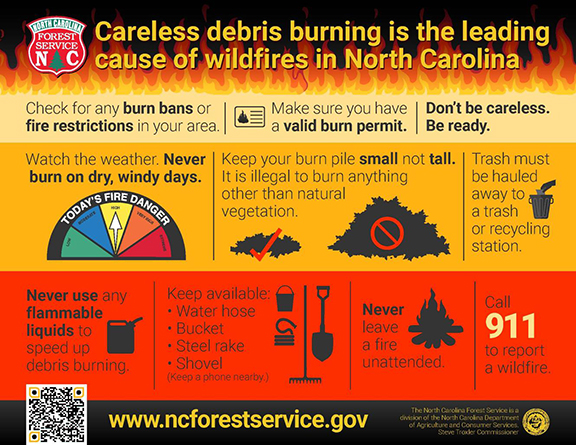
“Careless debris burning remains the leading cause,” the U.S. Forest Service release says. “Residents and visitors are urged to check burn bans and fire restrictions. Smoke may impact nearby communities and roadways, especially during morning and evening commutes. Drivers should use caution.”
Fires are not expected to experience any significant growth, especially as weather less beneficial to fire spread moves into the area Tuesday night, the U.S. Forest Service noted on its Facebook page Monday. However, the combination of dry fuels, limited rainfall and very low humidity will lead to an elevated risk of adverse fire behavior today.
Burning tips
Before starting an outdoor fire, contact your local county ranger’s office. The N.C. Forest Service also offers the following tips:
- Check local burning laws. Some communities allow burning only during specified hours. Others forbid it entirely.
- Make sure you have a valid burn permit. You can obtain one at any N.C. Forest Service office or authorized permitting agent, or online at ncforestservice.gov/burnpermit.
- Keep an eye on the weather. Don’t burn on dry, windy days.
- u Local fire officials can recommend a safe way to burn debris. Don’t pile vegetation on the ground. Instead, place it in a cleared area and contain it in a screened receptacle, away from overhead branches and wires.
- Be sure you are prepared before burning. To control the fire, you will need a hose, bucket, steel rake and shovel for tossing dirt on the fire. Keep a phone nearby, too.
- Never use kerosene, gasoline, diesel fuel or other flammable liquids to speed up debris burning.
- Stay with your fire until it is totally out.
- These same tips apply to campfires and grills as well. Douse burning charcoal briquettes or campfires thoroughly with water. Drown all embers, not just the red ones.
When soaked, stir the coals and soak them again. Make sure everything is wet and that embers are cold to the touch.
If you do not have water, mix enough dirt or sand with the embers to extinguish the fire, being careful not to bury the fire. Never dump hot ashes or coals into a wooded area