
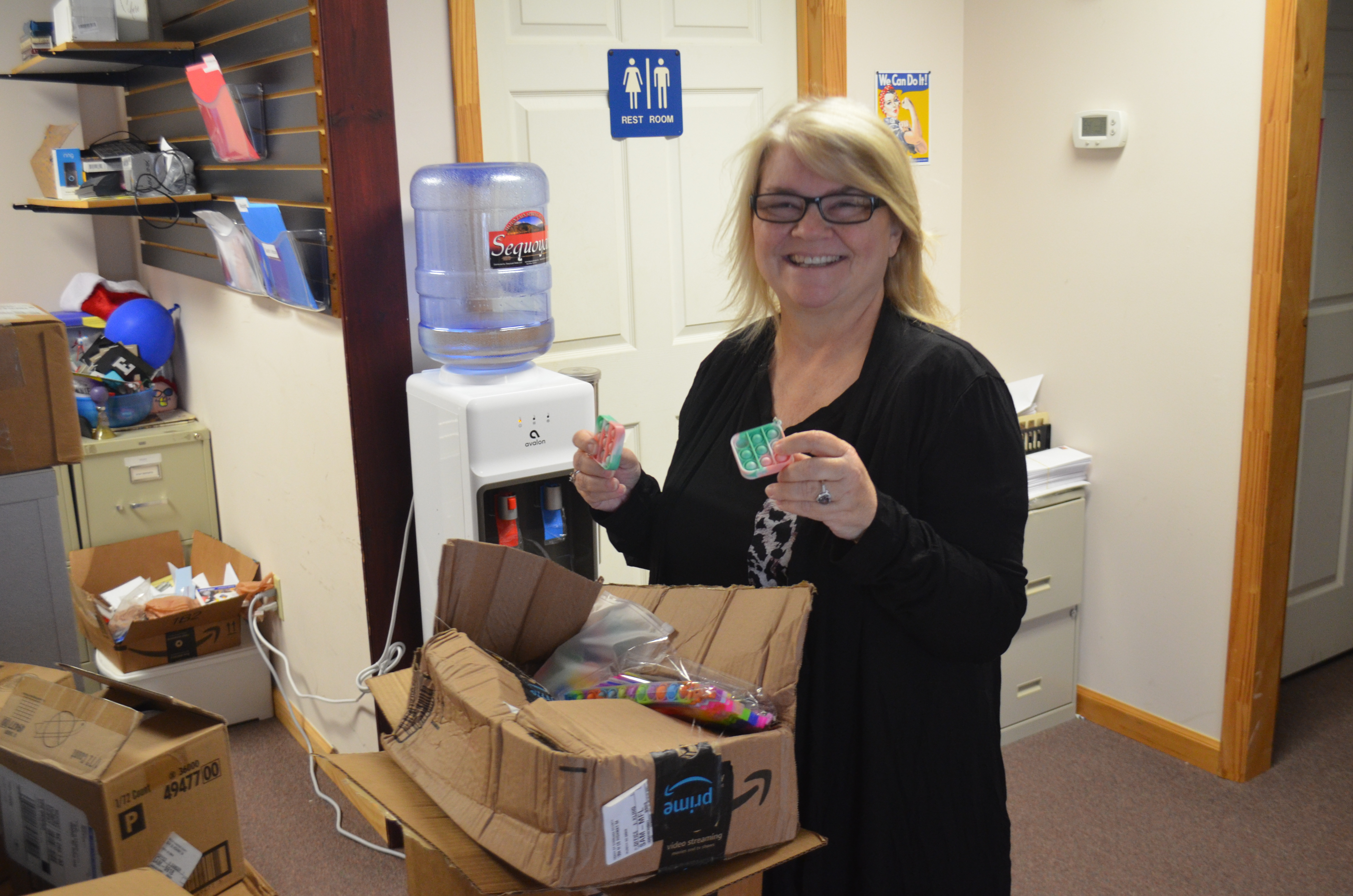
Murphy – Cecilia Crawford is determined to bust some myths.
“Domestic violence can happen to anyone from any income, race, age or sex stratification,” the4 executive director of Reach of Cherokee County Inc. instructs from her office at 1980 U.S. 64 W. As she lists misconceptions surrounding domestic abuse, the sound of bullets punctuate her words because the office is next to a gun supply store.
“They told me next door that if an abuser comes in here, to call them for help,” Crawford said with a laugh. While she appreciates their support, her programs run on strict protocols.
“In a small town, more people are reluctant to report abuse,” Crawford said, “everybody knows everybody, they see each other at church.”
Jessica Vernon, a trained crisis staff member at Reach, added that even if a person did come forward seeking help, “They may feel that they will be called a liar.” This familiarity among neighbors requires employees and volunteers to rely on trusted procedures and actions.
An intimate secret
Domestic abuse is a complicated; it’s intimate, and it’s usually kept secret by both the abuser and the abused. Crawford said “some people don’t even know they are being abused,” adding that it can start out quietly, maybe with just a harsh word or derogatory statement.
“The victim becomes accustomed to these negative behaviors so as they escalate, the victim learns to accept the abuse,” Crawford said. Challenging an abuser could lead to more harm, but more often “the victim loves the abuser. He or she is a member of their family, sometimes a respected member of the community.”
National domestic violence statistics show that when a victim gets the courage to leave the violent situation, they are in the most danger.
“That’s why it’s so important that we sit and listen without judgment,” Crawford said. “We don’t try to talk the victim into leaving the abuser.
“Our job is to listen and offer support. It takes a very long time for a victim to trust us. The most dangerous time for a victim is when they try to leave.”
Sarah’s story
This was true for Sarah, who lived inside a dangerous, domestic relationship for nearly 10 years with her partner, Matt.
“At first,” Sarah said, “he would just yell at me, call me stupid, you know.” But as their relationship deepened, Matt became more threatening with his words.
“I remember sitting on the bed with him hollering at me that he was going to cut off my head and hang it from a tree on the mountain,” Sarah said. She learned to not challenge him when he would “go to his bad place.”
It was safer for her to sit silently, trying to disappear than to respond or draw any attention to herself during these terrifying rants. By the time they moved to what Sarah calls “the shack,” because it had no running water or electricity, they had been together nine years.
“He was already pushing me down and pulling my hair before we left, but it got real bad out at the shack,” she said. At one point, “He smacked me across my face, and then threw a pot of boiled peanuts at my head.” Sarah ran up to the loft but soon realized her mistake. Matt stood at the bottom of the stairs, blocking her escape.
Sarah said she relied on her past behavior of silence until he calmed down.
“I had already been praying to God to help me get out even before we moved to the shack.” So, by the time he burned her face with the boiling peanut water, she was already resolved to go. “I was really quiet when I put on my sneakers. I knew I was going to leave him and that I would never come back.” This is unusual according to Crawford experience. “It usually takes victims between seven to ten times before they are finally free from their abuser.” Crawford said.
Making an escape
Once Matt felt Sarah was docile enough for him to walk away from the stairwell, she bolted down the stairs and ran for the shack door. She managed to get out, but Matt was right behind her. “The whole time he kept chasing me yelling, ‘I hate you, get out of my life!’ and I was running and yelling back at him, ‘I’m doing what you want!’ ”
She was able to gain enough distance at the top of a hill to call the police. “My hand was shaking when I dialed 911,” she remembered. “He must have been hiding close to where I was calling from because he heard me say I wanted to go to the shelter. He texted me saying, ‘Please don’t go to the shelter.’ ”
Sarah doesn’t like to think about what might have happened if the police hadn’t shown up when they did. “He might have killed me,” she said simply.
However, Sarah had had enough. She was knowledgeable enough about Matt by now to accept his claims of hanging her head from a tree as truth. His threats became a very real possibility. So, despite her fear, she gathered all the courage within herself, and when the police officer arrived and confirmed that she wanted to stay at the shelter, she responded with an unequivocal, “Yes.”
Reaching out
Things moved quickly once she sat in the safety of the police car. The officer helped her fill out a domestic violence complaint, then drove her to the shelter where a Reach employee walked her from the car to the shelter door.
“She told me she would help me fill out the paperwork for a restraining order the next day.” Sarah said the house was filled with women who “understood what I was feeling.” Despite being in a protected house, she was unable to sleep that night.
“I was so afraid he would get into that house,” she said, but he didn’t get in. In fact, Sarah never had to see him again.
“It was hard sometimes because I loved him,” Sarah said. But as she began healing from the ongoing trauma of living with an abuser, she became more confident.
“I stood in front of a judge the next day and told her what had happened,” she said. A Reach professional remained by her side through all of the legal maneuverings required to extricate her from a dangerous domestic relationship.
After court, Sarah said, “A police officer escorted me back to the shack to get my belongings.” Unfortunately, Matt was inside when she arrived. He was standing up in the loft and called down to her, “It’s OK, you can come up.”
However, Sarah declined his offer telling the officer, “I don’t want to go up there.” But in that moment, Sarah lost all of her possessions.
Filling the gap
Reach filled that gap by giving her clothes, food and a safe place to stay. Her beloved dog, Lightening Bug, was happily boarded at the Valley River Humane Society in Marble for the three months she lived at the shelter.
This boarding is a free service provided by the society for victims of domestic abuse who stay in the shelter. Sarah said her time in the shelter was healing for her.
“I made so many good friends; I learned so much about who I am,” she said.
Today, Sarah lives on her own in a house with both electricity and water. She uses her crockpot to make her favorite meal of pork tenderloin and potatoes with onions.
It took her some time to adjust to living on her own. Away from the protection of the shelter and the Reach staff, she felt vulnerable in her new house despite owning a stun gun, pepper spray and a key chain with two alarms.
“I slept on my sofa for the first three months because from my bedroom, I didn’t have a clear view of the front door,” Sarah said. She kept all her windows locked and curtains drawn.
Once, Matt attempted to contact her through a mutual friend, saying, “Tell her to come spend two nights with me. I’ll be a perfect gentleman.” To which Sarah replied, “Hell, no!” adding, “When I say ‘no’ now, I mean, ‘No!’ ”
She loves the freedom of her new life saying, “I’m stronger now. I may still be scared sometimes, but I done good!”
For Crawford and her intrepid team, it’s success stories like Sarah’s that keep them going.
“We celebrate not only with the survivor but among ourselves as well,” she added, “We’re superheroes!”