
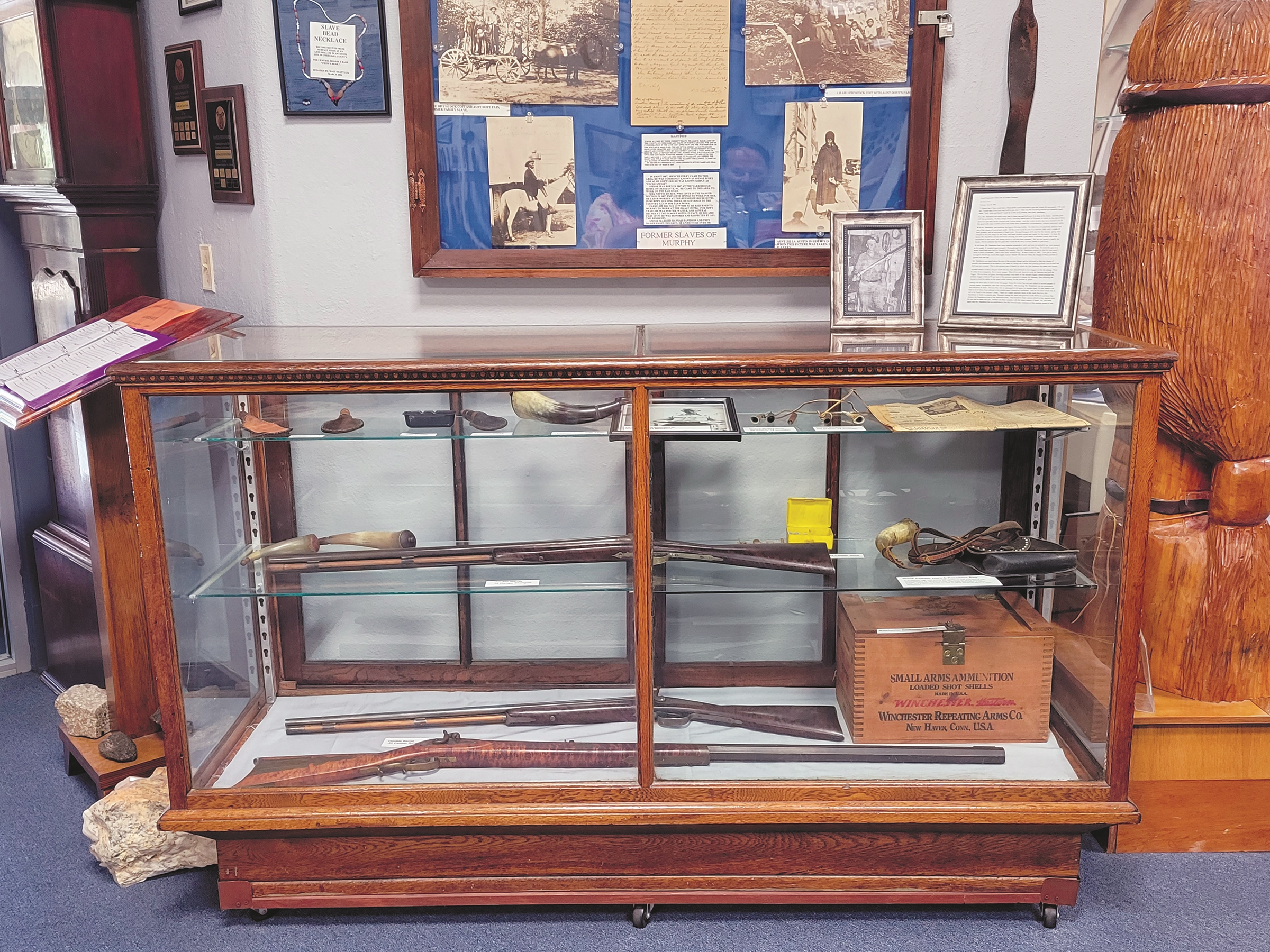
Murphy – A local family has donated items to the Cherokee County Historical Museum, which has set up the new display at the entrance of the Carnegie Library building downtown.
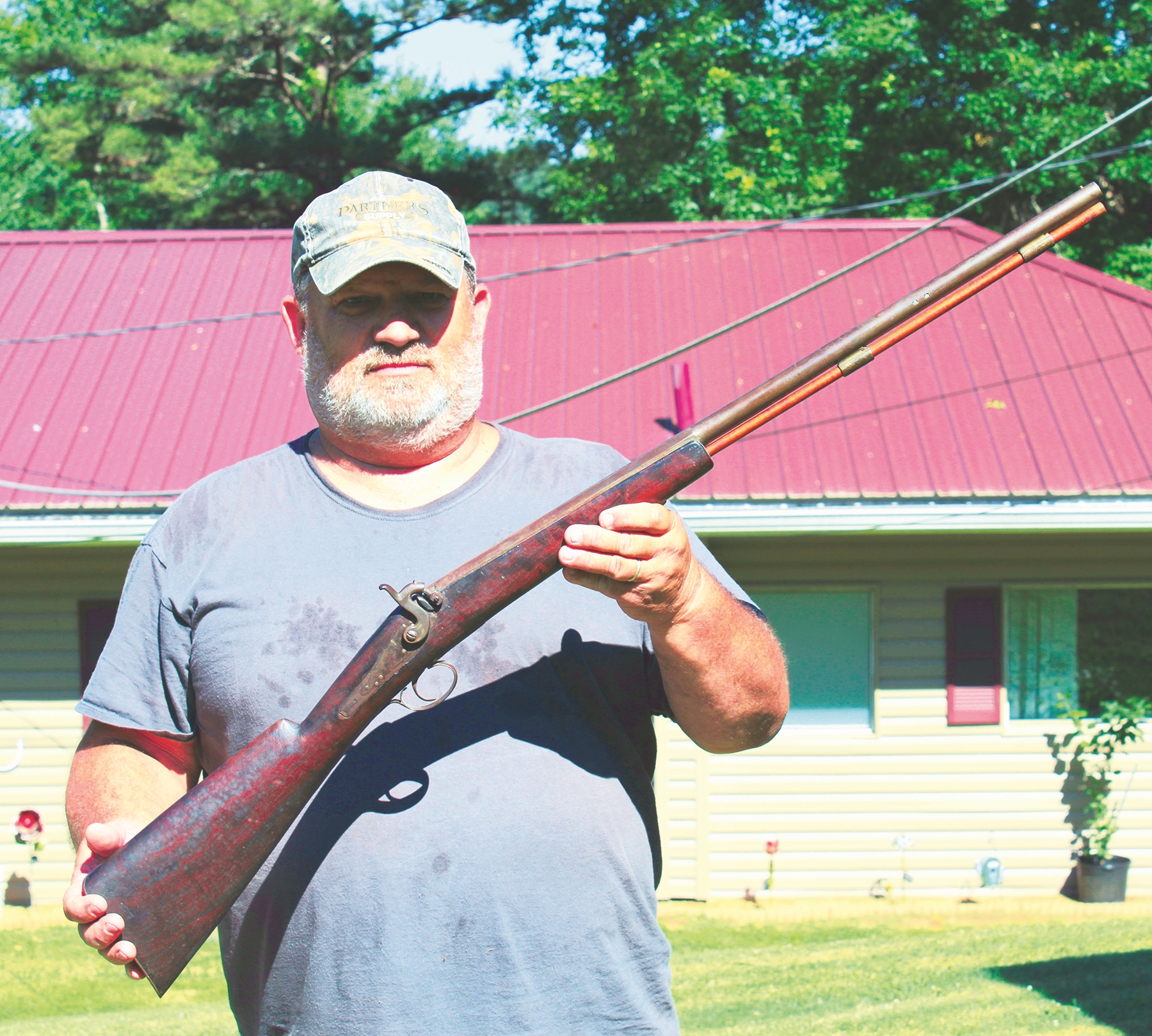
Last month, Dean Mashburn donated his grandfather’s three handmade muzzle-loaders and handmade bullets to the museum so others could enjoy them and his grandfather's talents could be remembered forever. Hoke was a well-known gunsmith in town for more than 50 years.
Mashburn said his grandfather was a simple man, but had a unique hobby that made him sought after by people nationwide.
“He was ingenious and a very innovative guy,” Mashburn said of his grandfather, Hoke Mashburn. “He really was born a century too late for the things he was interested in.”
Hoke Mashburn was born and raised in a place called “Hell’s Hollar” in Fannin County, Ga., with his parents. Hoke’s father was a mean and wicked man, who grew corn and made white lightning. He didn’t much care if his children got the education they needed, caring more for work than anything else.
“His father was a mean man and could have cared less if his kids went to school. He would make Hoke plow with a mule when he was so little he couldn't pick up the plow if it fell over,” Mashburn said. “But he found Jesus before he died. My grandfather had a third-grade education. In those days, they were lucky to go to school.”
When he was 14, Hoke moved up north to Terre Haute, Ind., during the Great Depression in 1928. He got a job with General Electric and was trained to be a high-voltage electrician. He made his way across the Northeast, following work.
He met and married his wife, Eva, at Cambridge Springs, Penn. Mashburn said an old man who lived in the community was a gunsmith by trade, and he taught Hoke all he knew about it.
Along the way, Hoke became interested in muzzleloaders, a type of gun that can be either single or double-barrel that uses black powder to shoot.
Hoke built his first muzzleloader when he was 19 years old, a crude instrument compared to his later work, Mashburn said. In 1932, he came home to the South, and when the Tennessee Valley Authority was established in 1933, he went to work for them in Blue Ridge, Ga., as a lineman.
In 1949, Hoke was transferred to the maintenance division of the TVA and moved to Murphy with his family. Dean Mashburn still lives on the family property that Hoke bought several years ago in the home Hoke lived in in his older days, and remembers the way the area looked while he grew up.
“On the ridge across from my house is where he lived in a white two-story house and raised his four sons,” Mashburn said pointing to an area across from his front porch. “He built this house for his wife and himself when he retired from the TVA in 1962. If he was alive today and drove up the driveway, he wouldn’t recognize his own home.”
While living in Murphy, he continued to keep up his hobby of making guns and muzzleloaders.
“He made bench rifles that was intended to shoot competitions,” Mashburn said. “He started in competitions all over the Southeast. He loved that and fixed guns for people all the time.”
From the time Mashburn was a small boy, he remembers hunting with his grandfather in the fall.
“He and my father were avid up-land hunters,” Mashburn said. “They would hunt for rabbit, squirrel and bird. When I was about 11 or 12 years old, Hoke acquired an old 1920s Ithaka Shotgun made from Damascus steel and someone had gotten the barrel stopped up and shot the gun, blowing up the barrel. He sawed off the barrel and made the gun useable again, then gave it to me to rabbit hunt with.”
Mashburn still uses his grandfather’s old shop with floors made from the lumber rescued from a Civil War hospital that was tore down almost 100 years ago. While it looks and smells different, Mashburn vividly remembers how the shop looked and smelled when his grandfather was gunsmithing inside the walls.
“He would pour and form his own bullets, and he made his own gun powder from charcoal, salt peter and rock salt,” Mashburn said. “The shop smelled strongly of gun powder and cleaning solvent. One of the things I remember the most was the smell.”
Mashburn remembers being a pre-teenager when his grandfather’s fame had spread across the nation. An article was published in the June 30, 1960, edition of the Cherokee Scout and another was said to have been published in Outdoor Life, a sister magazine to Field & Stream established in 1898.
“In those days, back in the 1960s and ‘70s, muzzleloader hunting didn’t exist, and the Western states had started to introduce it,” Mashburn said. “People started taking an interest to it but it was still crude. We were isolated from the world (in Murphy), and these two men from Nebraska made their way here to find Hoke and have him make them double-barrel muzzleloader rifles.”
He said he remembers the men clearly; they had come all the way here in the summertime and traveled back when the guns were done. Mashburn said all that work and his grandfather charged the men $300 for each rifle.
“That was just the type of person he was, he was always piddling with something,” Mashburn said. “If he wanted something, he would buy it or he would make it.”
He said his grandfather made way more things than just guns; he once made a tractor from scratch using an 8-horsepower Wisconsin engine, the rear end out of a Jeep and a transmission from a logging truck. Mashburn said Hoke built the frame himself, and he used that tractor every year to plow his garden or scrape his driveway.
“It was dangerous as a cocked gun,” Mashburn said with a laugh, remembering the contraption fondly. “But that was Hoke, that was the way he done business.”