
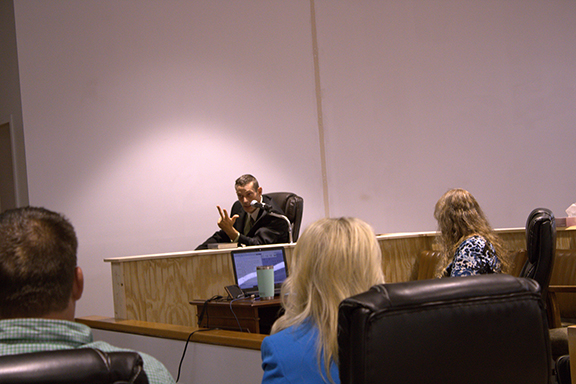
Bryson City – A former narcotics detective has accused the District Attorney’s Office of covering up crimes committed by members of the Graham County Sheriff’s Office.
Brent McMahan testified in open court last week that lawyers within the 30th Prosecutorial District are trying to cover up crimes allegedly committed by Graham County Sheriff Jerry Crisp, Chief Deputy Dennis Crisp, Detective Matt Cox and former sheriff Joseph Jones.
“I’m having to sue them civilly to expose them criminally,” McMahan told the court. “I have the evidence, and I can have it here in two hours or less.”
McMahan – a former Graham County deputy who sued Crisp, Jones and the county last year – testified in Swain County court regarding a traffic stop involving he and Cox that happened in 2019. McMahan said he “didn’t trust Cox in any capacity,” and that he was terminated from the agency after agreeing to take a polygraph test when he met with a State Bureau of Investigation agent regarding corruption within the sheriff’s office.
“The SBI did nothing,” McMahan said.
District Attorney Ashley Welch told the Cherokee Scout that McMahan’s accusations were unsubstantiated.
“His allegations were investigated by the SBI and completely unfounded,” Welch said the day following his testimony. “Yesterday was the first time he had implicated [my office] in this. His allegations are false, baseless, irresponsible and slanderous.”
Last week’s court hearing stemmed from a motion filed by defense attorney Holly Christy, who asked the court to suppress evidence and dismiss charges in the state’s case against Christopher Drew Hill, who is charged with eluding arrest and assault on a government official.
McMahan testified that Cox called him on the night of Oct. 16, 2019, and asked for his assistance in an “operation to capture Hill,” who was suspected of trafficking drugs. McMahan said his colleagues were “tracking Drew in real time” using some sort of a device prior to pulling him over around 9:39 p.m.
Cox testified that he was parked just outside Robbinsville town limits watching the general area of a “target’s house” when he saw a truck that lacked working tag lights. After initiating a traffic stop and speaking with Hill, Cox contacted Cherokee Indian Police Officer Zach Shivers to bring his narcotics detection K-9.
Shivers testified that Cox reported having information about Hill allegedly transporting drugs when he requested the use of his K-9, which ultimately gave a final response indicating drug odor near the driver’s side of Hill’s truck. He said he was putting his K-9 back in his patrol vehicle when Hill sped away from the scene with McMahan hanging out of the passenger side window.
Cox testified that he was not tracking Hill’s vehicle per se but had been in communication with Jones, who was communicating with an informant regarding Hill’s whereabouts. He said he understood the informant to be Hill’s significant other but had never met her.
However, Hill’s on-and-off again wife, Lindsey Hill, testified that she never gave Jones information regarding her husband’s location that night.
Cox’s report on the incident does not mention that he had information about Hill transporting drugs, according to court testimony. Nor does the report mention that he and Jones were assisted by an informant to track Hill’s location. It only mentions an inoperable tag light as the probable cause for the traffic stop.
Hill, however, says the tag light was functioning properly when questioned that night. His attorney argued the arrest was a “setup,” which Cox denied. Christy argued that the entire case hinders on the credibility of Cox, who was not only accused of corruption by McMahan but was also blacklisted by a former U.S. attorney for the Western District of North Carolina.
“Cox is the only one who said he saw the tag light not working that night,” Christy told the court. “Normally, when you have a cop versus a civilian, people would tend to believe the officer, but this officer’s credibility has been stained.”
Cox received what’s commonly known as a Giglio letter in March 2014, after two federal judges ruled that his testimony regarding a 2012 traffic stop “was not credible.”
“I have instructed our federal partners in the DEA and the BIA that we will not accept cases in which Detective Cox is an essential witness and that they should not utilize his services as a K-9 officer,” former U.S. Attorney Anne Tompkins wrote in a letter to former Graham County sheriff Mickey Anderson.
At last week’s hearing, Superior Court Judge William Coward questioned whether a Giglio letter is a permanent blemish on an officer’s reputation, especially considering Cox was later called to testify before a federal grand jury after Jackie Slaughter was repeatedly tased by Graham County sheriff’s deputies, resulting in retrograde amnesia.
“I would say that it is,” Christy responded, comparing the stain of a Giglio letter to the stigma of being labeled a criminal.
“If you’re a felon, you’re a felon for life.”
Assistant district attorney Caleb Decker argued that Christy “offered no proof of Cox being a liar, except for this Giglio letter” and suggested that it might not be in effect since Cox testified before a federal grand jury regarding the Slaughter incident.
Hinting that he may be leaning toward siding with prosecutors, Coward questioned why Hill’s vehicle inspection report from July 2020 showed “CORR” regarding his license plate light, raising questions about whether the light was fixed within the nine months following the car chase.
“The inspection doesn’t show that it wasn’t working that night,” Christy argued in response.
Coward is expected to make a ruling later this month on whether the evidence against Hill should be suppressed.
The judge did not respond to McMahan’s offer to produce evidence of corruption within the Graham County Sheriff’s Office.