
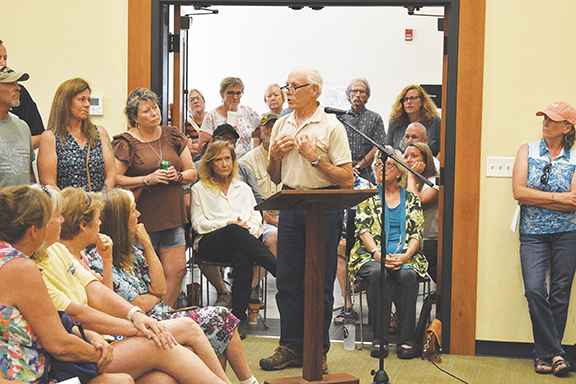
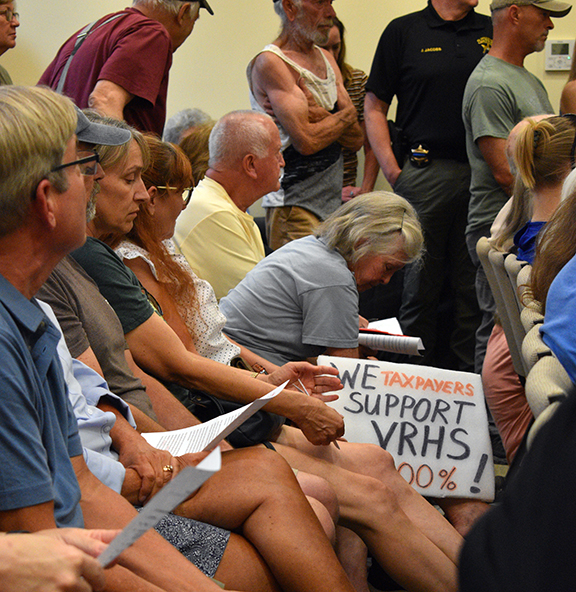
Murphy A crowd of people overflowed into the hallways during the July 29 Cherokee County Board of Commissioners meeting to defend funding for the Valley River Humane Society.
Led by Don Reynolds, president of the humane society’s board of directors, the group was reacting to funding doubts after commissioners called for interim reports to justify the county’s $250,000 annual contribution to the animal shelter for housing homeless dogs and cats.
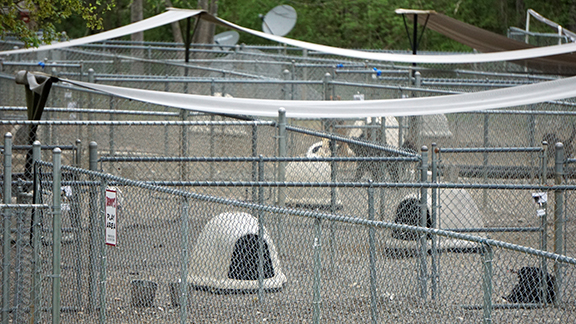
The humane society operates a low-kill shelter in Marble that provides shelter under contract for Cherokee and Clay counties. While animals that are gravely sick or injured face euthanasia, animals that are healthy are not put down.
State law requires the county to fund 72 hours of an animal’s shelter. Some commissioners say anything beyond that time is the shelter’s responsibility.
About 75% of the Valley River Humane Society’s $1.2 million budget is funded by donations. However, because of its low-kill policy, the shelter is often at capacity and can’t take new drop-offs.
As far as county commissioners are concerned, that means the shelter isn’t fulfilling its end of the contract. Some commissioners are also concerned that the shelter doesn’t allow drop-in visits from people interested in adopting animals.
The Valley River Humane Society had been serving Cherokee, Clay and Graham counties, with Cherokee County accounting for 72% of the shelter’s monthly intake of animals. Graham County was adding 16% of the intake, with Clay County accounting for 11%.
Graham County dropped out of the arrangement at the start of the year after the shelter and that county could not agree to a funding arrangement. Reynolds said the departure was a net gain for the humane society, since Graham County wasn’t covering its share of the overall costs.
Humane society supporters argue that Cherokee County would have to pay far more if it were to run its own animal shelter between staffing, acquisition of real estate and outfitting a new shelter from scratch. They also doubt that a county-run shelter would have anywhere near the number of volunteers for a kill-shelter that the humane society has as a low-kill shelter.
Commissioners included the $250,000 annual contribution in the county’s annual budget with largely the same contract as before, but with the twist on the interim reports.
The board wants monthly reports of all animals taken in, dog or cat, whether a stray or an “owner surrender,” where the animal come from (address, community, general area), why the animal was surrendered (stray, can no longer care for moving, etc.) and who surrendered the animal to include their name, phone number and physical address.
The board also wants data about those who attempted to surrender an animal but were turned away, and for what reason.
The shelter is also required to “maintain sufficient capacity to house animals seized as evidence by law enforcement agencies and animals submitted to VRHS by the Cherokee County animal control officer and shall maintain such space as to facilitate quarantined animals as may be ordered by the Cherokee County health director.”
In addition to housing animals, the shelter provides veterinary care. It is required to take reasonable steps to locate and return animals residing at the shelter to their rightful owners.
It also can’t reasonably restrict or prevent the adoption of any eligible animal from any person seeking to adopt an animal. The shelter has reported that it attempts to ensure that animals are a good fit for someone adopting it.
For example, an elderly person in a wheelchair is discouraged from adopting a young animal that requires physical activity.