
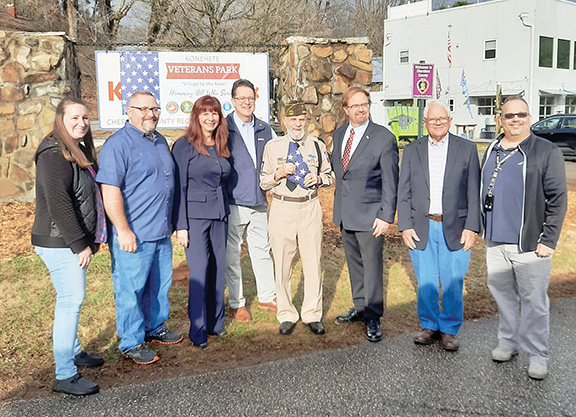
Publisher’s note: This article, written by former editor Matthew Osborne, was first published in the Cherokee Scout’s Celebrating Our Veterans magazine in November 2019. It has been updated by Editor Randy Foster to include news about Oscar Valdes’ recent death and add details about his involvement in the renaming of Konehete Veterans Park.
By Matthew Osborne
Cherokee Scout
Martins Creek – There were few louder or prouder voices for local veterans than Oscar Valdes, who fought heroically in the Korean War.
Valdes, 93, died at Erlanger Western Carolina Hospital in Peachtree at 6:57 p.m. Saturday, his daughter, Barbara Valdes-Thorne, announced in social media.
“Today my dad Oscar Valdes passed away at Murphy medical @ 6:57 p.m.,” she posted Saturday night. “He loved Murphy and the many friends he made throughout the years.
“He was involved with anything that had to do with the veterans. He was a Korean War veteran and did whatever he could for the veterans. He was an Honor Guard and a contributor for the veterans park. He was a soldier! He will be missed and honored.”
Valdes was born on Jan. 17, 1932, in Manhattan, N.Y., living in the South Bronx until he was 17. He was worried that he would get put in juvenile detention for his involvement with gangs during his rowdy youth.
“You had to be in a gang in New York City at the time,” Valdes said. “I’m Cuban-Irish, so that put me on a good line with both Spanish-speaking people and the Irish.”
Instead of going down that path for good, Valdes told his parents he wanted to join the U.S. Navy. His stepfather was all for it, while his mother was against it.
“I tried to get in the recruiting station, but the Navy guy looked rough to me,” he said. “But down the hall, there was this sweet Army sergeant who offered me a cup of coffee, and that to me was it. I enlisted for three years in the infantry.”
Valdes was sent to Fort Dix, N.J., and later Fort Benning, Ga., for about 18 months. In the summer of 1950, he went home on a furlough but he only stayed for three days before getting back to base, as on June 25 the war in Korean broke out.
“My mom wanted me to lie and say I didn’t get the notice to return, but I couldn’t do it,” he said. When I got back to base, all the guys I had trained with for a year and a half were gone.
“They formed a unit with all the guys on sick leave, all the guys from the stockage – it didn’t matter who you were, they sent us all to San Francisco, then we were supposed to go to Hawaii.”
Valdes said his commanding officers told the unit that the troops in Korea could hold it. However, on the way to Hawaii, their ship changed course for the South China Sea and ended up in Pusan, South Korea.
“We stayed a few days in warehouses because we thought the war was going to be won quickly,” he said. “When they wanted to move up, we had trouble getting the guys into these trucks … there was a lot of (complaining). When we got closer to the front line and a shot was fired, you could have gotten 20 more guys in the truck.
“We were scared, but we were just kids.”
Valdes and his unit were sent into battle on the outskirts of Pusan, and he was shot in the ankle while trying to avoid heavy fire. The bullet went into his foot and out through the heel. He was taken away from the scene in a Jeep and flown to Sendai, Japan, where he received medical care.
“It took quite a while for me to walk again,” Valdes said. “There was one doctor here who made me walk, took me by the shirt and made me do it.”
Around the time he was healing, the battle of Inchon was about to take place on Sept. 15, 1950. Valdes wanted to get back to his unit and returned to Pusan, but could not find it. He continued followed his unit to Seoul and later to Pyeongchang, then to an area near the Yellow River on the border of Manchuria, China.
“I asked why we were going so far and the guy told me, ‘You’ll know when you get there,’ ” he said. “We come to find out the Chinese had become involved in the war.”
Valdes said the conditions his unit endured were inhuman, with temperatures dropping to 22 degrees below zero and troops lacking proper winter gear.
“It was hell,” he said. “You woke up in the morning with ice on your sleeping bag and had to check to see who was alive and who was dead. Food was terrible also. Sea rations from the second World War was the best we could do.”
Water also was scarce, and their choices often came down to water from the rice patties that were fertilized with human waste or water used to cool the machine guns.
“We used to have to put a pill into our water and shake it around a little, then leave it there for about an hour before you could drink it,” he said. “Not only did you drink your water, but you chewed it, too.”
Valdes said the unit was marched all over the region, going on new missions each week. The Chinese fought in waves, with the first wave equipped only with drums and trash talking the United Nations troops about how their wives and mothers were doing back home. Ultimately, the troops were wasted a lot of their ammunition mowing them down, allowing the second wave of Chinese soldiers to attack with actual guns.
“They just kept on coming and coming,” he said. “They did not have a chain of command like our Army. If their corporal dies, they have no idea what to do.”
Valdes earned a Bronze Star medal and quickly advanced in rank from private first class to sergeant first class, an astonishing rise in just three months of combat. When he returned to the states in the summer of 1951, he was sent to Fort Lewis, Wash., and eventually on a 10-day leave to Tampa, Fla., where his family had moved from New York.
He was sent next to Aberdeen Proving Ground in Maryland, where he was given a platoon to train and command because of his rank.
“It was idiotic because I had never trained anybody,” Valdes said. “I was a private when I went to Korea, and here I’m coming back as a platoon sergeant and I didn’t know what the hell to do.”
He was going to be put in as a master sergeant but decided to get out of the military. He got a job at the post office in Tampa and joined the Florida National Guard, serving for more than three decades. He helped out during riots several times, including disturbances in Miami and Tampa.
Before settling into civilian life, Valdes took a trip to Cuba with his mother, where he met Nancy, who became his wife for more than 70 years.
In 1977, Valdes first visited Cherokee County for the first time and fell in love with it. He bought 4 acres in Martins Creek without even thinking about it, then ended up with a summer home he finished building in 1984. He moved there permanently in 1998, when he became involved in local veterans organizations, including Veterans of Foreign Wars and the American Legion.
He helped deliver Meals on Wheels for 13 years and was part of the Honor Guard that helps with veteran funerals across the region.
Valdes crusaded for several years for Cherokee County and Murphy to erect a sign at Konehete Park, asking it to be renamed “Konehete Veterans Park.” The change became official in 2022, after the Murphy Town Council voted to approve a proposal presented by Commissioner Ben Adams. A permanent sign designed by a local student was installed in 2024.