
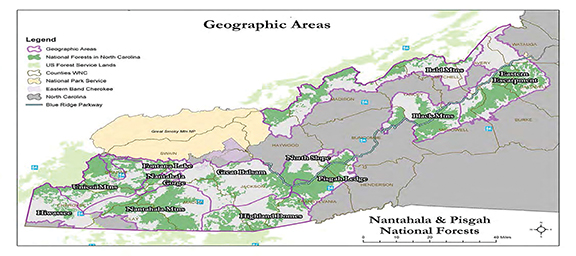
The U.S. Forest Service released the final revised Nantahala and Pisgah Forest plan that will guide future management of national forests in western North Carolina. It takes effect in mid-March, 30 days after release of the final revision.
“The forest plan is a framework to address incredibly complex challenges like climate change and invasive species, impacts from development on adjacent private lands, and high levels of visitor use,” James Melonas, forest supervisor of the National Forests in North Carolina, said in a statement. “Ensuring our forest ecosystems are healthy and resilient is critical to long-term sustainability of all the habitats and ecosystem benefits, on which we all depend.”
The final plan has drawn criticism from a variety of directions – including from Cherokee and Graham counties, which oppose increased wilderness areas, while environmental groups oppose increased logging.
In developing the plan, the Forest Service worked with representatives of other agencies, local government, tribes, partner and collaborative groups, and individuals to consider the best science and various approaches to managing the forests.
The Forest Service said the planning team “developed a balanced plan that supports the multiple uses and benefits of national forests, including recreation, water, wilderness and wildlife habitat, healthy and resilient forests, and sustainable management. The new plan emphasizes the ways people use the forest and the places that are important to them.”
The revised forest plan was built with tribal input and enables the Forest Service to partner with tribes to co-manage resources while honoring traditional ecological knowledge and protecting places of significance, the Forest Service said.
“One example of the revised plan in action is the new Tribal Forest Protection agreement the Forest Service has with the Eastern Band Cherokee Indians,” Melonas said. “This agreement, which began with tribal consultation on the forest plan, enables us to co-steward the forests for shared values with the EBCI.”
The plan is centered around four themes that came out of public engagement during the revision process. These themes are connecting people to the land, sustaining healthy ecosystems, providing clean and abundant water, and partnering with others.
“We can do more together than alone. That’s why partnerships are the backbone of the plan,” said Michelle Aldridge, planning team lead. “The plan is explicit about our commitment to ensure that we welcome new voices and diverse perspectives to create an environment where everyone is welcome, valued and treated equitably.”
The boards of commissioners in Cherokee and Graham counties were among the objectors to the previous draft plan, called Alternative E, which was a blend of earlier alternatives that combined environmental protections with active recreational use, with compromises added from previous public feedback.
Cherokee and Graham counties do not want additional wilderness areas within their counties. Graham County does not support the designation of Wilderness-Study Areas because “limited access to the forests combined with current management practices literally creates wilderness areas by taking no action.”
While appreciative of past collaboration and the willingness to negotiate less-recommended wilderness areas, Graham County still contends that there is more room for compromise. Cherokee County is concerned that the Unicoi Mountains and Bald River Area are within the boundaries of Cherokee County.
They see wilderness designations as too restrictive and a loss to the local economy. They are concerned about loss of access for the motorized communities, recreational tourism and loss of forest products extraction.
The summary of responses included just one example where it seems to be addressing concerns expressed in Cherokee and Graham counties. That response clarified aspects of management for user-created trails, updated guidance on managing climbing routes through unique habitats, and added management approaches related to visitor management at equestrian campgrounds, all based on input from objectors.
Documentation can be found at fs.usda.gov/goto/nfsnc/nprevision.
The Center for Biological Diversity, based in Tucson, Ariz., said the Forest Service disregarded 36,000 public comments supporting more and stronger protections for the 1.1 million-acre national forest and ignored the will of a crowd of more than 400 people who rallied outside the Forest Service headquarters last fall urging the agency to safeguard more of the forest.
“The Forest Service flat-out refused to listen to the public and consider easy, win-win solutions that were widely supported,” said Will Harlan, a scientist at the Center for Biological Diversity. “Instead it’s pursuing its own hyper-aggressive logging agenda that sentences the forest to decades of conflict, litigation and community resistance.”
The plan is a blueprint for the next three decades of forest management – a map that determines which parts of the forest will be logged and which will be protected. It opens more than 63 percent of the forest to logging, including recreational and ecological hotspots, and reduces protections for the forest and its wildlife, according to the organization.
The Southern Environmental Law Center also expressed dismay at the plan.
“The Forest Service failed to make needed corrections,” it said in a statement. “The plan dramatically expands the amount of logging in these forests and fails to protect more than 100,000 acres of old-growth forests, habitat for rare species, and roadless back country. The plan also ignores the role of these forests – and their ability to store massive amounts of carbon – in the fight against climate change.
“The limited remaining old-growth areas in the Nantahala and Pisgah National Forests are particularly vital to fighting climate change and preserving biodiversity,” the Southern Environmental Law Center said. “In the draft plan, the Forest Service suggested that it might spare individual stands of old growth in the future. In the final plan, however, the agency backed away from even this small gesture.
“The Forest Service now says it won’t even consider whether forests qualify as old growth before logging them. This is a violation of current Forest Service guidelines, and it blatantly defies Biden administration directives to conserve old-growth forests.”
The Forest Service said it used a science-based approach, and that the plan provides a vision for each ecosystem on the forest. Special places and rare species are recognized and protected in the plan for unique ecological, biological, scenic and cultural values.
The plan recommends 49,000 acres for new wilderness, in addition to the 66,000 acres of designated wilderness already found in the forest, according to the Forest Service.
The plan also recommends nine newly eligible wild and scenic rivers, in addition to the 10 currently eligible and three existing. Wild and scenic rivers are maintained for their free-flowing nature and outstanding values.
The new plan focuses on forest resilience in the face of climate change to ensure the Forest Service can sustain these forests for future generations, and that they will continue to provide benefits such as clean water, high-value recreation opportunities and diverse wildlife habitat, the Forest Service said.
The Forest Service said the plan makes the biggest commitment to old growth in decades. It increases the designated old growth network to about 25 percent of the forest where the Forest Service will work to ensure the development of old growth characteristics. In addition to the 265,000-acre designated old growth network, hundreds of thousands of acres of forest outside the network will continue to age and progress to old growth conditions over time.
“The plan also recognizes the need for more young, open forests and restoring species such as oak,” the Forest Service said. “The plan will lead to a more diverse forest that has young, mature and old forest characteristics. This diversity makes forests more resilient to insects, disease and climate change.”
“Our current forests are what grew up after extreme logging practices more than 100 years ago, before these lands were national forests. The trees are now mostly the same age and size,” Aldridge said. “We need more young and open forest for wildlife species including bats, ruffed grouse, pollinators, and rare species, such as the golden-winged warbler.”
The plan also prioritizes sustainable recreation. The Nantahala and Pisgah National Forests are among the most visited forests in the country and that visitation is increasing every year. Ensuring a quality recreation experience and equitable access to the outdoors is important to local economies, tourism, and community well-being in western North Carolina.
The final plan, environmental impact statement and record of decision are available at fs.usda.gov/goto/nfsnc/ nprevision and fs.usda.gov/nfsnc.
“It’s a shame that the Forest Service has turned a tin ear to legitimate input from all of the stakeholders who pointed out substantive deficiencies in the draft plan and offered workable alternatives,” said David Reid, N.C. Sierra Club’s National Forests Issue Chair. “The N.C. Sierra Club’s volunteer leaders contributed expertise and countless hours to the plan’s development since the stakeholder process began a decade ago. We collaborated in good faith, in the hope that our input would be respected and reflected in the final version, for the sustainable future of these forests and the health of our broader environment.”
“The Nantahala and Pisgah Forests represent the gold standard of National Forests for key priority conservation lands, old-growth and mature forest, wildlife habitat, biodiversity, and clean drinking water,” said Hugh Irwin, senior conservation specialist at The Wilderness Society. “Despite receiving thousands of objections from those who depend on the Nantahala and Pisgah National Forests for these values and use these lands, the Forest Service chose to blatantly ignore the voice of the people and the best available science in determining the future of our public lands.”