
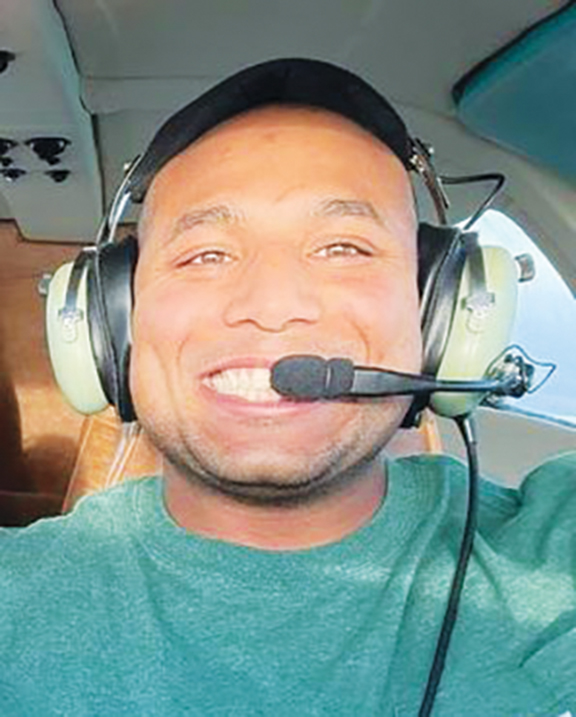
Ibrahim
Andrews – The Kentucky man killed on April 15 when the experimental airplane he was piloting crashed shortly after takeoff from Western Carolina Regional Airport was test-flying the aircraft for its owner, according to a National Transportation Safety Board preliminary report.
The aircraft was piloted by Robert “Bobby” Ibrahim, 36, of Christian County, Ky. Ibrahim, the sole occupant, was pronounced dead at the scene.
Fort Campbell officials confirmed Ibrahim was a “Night Stalker” assigned to the 160th Special Operations Aviation Regiment. He joined the U.S. Army in 2005 and arrived at Fort Campbell in 2019.
He was a native of Cocoa, Fla. He is survived by his wife, Melissa Ibrahim, herself an Army warrant officer and helicopter pilot.
At 10:39 a.m. April 15, an experimental, amateur-built Velocity, registration number N2357, was destroyed when it crashed shortly after takeoff from the Andrews airport. Ibrahim was killed.
The airplane was operated as a Title 14 Code of Federal Regulations Part 91 personal flight.
According to the current airplane owner, the airplane suffered a landing accident in 2004 and was purchased by a salvage facility. That facility removed the engine and avionics, then sold it to the previous owner, who installed a newly overhauled engine equipped with a turbocharger.
The current owner purchased the airplane and installed a new propeller and avionics. At the time of the accident, the engine had about 54 hours of operation since overhaul in 2012.
Due to the modifications, a Federal Aviation Administration-designated airworthiness representative inspected the airplane, issued an amended airworthiness certificate with revised operating limitations and endorsed the airframe logbook on April 1 – just two weeks before the fatal crash.
The accident flight was the first flight since that endorsement.
The current owner is a private pilot with about 90 hours of flight experience, of which about 10 hours were in the make and model airplane. Since he had little experience, he hired Ibrahim to fly the first flight since the modifications/DAR endorsement.
Ibrahim inspected the airplane for about 90 minutes prior to takeoff, according to the report. The owner saw the airplane take off on runway 26, a 5,500-foot-long runway, but lost sight of it behind buildings.
The owner said the engine was equipped with a fixed-pitch cruise propeller. With the turbocharger engaged, the engine would obtain 2,300 rpm; however, with the turbocharger bypassed, the engine would only obtain about 2,050 rpm.
A spring switch in the cockpit controlled the turbocharger waste-gate to select whether the turbocharger was engaged or bypassed (or midrange).
The owner added that at 2,050 rpm, the airplane would not be able to fly with one pilot and full fuel, which it had for the accident takeoff. The owner provided a video that he recorded of a portion of the takeoff.
Review of the video revealed that during the takeoff roll, the airplane accelerated slower than normal, used more runway than normal, and lifted off the runway in a nose-high attitude. The airplane then descended back to the runway and bounced, before lifting off nose-high again toward the end of the runway, where the video ended.
Witnesses reported that the airplane took off, climbed about 300 feet above ground level while flying a left traffic pattern back to runway 26. Near the crosswind to downwind turn, the engine sounded loud, and the airplane descended into a wooded field, crashed and burned.
The wreckage came to rest inverted, oriented about a 75 degrees magnetic heading, leaving a debris path about 50 feet long.
The left wing was separated and found against a tree inverted at the beginning of the debris path. The main wreckage was consumed by fire at the end of the debris path.
No cockpit controls or instrumentation were identified. No seats or restraints were identified.
The left aileron and left rudder separated and were recovered near the left wing. The right wing and canard remained with the main wreckage and were consumed by fire.
The flight controls consisted of control rods and push-pull tubes. Flight control continuity and trim continuity could not be verified due to fire damage.
The engine came to rest inverted, separated from the airframe. The two-blade propeller remained attached to the hub. One blade appeared undamaged while the other blade exhibited charring and tip separation.
The top spark plugs’ electrodes were intact and light gray in color (the Nos. 1 and 3 electrodes were oil soaked).
Borescope examination of the cylinders did not reveal any anomalies. The crankshaft was rotated via an accessory gear drive. Crankshaft, camshaft, and valve train continuity were confirmed to the rear accessory section of the engine, and thumb compression was attained on all cylinders.
Both magnetos had separated from the engine. One magneto was recovered, and it produced spark at all leads when rotated via electric drill. The other magneto was not located.
Due to fire damage, the fuel system could not be tested. The turbocharger waste-gate was found in the open position.