
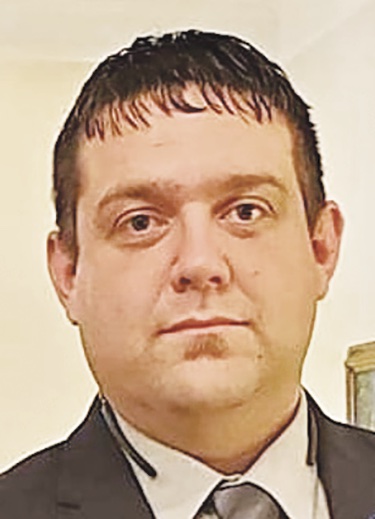
Justin Hyde
Murphy – The status of Cherokee County commissioner-elect Justin Hyde remained unknown as of press time Monday morning.
Hyde, the commissioner-elect for the Cherokee County Board of Commissioners District 2 seat, is considering not accepting his seat on the board. A week ago, he said he expected to decide by Friday afternoon. However, his decision was unknown as of Monday and the Cherokee County Board of Elections Office had not received any communication from him.
At the board of commissioners meeting on Nov. 12, county attorney Darryl Brown announced that Hyde’s status as a county employee would result in a conflict of interest.
As it turns out, Roy Dickey was subject to the same conflict of interest when he served on the board while working as the county’s maintenance director . Dickey earned more than $60,000 in pay and benefits.
“Neither the county clerk nor I could find any exemption of record,” County Attorney Darryl Brown told the Scout. “I was not the county attorney when Roy Dickey was appointed and then elected. I do not know if the issue was explored by my predecessor.”
Brown’s predecessor was Scott Lindsay.
Hyde is a basic emergency medical technician working for Cherokee County Emergency Services. He is also chief of the Valleytown Fire & Rescue Department, a separate agency but which receives county funds.
Hyde would not be considered eligible to be a county commissioner without the board approving an exception, Brown said.
Exceptions are permitted if a county doesn’t have municipalities of more than 20,000 citizens (Andrews and Murphy fall well below that threshold) and if Hyde makes less than $60,000 a year in his position with the county.
If Hyde declined health insurance, it would bring his pay and benefits below the $60,000 threshold. Hyde said pay he would receive as a county commissioner – $13,186 per year – would cover the cost of insurance, but keeping his EMT pay below $60,000 would be tricky.
As an emergency medical technician, Hyde would be expected to be available for overtime – emergency services tend to be unpredictable and overtime could quickly add up, so he would have to be careful about monitoring his hours.
Candidates
District 5 Commissioner Jan Griggs, who lost her election bid in this year’s Republican primary to Alan Bryant, gave parting remarks at the Nov. 12 board of commissioners meeting, her last before Bryant takes office in December.
Griggs expressed pride at the job she did as a commissioner and as a retired Marine.
Three Cherokee County school board members were reelected during the November General Election – Jeff Tatham, James Ellis and Arnold Mathews – but only Mathews faced competition on the ballot.
Mathews defeated retired elementary school principal Paul Wilson, an unaffiliated candidate who received 4,671 votes for the Cherokee County Board of Education District 2 seat. Mathews, a Republican, received 11,872 votes.
“The election served as a validation of who I am, my background and education” Mathews said at the Nov. 21 meeting of the Cherokee County Board of Education.
“Hopefully the decisions I make are in the best interests of the children,” he said.
A very red county
Cherokee County voters were among the most conservative in the state in the Nov. 5 election, which went to Republican Donald Trump and kept a majority Republican congressional delegation, but went Democratic Party for many Council of State seats including governor, lieutenant governor, attorney general and superintendent of public instruction.
In Cherokee County, Republican candidates at the state and federal levels have had at least a 2-to1 margin over Democratic Party candidates since the early 2000s, but starting in 2012, that margin increased steadily in favor of Republican candidates.
In 2004, 67.12% of Cherokee County voters picked Republicans George W. Bush and Dick Cheney, with 32.46% backing John Kerry and John Edwards (Edwards was a U.S. senator from North Carolina).
In 2008, 68.67% of Cherokee County went to Republicans John McCain and Sarah Palin in their unsuccessful run against Barack Obama and Joe Biden, who got 30.07% of the vote in Cherokee County.
In 2012, Republicans Mitt Romney and Paul Ryan got 72.11% of the vote in Cherokee County to Obama and Biden getting 26.25%
In 2016, Republicans Donald Trump and Mike Pence got 76.47% of the vote in Cherokee County, compared to Democrats Hillary Clinton and Tim Kaine getting 20.17% of the vote.
In 2020, Trump and Pence received 76.89% of the vote against Democrats Joe Biden and Kamala Harris getting 21.82%
This year, Republicans Trump and running mate J.D. Vance received 77.91% of the vote. In Cherokee County, with Harris and Tim Walz receiving 20.65%.
As recently as 2006, Cherokee County was nearly split over congressional races and even voted by a 2-to-1 margin for a Democrat candidate for State Senate, John Snow.
The county tended to vote Republican in presidential races but varied for other federal, state and local races. It picked Democrat Heath Shuler by 56.06% for U.S. representative in 2008, but Republican Elizabeth Dole for U.S. Senate by 64.39%.
Straight party voting was available that year, with 60.34% of republicans and 37.8% of Democrats choosing that option.
Back then, Town of Murphy council seats and mayor were partisan races, while Town of Andrews Board of Aldermen and mayor races were non-partisan. Now, both towns run non-partisan elections for their local boards.
In 2010, voters picked a Democrat for sheriff, a Republican for clerk of superior court, and one Democrat and two Republicans for county commissioner. They picked a Democrat for State Senate and a Republican for State Representative.
For Congress that time, Shuler lost Cherokee County and voters chose Republican Richard Burr by a 2-to-1 margin.
Since 2010, Cherokee County voters have favored Republican candidates when given the choice, while at the town level, Democrats have been favored in Murphy and Republicans favored in Andrews.
Andrews aldermen and mayor are all Republicans and Murphy’s town council and mayor are Democrats or unaffiliated.