
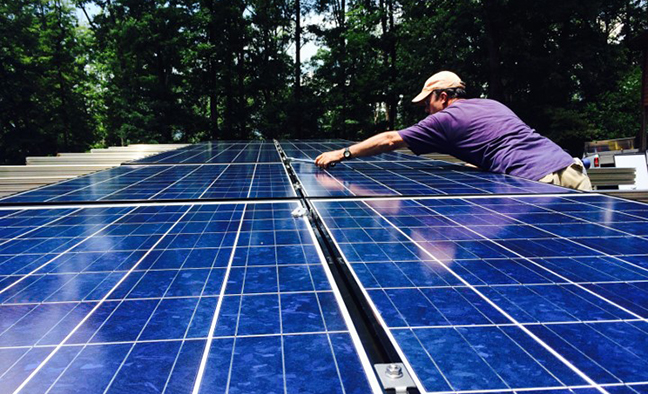
Murphy – “I got tired of the power outages and wanted to be off grid.”
This is Andrew Prichard of Eagle Ridge Buildings, discussing why he chose to install solar panels to power his local house.
“Our area recently lost power for almost nine hours, and I just don’t want to deal with that,” he said.
Prichard isn’t alone.
“Did you know Cherokee County is a state leader in receiving federal solar grant funds for small business solar projects?”
This is Stewart Senger, owner of Carolina Mountain Solar. He got interested in solar during a trip around the world in 2008.
“I visited many countries on multiple continents. Many, including in the developing world, were clearly far ahead of the United States in solar power development,” Senger said.
“I wanted to bring the choice to control your own power to everyday people where I lived, too. Americans should be able to access the sunshine in their own backyards.”
Senger believes solar power creates independence and diversification of resources. The county may need this diversification of resources as electronic vehicles become more prominent in the marketplace.
“EV cars will put tremendous pressure on the grid,” Senger said. “Even without EV cars, the U.S. electric grid will need to grow and expand to handle a growing population. Planning ahead with solar helps mitigate these issues.”
The federal government agrees with Senger.
“Congress passed the Inflation Reduction Act, which will provide great opportunities in solar over the coming years – especially for the local power co-ops, Cherokee tribe and towns. This could help hold down rising electric prices, and lower cost and taxes for the county and municipalities,” Senger said.
The Tennessee Valley Authority is ahead of the game. They operate those large fields filled with solar panels dotted around the county.
“They power the grid, meaning they generate energy to feedback and sell directly to the TVA,” Senger said. They are usually owned by private investors.
What are the disadvantages? For one, solar power obviously requires sunlight, although it’s a myth that the power goes out when it’s cloudy outside or the sun goes down.
Batteries store energy for conversion through sunlight. Think of it like a water pitcher in the refrigerator. It can offer a glass of water in the middle of the night without using the tap, as long is it has been filled beforehand.
The batteries can store energy to be used when the sun isn’t directly powering them so long as they are refilled during the sun hours. Still, for those living in a shady environment, their storage capacity will be limited.
The largest barrier to homeowners is cost.
“Turn-key systems typically cost $25,000 to $70,000, depending on size and components,” Senger said. “Commercial systems have a wider range.”
For Prichard, cost wasn’t a deterrent.
“I wasn’t interested in the cost as much as getting off the grid,” he said. “My 1,700-square-foot house cost $40,000 to install, and it runs my entire home just by flipping the switch.”
Prichard said his power meter runs backward when his solar is up.
It’s unlikely alternative power sources will be darkened by traditionalists who believe in the endless supply of fossil fuels. Progress marched through the resistance to converting lantern-lit houses with electricity, and it will continue its movement to converting the community attachment to electrical grids into autonomous power for each home.
“Solar power is the power of choice,” Senger said. “At no other point in the modern era have citizens had the ability to make their own power effectively.”
It seems there is not a lot to dislike about solar power.
“Solar energy,” Senger touted, “is local-made, clean and abundant in our area.”