
It all comes back around, in the end. Up until the late 1800s, humans disposed of their bodies by offering a ritual for the surviving clan or family, which involved displaying the decedent in some manner, usually smartly dressed, and then burying the body in a back garden or church plot.
However, all that changed when German Dr. August Wilhelm Von Hoffmann discovered formaldehyde’s preserving qualities. Nobody questioned how he came to his findings, but the world adopted his technique of draining the deceased body fluids and replacing them with a formaldehyde solution. This practice was useful for a culture that became less attached to family land and moved away to urban centers, as was the trend during the Industrial Revolution.
Von Hoffman’s discovery meant that loved ones could return for a funeral service from greater distances without the fear of the body decomposing before their arrival. It also formalized the restrictions inside many cemeteries.
Green burial
But in recent times that practice has been questioned by some conservationists. The main argument focuses with how the embalming chemicals affect the water table as the body decays.
John Ivie of Ivie Funeral Home in Murphy explained that embalming, while remarkable in its efforts against nature, eventually loses the battle.
“I recently disinterred a man who had been buried in 1942, and he was in a recognizable condition,” Ivie said. “His skin was brown, but the embalming process helped him skip purification.”
As hearty as the chemicals are, shifts in cultural values are moving back to the pre-1867 rituals. Today, it’s called “green burial,” but that’s just a modern tagline on a historic practice.
Body farms
Modern culture offers options unimaginable in history. Among them, people can designate their body to be studied at what is commonly called a “Body Farm.”
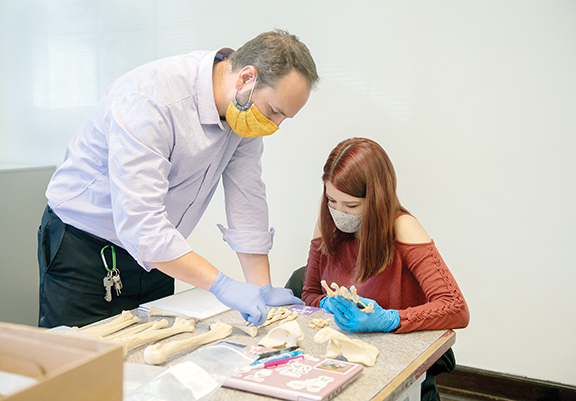
Scientists at Western Carolina University’s forensic anthropology wing in Cullowhee call it the Forensic Osteology Research Station, or FOREST for short.
“We don’t call it a body farm,” said Dr. Nicholas Passalacqua, the college’s forensic anthropology facilities director. “People like to call it that, which is fine, but we aren’t farming bodies here.”
There are only seven body farms across the United States, all of which are associated with teaching universities. Western Carolina’s farm receives up to 20 bodies a year from those wishing to donate their remains for future forensic anthropologists to study.
The basic idea behind what Passalacqua, calls “our outdoor lab” is to place bodies in various conditions to study the decomposition. These acute observations are tediously logged and may one day help solve a crime.
Field labs
There are two field labs assigned to the university. They are off campus down a long, gravely, un-marked path with high-tech security, including tall fences topped with barbed wire and security keypads for entrance.
The security look a lot like what’s found in prisons, but their purpose is inverse. The scientists are trying to keep people out rather than in.
“This field here,” Passalacqua said, pointing to a fenced-in area, “is the burying field.” To the untrained eye, it looks like an inexperienced gardener haphazardly dug holes, then filled them in with no sense of order or system.
“The bodies are buried in different conditions and at different depths,” he added.
Deeper within the actual forest, the second FOREST field station appears.
“This field contains unburied bodies,” Passalacqua said adding gravely, “no pictures here.”
There is little chance of anyone breaking through the high-security fence, another keypad, plus a gate with a forbidding lock. Inside, the surrounding forest, with sunshine dappling though the leaves and birds happily chirping happily, fades away in a shocking tableau.
About a dozen bodies lay in various conditions on top of the ground. Cages cover several bodies.
“Those are to keep the birds away,” Passalacqua explained.
It’s a sophisticated lab. The students study everything from ground temperature and humidity, to animal activity and taphonomy-a branch of science dedicated to the process of fossilization.
“Some of our willed donors come with special requests. For example, they want to be placed in the above-ground lab,” Passalacqua said, his jingling keys betraying the somberness of the field.
Respecting the dead
Ivie, who has been in the business of body disposal for decades, said traditions around death are changing.
“A lot of people don’t have a funeral now,” he said. “But they don’t realize that a funeral is not just for the immediate family. It’s a time for the community of the loved one to gather.
“Many people later tell me that they wished they had done more for their loved one. They regret not having a service so their grandchildren could say goodbye.”
For Passalacqua, the decomposing bodies in his lab represent people willing to advance science. And that holds its own kind of reverence.
“We respect why people are out here,” he said. “These remains are tied to people; their bodies contained their ‘person-ness.’ We feel a connection to these remains.”