
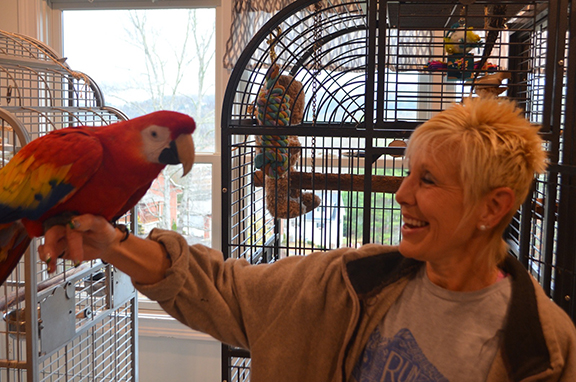
Hiawassee, Ga. It all started with a featherless newborn baby macaw parrot named Noah.
Noah required Kimberly Utt and her husband, Jim, to manually care for it, including eye-dropper feedings and a constant stream of love. Fast forward four years, and Kimberly has slowly built Noah an ark, filling it with eight more rescue parrots.
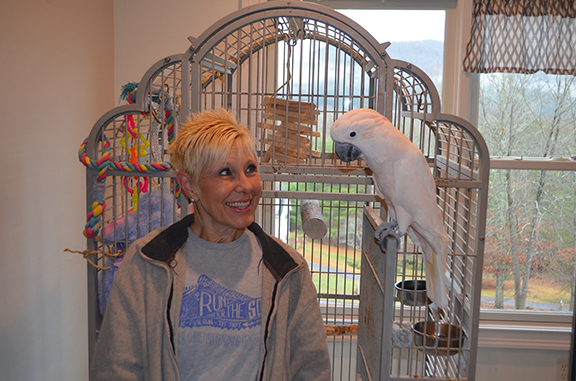
The house is a noisy one as the parrots hold court in what was designed to be the formal dining room. Kimberly taped paper to the floor, then lovingly lined up nine cages on castors around the room. Noah and his flat-mate Charlie, a green-winged macaw, along with a Moluccan, Lola, nest in the prime real estate of the room.
Their three cages – giant constructions at least 8 feet tall complete with children’s toys, wooden structures handmade by Jim – and an iconic perch bar sit in front of two large picture windows. Lola, who is the “Chatty Cathy” of the menagerie, only stops talking to frighten the guests with a menacing, Disney villain-like cackle. Kimberly finds it endearing.
“They watch Disney movies at bedtime,” she sad by way of explanation.
Instead of popcorn, they each get a complimentary bowl of peanuts for their bedtime snack. Charlie is the brainiac of the aviary, which is why Kimberly put a deadbolt on his cage.
“He figured out how to open his cage,” she said. “Once he was free, he would open up Noah’s cage so they can play.”
Full-time care job
The bird room is full of light and smells, much like one would expect inside a miniature solarium full of really big birds. Jim takes charge of their maintenance, which according to him “is a full-time job.” The problem with their plan is they both already have full-time jobs.
To properly tend to each bird, Jim gets up and begins the morning routine around 4 a.m. That includes cleaning out the cages, water and feeding bowls. He has to reline the cages, often with old copies of the Cherokee Scout, then line up the bowls for Kimberly to fill when she gets up. It’s a two-hour bird dance for Jim.
Once a quarter, he takes all the cages outside and power washes them. One bird, a crippled rescue named Taco, had deep anxiety when Jim took her cage outside to clean it.
Once, Taco perched himself on a ledge, nervously watching Jim work. When he finally came back in with his shiny, clean home, Taco screeched, “Praise the Lord!”
After Jim leaves for work, Kimberly takes over. She “let’s them out” for a two-hour walk-about inside the house.
“In the summer, I take them into the back yard,” she said. While the birds do bird things, Kimberly busies herself in her open kitchen.
“I make all their meals,” she said with the pride of a mother cooking homemade baby food. “They eat a mostly human diet,” she started before Jim interrupted. “Well, we do buy about 75 pounds of dry bird food a month,” he said, which Kimberly uses as a base in their bowls, adding scrambled eggs and orange slices on top for their breakfast.
Preparing human food for their meals may be less expensive than a full birdseed diet. Jim estimates that “25 pounds of birdseed costs us $100.”
Kimberly justifies the high cost. “It’s made of all natural seeds and carrots,” she said.
Living with toddlers
Most of their home life is tasked with cleaning, feeding and caring for their birds. She said parrots have the brain capacity of a 3-year old and that life feels very much like “living with toddlers.”
“At the end of the day, I go downstairs and sit in my chair. I can hardly move,” because “proper bird care requires a lot of energy,” Kimberly said.
Properly caring for birds is her focus. All of the exotic birds in her house, which include three finches and two parakeets kept upstairs by another large window, “I rescued.”
Kimberly holds firm beliefs about mistreated birds. “If you can’t take care of your bird, you are a bad person” she said. “You should have never gotten that bird.”
Kimberly said she is known as “the bird lady” in town, a moniker she enjoys. Two years ago, their beloved parrot named Jewell died of cancer. The loss gutted them.
“I cried my eyeballs out,” Kimberly said quietly, while Jim looked at her with sadness. When they rescued Jewell, “all she could say was ‘help!’ ” Kimberly said, looking into the bird sanctuary full of her overly loved birds.
They chose not to replace Jewell and “are no longer taking in birds,” as they are quite pleased with their pandemonium.
“I get to see this beauty everyday. Most people have to go to the zoo to see this,” Kimberly said with a smile. The toil of bird care has become her passion.
“Parrots live about 80 years,” she said, so her intention is to keep her bird family together until her death, when she and Jim plan to will the birds to a sanctuary.
When asked what she would change about her busy life and role as caretaker to these magnificent winged creatures, she answered immediately and with conviction, “I would change nothing.”