
Traditional adversaries find common ground
By Randy Foster
news@grahamstar.com
Peachtree – Bear hunters, environmentalists and private property owners – traditional adversaries in western North Carolina – found common ground over a proposal to issue a limited number of hunting permits in three black bear sanctuaries.
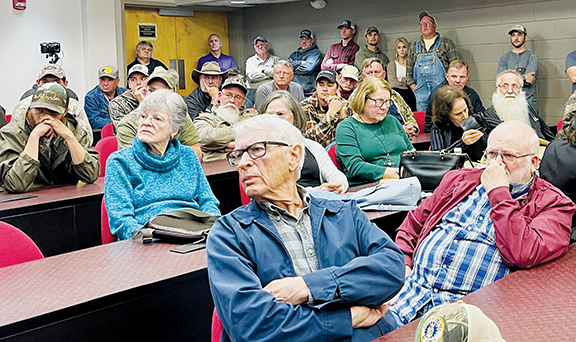
At a public meeting held on April 5 at Tri-County Community College organized by state legislators to talk about the proposal, members of the N.C. Wildlife Resources Commission laid out the reasoning for allowing limited hunting in the western North Carolina sanctuaries.
The affected bear sanctuaries are Standing Indian in Macon County; Pisgah in Buncombe, Haywood, Henderson and Transylvania counties; and Panthertown-Bonas Defeat in Jackson County.
The rule change by the Wildlife Resources Commission would permit limited bear hunting beginning in fall 2022. The change affects 92,500 acres and was approved by the commission after a request by “the property owner” or, more precisely, the U.S. Forest Service, which manages the acreage.
The meeting was called by state Rep. Karl Gillespie and Sen. Kevin Corbin (both R-Franklin), who said they have received numerous calls from constituents about the proposed change.
Background
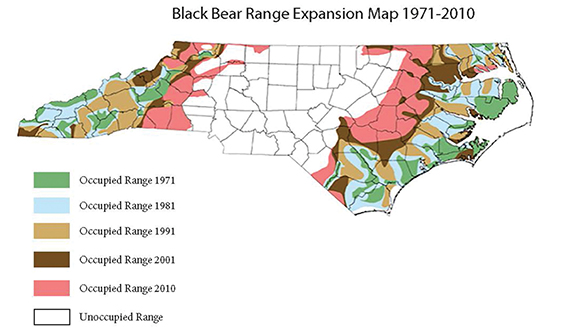
Bear populations in North Carolina have steadily grown since the 1970s, when the sanctuaries were established. Wildlife officials claim that the bear population increases by about 5 percent per year, and the U.S. Forest Service wants to reduce that population growth to zero percent to control bear populations and reduce the frequency of bear-human interactions.
James Tomberlin, mountain region supervisor for the commission, said there are some details to be worked out and they will “take everybody’s concerns into consideration.” About 50 people showed up for the meeting, and early on there was clearly tension in the air between hunters, environmentalists and property owners.
The tension evaporated amid the realization that they were all there for the same reason – none of them supported bear hunting in the three sanctuaries. The process leading up to the proposed sanctuary change found few supporters, and among those at the April 5 meeting, the statement that the commission would “take everybody’s concerns into consideration” rang hollow.
Gillespie urged state wildlife officials to respect the feedback they received, go back to Raleigh and take another look at the plan.
“We are all servants of these people,” he said.
Success story
The American black bear is the only bear species found in the eastern United States.
The successful comeback of the black bear in North Carolina represents one of wildlife management’s greatest achievements. Tomberlin said the bear population dipped below 1,000 in the 1970s and has increased to about 7,000 bears now.
Black bears were once restricted to remote areas and reached very low population levels in the mid-1900s. Today, black bears are found approximately 60 percent of the total land area of North Carolina, according to wildlife resources literature.
There are 22 bear sanctuaries throughout the state. There are three where a limited number of hunting permits are issued each year – in western North Carolina, Mount Mitchell in McDowell and Yancey counties and Daniel Boone in Avery, Burke and Caldwell counties; and in eastern North Carolina, Dare in Dare and Hyde counties.
There are other de facto sanctuaries, such as Asheville city limits and – vastly larger than all the rest – the Great Smoky Mountains National Park. That leaves regulated hunting in sanctuaries as the primary tool available to reduce the bear population, wildlife resources officials say.
Increasing population in western North Carolina has caused a decline in hunting ground, Wildlife Resources Commission Capt. Andrew Helton said, adding that bear sanctuaries are going to provide more opportunities for bear hunting. Enforcing the sanctuary is difficult for law enforcement.
“Dogs can’t read signs,” and in areas where signs are missing, sanctuary boundaries are unenforceable, he said.
Some of the bear hunters at the meeting described the situations they face, including property owners attracting bears into populated areas by feeding them (intentionally and unintentionally), and how property owners are making it difficult for bear hunters by staking out private property and making it difficult to retrieve their hunting dogs.
The bear hunters see taxpayer money going to pay for kayak ramps and bicycle trails, while primitive hunting trails and often even Forest Service roads fall into disrepair. On the flip side are people attracted to the region and who buy acreage, but who don’t see eye-to-eye with local customs and traditions – such as bear hunters going through their private property with guns and dogs. However, they found a common adversary over the issue of hunting in bear sanctuaries.
About black bears
The Wildlife Resources Commission is funded by hunters and people who fish through the fees they pay for licenses. They are seen as the constituents of the commission and North Carolina wildlife as a public trust. But it is the Forest Service that seems to be controlling the move toward permitted hunting on bear sanctuary land.
“I think you should listen to the people,” said one speaker, who identified herself as a biologist. “It seems like the decision was made long ago.”
The black bear is an omnivore with a diet of both plants and animals. In North Carolina, the black bear is usually black with a brown muzzle and sometimes a white patch on its chest, commonly referred to as a chest blaze. All bear species have five toes on each foot and each toe has a sharp curved claw enabling the bear to feed on insects and grubs in decaying logs.
Black bears rely mostly on their sense of smell and hearing due to poor eyesight, but are adept at climbing, running, swimming and digging. They have been clocked at speeds of 35 mph over short distances.
Bears prefer large expanses of uninhabited woodland or swampland with dense cover. Recent research has shown bears to be much more adaptable to habitat changes than previously thought and some bears have adapted to living near developed areas.
Bears put on additional weight in autumn to prepare for winter denning. They build dens in cavities of live trees, hollow logs, caves, rock outcroppings, cavities in the ground, or in a thicket. Usually black bears construct nests of leaves, sticks, and grass within the den, which often resemble giant bird nests.
In North Carolina, den entry can occur as early as November or as late as January. Most North Carolina bears emerge from their dens in March or early April, depending on the weather and mobility of their cubs.
View a bear expansion map on the Cherokee Scout’s Facebook page.