
Anatomy of an arrest – and after
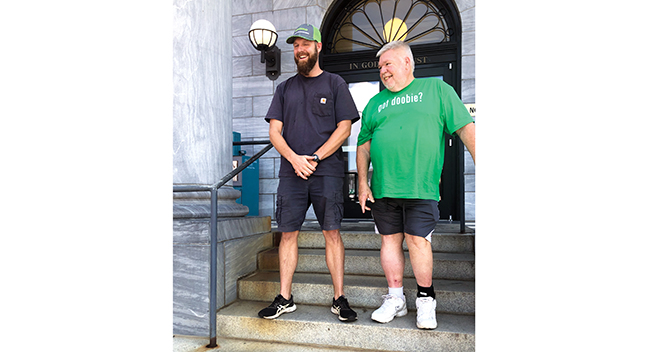
Murphy — The first thing, of course, is not to get arrested. However, for those finding themselves among the projected 1,800 arrests in Cherokee County for next year, it might be helpful make an introduction to Doobie White, a local bail bondsman.
For the uninitiated, arrests can be both scary and confusing. The charged offender begins his journey in the back of a blue light-blinking cruiser. He is transported to the Cherokee County Detention Center, where he will be processed.
Processing is shorthand for transforming the accused into prisoners and includes the surrender of all personal possessions, including a wedding ring, use of a state-of-the-art fingerprinting machine that relies on digital readings rather than unsightly ink and the exchange of good guy clothes for an orange jumpsuit signifying a bad guy. One’s guilt or innocence is not discussed at this stage, meaning those wrongfully arrested must wait their turn in jail next to those who have earned their spot in that line.
There are several ways a person ends up wrongfully committed, but most can be calibrated either to human error or human bias. But those who are falsely arrested in the community need not despair. The U.S. Constitution allows every citizen the right to hear the case against him and lodge a defense in trial.
Unfortunately, trials don’t happen the day after the arrest. This means the accused must sit in jail until their case appears on the judge’s docket. This could take months, and sometimes years.
At an arraignment
However, there is a remedy for a long interment while waiting for trial. An inmate may only have to remain in county custody until after their arraignment. These occur much faster than trials, usually within days of the arrest.
An arraignment is a court proceeding almost like a roll call for the charged individual. Three things happen in an arraignment. First, the accused hears the formal charges against him or her. Second, he or she enters a plea of “guilty” or “not guilty” regarding those charges.
Note that there is no plea for “innocence.” Lady Justice, evidently, finds no person worthy of such classification.
Third, and likely earning the most anxiety for the inmate, the judge sets bail according the severity of the charges and character of the accused. This is where teaching Sunday school or volunteering in the community can have a pragmatic life benefit.
The District Attorney’s Office will argue against the inmate by listing the egregious nature of the crime and quite possibly mention the inmate’s overdue parking tickets and the like. The defendant, called so because he is defending himself against the charges put against him, will have his own attorney arguing for a lenient bail based on the weakness of the prosecution’s case and innate goodness within the defendant himself.
An arraignment is not a trial. Nobody presents evidence nor argues the details of the crime. It’s a simple three-part procedure. Except that it isn’t simple.
‘I am people’s last resort’
Once a judge sets bail, the defendant is required to pay the full of the amount to gain his freedom until trial. An inmate with a $10,000 bond; however, is unlikely to have that amount stashed in the cookie jar at home. This is where Doobie White steps in.
The North Carolina-licensed bail agent has been in business for more than 20 years.
“I am people’s last resort,” White said with a laugh. “They’ll try anything before calling me.”
He said there are multiple remedies to leave jail during pre-trial. Some defendants are released on their own recognizance; some put up land or a put a lien on their house. However, for those without land or a house, they offer the court a Doobie.
White got interested in bail bonding after working a post-retirement job as an officer at the Cherokee County Detention Center.
“A lot of times, I saw people in jail who were not guilty,” he said. “They needed a way out.”
So when he left the county job, he became a bail bondsman to help give them a way out.
It works like this. Once bail is set, the defendant will call White asking for help. White said there are several factors involved to decide whether to assist an inmate.
“We do a risk assessment on the defendant,” he said. “We look at the severity of the charge, how many times he has been arrested before, how many ‘failure to appear’ charges he’s got.”
White said he turns down requests based on the risk factor.
“I’m the one whose going to lose the money if they don’t show up at court,” he added.
Once White and his team decide to accept the defendant, they inform the court and “do a lot of paperwork.” Essentially, the bail agent offers his own reputation with the court to release the defendant.
“We don’t actually exchange money but if the defendant fails to appear, I’ve got to pay it,” he said. The defendant is released from jail, but now has a new problem. He has to pay White 10 percent of the bail.
Bail reform movement
This is a tenuous issue within the justice system. A bail reform movement has gained some traction, arguing that pre-trial imprisonment is class based. The rich can pay the Whites of the world, while the poor have to sit in jail – losing jobs and sometimes families – waiting for their day in court.
White argues against the idea that the criminal system is favorable to the rich.
“I don’t agree with the idea that the rich get out and the poor have stay. Everybody has a constitutional right to pay his or her bail,” he said.
However, the Constitution doesn’t provide relief for those lacking the resources to pay the bondsman. The N.C. Bail Agents Association bypasses the pith of the argument altogether, saying, “Not a single person is sitting in jail because of the size of their wallet. They were accused of a crime based on probable cause.”
For those who have the cash, White orchestrates their release. The defendant’s first stop is White’s office to fill out paperwork, while White and his crew incentivize the defendant to show up for court. Both White and his son, Brody, are imposing.
“The high-risk defendants have to do phone and visual check-ins with us, but the lower risk ones can just phone in,” White said.
The other 10 percent
If all goes well, and White said it does about 90 percent of the time, the defendant will show up on his court date. White is no longer bound to the price of his bail.
However, what about the 10 percent who don’t show up? They get the Doobie treatment.
“If they don’t appear, the court will issue a bond forfeiture, and we’re given a grace period of so many days for us to go catch ‘em and bring ‘em in,” White said. He can’t disclose the number of days without jeopardizing his system.
“Once they skip court, I go out and collect them,” he added. “There is a risk to this job; I’ve been in dangerous situations.”
White chose not to reveal his collection methods to avoid exposing private information about his defendants. He does say the job is tough.
“We have to go into people’s houses and we don’t know what’s behind that door,” White said. He claimed his services save the state millions of dollars.
“They don’t have to keep tabs on them or send out a deputy to bring ‘em in,” he said. “We do all of that.”
Despite the discomforts of the job, White said he has no intention of leaving.
“I’m getting some age on me now, and will one day hand the business over to my children,” he said. “I stay in it to help people. I’ve had defendants turn into good friends.
“Some people call to thank me,” he added with a laugh. “But, of course, others call to threaten me. I am the one who is going to put them in jail.”
For details, visit gotdoobie.com.