
History runs deep in these foothills, and most of it is buried deep in the ground.
Treasure hunters like Ben Pope of Hiwassee Dam and Taylor Ruf of Murphy have found a fun hobby in searching the streams and land of Cherokee County for relics left behind by the citizens of yesterday.
Pope has been infatuated with artifact hunting since he was 7 years old, when he found an arrowhead at his house. Pope started the YouTube channel “History Hound” about a decade ago to share his hobby with like-minded people.
“It connects me with an audience that shares a similar love for history,” Pope said with a smile.
“I bored most of my family to death, so YouTube helped me find others with the same interest.”
Hounding for history
Pope has had some interesting finds over 35 years of hunting, but his favorite finds are those that cross the line between art and utilitarian use in Native American culture.
“Stone tools like gorget and bannerstones, something that has intentional artistry, are my favorite finds,” he said.
“We still don’t completely understand their intended use, but it is obvious they were decorated with intent, and they were important projects for those who created them.”
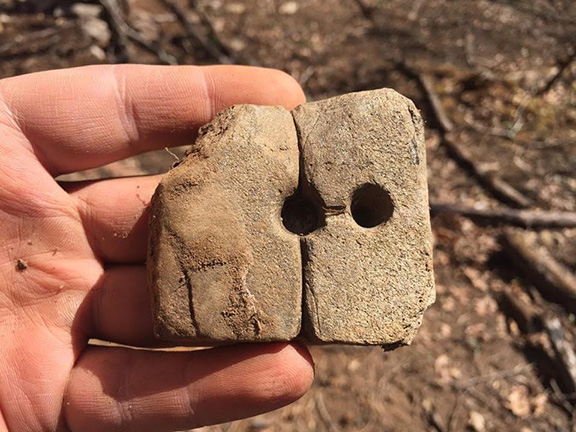
Pope said he has found four drill stone artifacts in Cherokee County so far after hunting from one end of the county to the other. He has to be secretive about where he hunts because people have shown up to the sites before, and there are rules that have to be followed in the hobby.
“First thing, get permission from landowners to look and know local laws,” Pope said. “No one can hunt on Tennessee Valley Authority or National Forest Service lands.”
Another important rule is to keep their finds site specific. Removing an artifact and not keeping a detailed note of where it was found can affect the history of the object. For instance, artifacts found can tell a story to help us better understand how people lived centuries ago.
“In one garden site, I have found five different kinds of materials,” Pope said. “Rhyolite from near Yellowstone, Jasper from Alabama, Agate from Tennessee, Flint Ridge Flint from Athens, Tenn. This tells us that these people were traveling vast distances and trading, they didn’t just stay in one cove their whole lives.”
For people hoping to find treasures in their own backyard, Pope has some pointers.
“Look for broken dirt or disturbed ground, which for most landowners is their garden site where they’ve been tilling up dirt, then identify the right materials,” he said. “If you see a lot of quartz or flint, then 100 percent positive you are on a Native American site.”
Backyard treasures
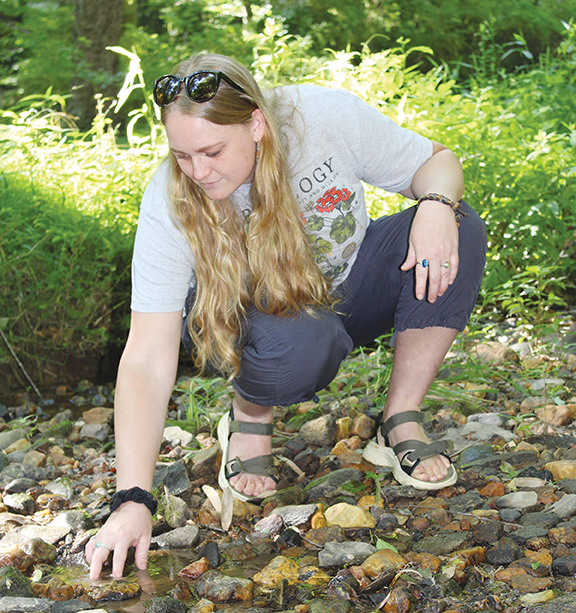
Ruf, who has lived in Cherokee County for eight years, said she has always loved being outdoors. So when she began to find hidden treasures among the rocks of the nearby stream, she became a hunter for glass, pottery and rocks.
“I’m pretty sure I’ve gone through and touched some of these things before without realizing it,” she said while laying out the past two years worth of finds on her kitchen table. The boot tray she uses to store her finds is filled to the brim with colorful glass and even small animal bones.
“If I find something cool, I normally bring it home,” Ruf added. Some of her cool finds are a quartz arrowhead she found in the creek one day with her husband.
“It was just sitting in the sandy edge of the creek, and I saw the bottom portion of it sticking out, I knew what it was the instant I saw it,” she said. “My heart spasmed, and all I could say was, ‘No way!’ ”
She finds several types of rocks in the stream, including quartz, mica schist and agates. Ruf is also on the hunt for rubies.
“We shine a blacklight to see what glows,” she said. Rubies are bioluminescent and will glow when a black light is shined on them at night.
Ruf’s most recent excursion on June 18 did not yield any rubies. However, she did find that crawfish love the night and glow under a blacklight.
Precious gems – like rubies, emeralds, garnets and sapphires – have been found in the valley. A notably large sapphire was found in the vicinity of Andrews, including a huge sapphire was found in 1969 by Rob Cutshaw.
The stone weighed 2,111 carats. However, it was not noted as a rare find until 1987, when Cutshaw took it to be cut. He owned a rock shop on U.S. 19 in Andrews, where the sapphire sat for 18 years.