
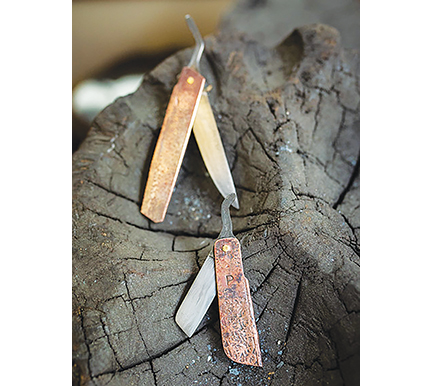

Jason Bivens (top photo) learned blacksmithing at a young age by making pocketknives (bottom photo).
Brasstown – The passion ignited by a boy and his homemade pocketknife has forged an award-winning sword.
Jason Bivens, representing John C. Campbell Folk School’s Clay Spencer Blacksmith Shop, won the Forged in Fire: Appalachian Showdown on Oct. 25.
The folk school’s shop appeared on the season’s third episode of Appalachian Showdown, which aired on Oct. 11.
Bivens lives in McMinnville, Tenn. He made his first knife when he was 12 years old, back in the days before the internet.
“I didn’t know what to do. I slowly but surely gained experience. I used lots of books and magazines,” he said.
Bivens also relied on trial and error. He eventually joined the blacksmith shop at the county’s fairgrounds.
“I started meeting people and learned basic blacksmithing. It taught me how to move metal, which is needed for knife making,” he said. Eventually, he ran the county fairgrounds blacksmith shop.
In 2000, Bivens started the Warren County Blacksmiths Association, a local forge group that meets at his house.
His forge group is a member of the Appalachia Area Chapter of Blacksmiths, a collection of forge groups throughout Tennessee, North Carolina, Kentucky and Alabama. The folk school is a member of the organization, which meets at shops and attend conferences.
Bivens has taught at the Appalachian Center for Crafts and been in demonstrations all over Tennessee. His lifelong pursuit of blacksmithing made him a great contestant.
At the first show, filmed at the Clay Spencer Blacksmith Shop, the three contestants were Bivens, Jesse Bowling and Cole Harrison. Their first assignment was to create a blacksmith’s knife, which is a knife forged from one piece of steel incorporating the handle and blade as one piece. The judges agreed that Bivens’ knife was superior.
In keeping with the Appalachian theme, the judges wanted the contestants to make a farm tool: a pitchfork. The pitchfork Bivens crafted was impervious to the many stress tests it underwent, and stylistically would have been a good prop in a Tim Burton movie.
“Everyone is asking me if I’m going to make another one,” he said. “My kids say it looks like fingers from a movie.”
Bivens prevailed in the first episode and competed in the championship, where his skills and creativity led to victory. In that final show, he made a Damascus knife, starting with 18 pieces of steel. He folded it once to get it to 36 layers.
“We had three hours to make the blade. Then, next round was 90 minutes to do the handles,” Bivens said. His knife was subjected to performance tests and a design evaluation, passing them all with flying colors.
The final assignment on the championship show was an 11-inch Moplah sword, an implement that has been used since the 17th century as a weapon and a tool. Coincidentally, Bivens, who had made several versions of this sword, already had created a 4-to-6-inch version about a month before the show.
“It was fresh on my mind, but that was one of the biggest ones I’ve made,” he said.
Fans were able to talk to the contestants at the school’s Forge After Dark event and auction on Nov. 3-4. Bivens was there all weekend.
“They had the shop open till around midnight Friday night. I made a cable Damascus knife that night for their auction on Saturday that brought $450. I had also previously donated one for the auction, and it brought $325,” he said.
“The people from the school treated me awesome and were a pleasure to work with. They were very appreciative of everything I did for them and how I represented them. Hopefully, it will bring more awareness to the school and their functions.”
Bivens stood out because he seemed very comfortable in front of the camera.
“They told us, ‘Be you, so be more than you. Laugh and cut up.’ I naturally do that all the time anyway,” he said. “I always enjoy making people laugh and smile.”
Bivens loves making beautiful pieces.
“I try to finish to the best of my abilities to make it a great piece of art,” he said.
That ambition was obvious on the show. Bivens said he used any extra time on the show to improve what he was making.
“I can’t not do it,” he said. “The artist in me can’t leave well enough alone.” For example, he doesn’t like to leave hammer marks.
To date, Bivens has made 300-400 knives, 30-40 pocket knives and plenty of swords. Blacksmithing is an art he loves, but he said it is a hobby.
“I found out really quick I couldn’t do it for a living. A lot of people turn hobbies to jobs and stop liking it,” Bivens said.
“On the show, I got to meet a lot of great people and made new friends. I wouldn’t mind going back.”