
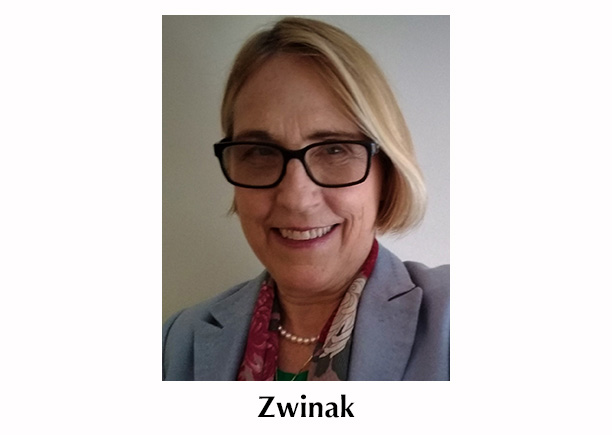
Tamara Zwinak
The Green Party candidate seeking North Carolina’s 11th Congressional District seat filed a discrimination complaint with the Federal Communications Commission last week alleging that she was deprived of prior knowledge of a debate held earlier this month.
On the evenings of Sept. 4-5, Republican candidate Madison Cawthorn and Democratic nominee Moe Davis participated in political debates sponsored by Blue Ridge Public Radio (a member of the National Public Radio network), Smoky Mountain News and Mountain Xpress. The debates were held on Western Carolina University
campuses.
Cawthorn and Davis also participated in a debate held at Southwestern Community College on Sept. 9. Both schools live-streamed the debates. Libertarian candidate Tracey Nathaniel DeBruhl and Green Party nominee Tamara Lynn Zwinak did not participate in either event.
“I was not invited,” Zwinak wrote in her complaint to the FCC, adding that she didn’t learn about the debates at Western until two days before the first one. “Thus, I was not able to meet the ‘timing request’ deadline. BPR knew or should have known that there are four candidates for U.S. House of Representatives District 11. Names of all the candidates have been published in the Smoky Mountain News, Franklin Press and Mountain Xpress.”
Zwinak’s complaint alleges that BPR violated the Communications Act of 1934, which prohibits discrimination between political candidates. She cites a section of the law that states, in part, “... nor shall any licensee make any contract or other agreement which shall have the effect of permitting any legally qualified candidate for any public office to broadcast to the exclusion of other legally qualified candidates for the same public office.”
“Penalties for discriminating between candidates may include administrative sanctions, up to and including the revocation of a broadcast license,” Zwinak argues in her complaint.
The news director for BPR told the Cherokee Scout that Zwinak and DeBruhl failed to meet all of the criteria required for them to be included in the debates, which among other things includes having an “active and current public campaign website and social media presence that provides information about their policy positions.”
BPR also requires debate participants to receive 10 percent of the votes in recent elections for the office of which they’re running or hit 10 percent of votes in reputable, nonpartisan polls for the upcoming general election.
“We recognize that they will both be on the ballot for the November election, so we will mention their names in our program when portions of each forum are broadcast this Friday morning at 9 a.m. and Saturday afternoon at 3 p.m. on Blue Ridge Public Radio,” BPR News Director Matt Bush said via email.
In a conversation with the Scout, Zwinak said she prefers not to complain, but she feels this is an issue that warrants attention to prevent it from happening again.
“They know their license could be taken away,” she said. “If they keep repeating this, it could be an issue,
and I don’t think BPR wants to do that. They don’t want to be in that position.”
Zwinak, 67, is a resident of Franklin. This is her second time running for an elected office. While she is running on North Carolina’s Green Party ticket, she is not endorsed by the party.
“Her positions on several issues do not align with our platform,” party treasurer Wayne Turner said via email. “When a party has ballot access in North Carolina, anyone can file to run as a candidate of that party. This is what Zwinak has done, and because there was no primary challenger, Tamara automatically becomes the NCGP candidate for the 11th U.S. House district.”
Zwinak, who has supported the Green Party for years, acknowledged that some of her views do not align with the party’s platform.
“The Green Party was not socialist in the past, and I am not a socialist,” she said.
Zwinak is a licensed clinical social worker. She believes her professional career makes her the ideal candidate for Congress.
“I’ve been active in politics since I was a teenager,” she said. “I think I was the first candidate ever to run on a platform of sustainability, health care and social justice in the 1990s, and we’re still dealing with these same issues today. … As a professional social worker, I’m trained on how to work with all levels of government and how to get things done. We have to overcome partisan politics to ensure the welfare of the people.”
While Zwinak has strong opinions on numerous
foreign and domestic issues that affect Americans’ way of life, her top three concerns today are pandemic response, sustainability, and health care. She supports mask mandates, social distancing and rapid COVID-19 testing with immediate results.
“[We need a] safe and effective vaccine available to all, and we’ve got to make our [personal protective equipment] here in the United States, as well as the medications and vaccines,” Zwinak said.
During her first term in Congress, Zwinak would strive to create a U.S. Department of Sustainability aimed at “transitioning to sustainable communities that will reverse climate change and create enduring communities, without crashing the economy.” She feels the United States must build communities that have balanced economies so
that towns do not decline when large businesses leave an area.
“The Green New Deal is a piecemeal deal,” Zwinak said. “They mention the word sustainability a few times in there, but it’s not a sustainability plan.”
Zwinak supports universal health-care coverage but feels the Affordable Care Act is not affordable nor economically sustainable. She would like to implement a plan she has dubbed MedicareUSA, which would provide health care to everyone for a small monthly premium and co-pays to cover outpatient and inpatient care. Employers could opt into the plan or continue to provide their own coverage for employees.
“I don’t believe in a single payer [health-care system],” Zwinak said. “I think people always have to have a choice. MedicareUSA would give everyone in the United States the option to enroll in that program and everyone would pay a premium, thereby lowering the premium costs for seniors.
“Right now, some people are paying an astronomical amount for health insurance; other people are paying absolutely nothing. It’s really inequitable.”
If elected, she would also fight to protect Social
Security.
“No one will have their pension or disability cut if I am elected to office,” Zwinak said. “Social Security represents our value of helping people. We’re altruistic people, and I don’t want to see that altruism taken out of our government and taken out of our values.
“We have to provide for the needy and those people who can’t work.”