
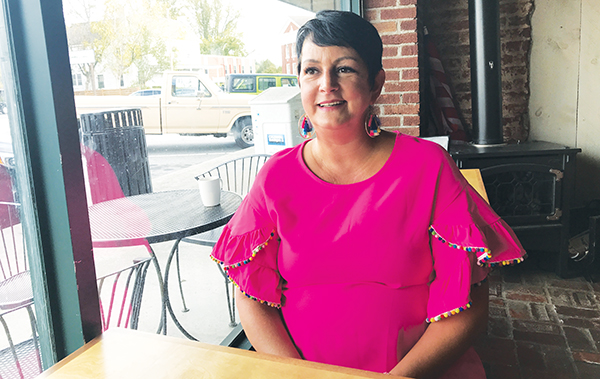
Murphy – Jill Kernea was a little young to be worried about breast cancer.
One in eight women will develop invasive breast cancer in their lifetime, according to breastcancer.org, but around 95 percent of those women are over age 40.
In the early weeks of 2017, the then-39-year-old Peachtree native got bumped by her grandson and felt a little pain. She later felt a lump and immediately went to a doctor to be checked.
Kernea was diagnosed with breast cancer on Jan. 13, 2017.
“It’s a lot of waiting at first,” she said. “They have to do this test to figure this out or figure that out. It was three months of tests, but it felt like years.”
Kernea, who is married to Murphy Electric Power Board President Larry Kernea, has a degree in business from Western Carolina University. She worked 18 years at United Community Bank and today does financial work at Murphy Elementary School.
Surgery and more
The diagnosis started with a ductal carcinoma, for which Kernea was told there would be a lumpectomy and a little radiation and she would be fine.
The lump was under 3 centimeters, which at the time seemed to keep her away from having to undergo chemotherapy. Doctors also determined that there was no seriously family history for her to worry about.
She underwent surgery on March 1, 2017, then went back six days later for a follow-up appointment.
“The doctor said they had good news and bad news,” she said. “The good news was my lymph nodes were clear. The bad news was that there was another kind of cancer they did not know I had.”
She was told she had lobular cancer as well, which “begins in the milk-producing glands (lobules) of the breast … (and) have broken out of the lobule where they began and have the potential to spread to the lymph nodes and other areas of the body,” according to the Mayo Clinic.
Kernea had to have a second surgery the next day. With the total cancer going over the side limit, it was time for 17 rounds of chemotherapy.
“It was hard. I’m not a person who generally goes running to the doctor, so this changed my life,” she said. “They told me there would be all kinds of side effects, like my hair falling out within 12-14 days.”
Kernea’s hair fell out the day before her 40th birthday.
“That was one of the hardest things for me because you kind of lose your identity a little,” she said. “You think you’re prepared for it, but I got out of the shower and took off the towel, and I saw a big bald spot.
“My oncologist was funny. When we came back for the next round of chemo, he said he was worried I was not going to show up. But we did it – 17 rounds, once every 23 days.”
‘A good mindset’
Despite the challenges before her, Kernea did not allow it to get her down.
“When you go through chemo, a lot of times you look sickly when you lose your eyelashes and eyebrows, things like that,” she said. “But the doctors said I never looked sick to them. I made myself get up every day, put on some eyebrows and live my life.
“It’s all about your mindset. If you want to lay down and be sick, you can be sick, or you can try to enjoy life the best you can.”
Many of Kernea’s co-workers and friends were spurred on to get checked in the wake or her diagnosis – and some of them also found they, too, had cancer. This formed a mini support group of sorts for the women as they battled together.
“Everybody was really great. They brought food when I was having bad days, and they planned stuff to get me out of the house,” she said.
Kernea said she would like to see organized groups come to smaller areas like Cherokee County and help women along the entire path, as they have in larger urban areas.
“Near our doctor’s office, they have classes and peer groups and anything like that would be awesome,” she said. “Just to have somebody who has been through it to help you … it’s a scary thing.”
Kernea had scans last week, and everything came up normal.
“It takes a lot of the worry away,” she said. “We have grandbabies now, and some of our kids aren’t married yet. When you go through this, you start wondering a lot of things, like what if you aren’t here for some of this stuff. It makes you want to power through it.
“I fell like I was strong through this because I had a good mindset and a good support system.”
Kernea recommends that women over 40 get a mammogram to catch anything that may be there as soon as possible. Through her tribulations, she still found time to be with her ailing father at the hospital.
“There were just reasons to be strong,” she said. “Sometimes that helps you make it through. You’ve got to have a positive outlook, and family and friends, to keep your mind off it.”