
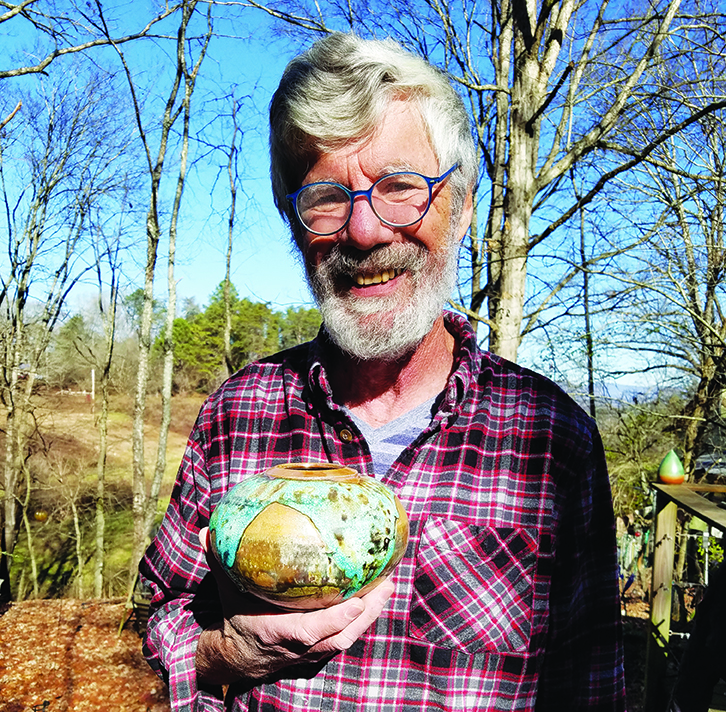
Peachtree - Harry Hearne always joked that he would become a potter.
In 1984, Hearne was gifted a pottery class for Christmas. He started taking the class in February, and when he touched the wheel felt like he returned home.
“In that moment, I knew that was going to be my future,” Hearne said.
After that first class, on the way home he stopped at a local library and checked out every book he could find about throwing pottery. At night, he fell asleep dreaming about it.
“I’ve done some reading on this idea,” Hearne said. “We are predisposed to use our hands, and probably even to be creative in how we use our hands.”
Growing up in Florida
Hearne was born and raised in St. Augustine, Fla. His school dances took place in a dining room, surrounded by Tiffany glass windows, in what later became Flagler College.
“I was like any other high school kid at the time. I thought any place in the world has got to be better than this,” he said.
As he got older, he realized that growing up in St. Augustine was a great opportunity. He could ride his bike to the beach, and there were plenty of work opportunities for young people.
Hearne’s first job was working as a parking attendant at Marineland. It paid minimum wage, and there was a bus that took him back and forth.
Another job he had was working as a driver and guide for Red Train Tours while attending classes at nearby St. Johns River Community College in Palatka, Fla. He would drive on afternoons, weekends and holidays.
He thought the two years of education he got at the college was well worth it – it cost very little money, and some his most creative teachers there. Many of those teachers were recent University of Florida graduates.
Hearne went on to Carson-Newman University, but came home to work at the Castillo de San Marcos fort as a park ranger.
“The really cool part of that summer was it was the summer we went to the moon,” he said.
From the fort, Hearne watched the rocket launch, thinking of pirates firing cannons into the bay and how far we had come as human beings.
Serving the community
At Carson-Newman, he majored in psychology and minored in Bible studies. Hearne said he didn’t know what he wanted to do in his life. When people starting asking him what he wanted to major in, he thought about what he wanted to do and decided to become a Baptist minister.
“I was born and raised as a Southern Baptist,” he said.
Hearne choose to major in psychology because his advisor, a retired U.S. Air Force chaplain, informed him he would get plenty of religion studies in seminary school, and it would be better to take a broader approach.
“I thought that was great advice,” he said. “The more education you have, the more well-rounded you are.”
In 1969, he entered seminary school at New Orleans Baptist Seminary, focusing his studies on social work and counseling.
He spent a few years in Valdosta, Ga., working as the director of youth and education at Lee Street Baptist Church before being hired by the D.C. Baptist Convention as their director of social services in 1973, just months before President Richard Nixon resigned. His job involved helping churches find ways to get involved in their communities and discover people’s needs.
A couple of years later Vietnam fell, and they had heard there would be refugee camps in the United States. One of the members of his church was a senator, and he arranged a conference with church leaders and people from the government, including a gentleman from the state department with very clear information about what was going to happen.
After that meeting, he was involved in creating the Baptist Committee of Metropolitan Washington for Refugee Relief, serving as co-chairman with Allen Oliver, pastor of a church in Adelphi, Md. They wanted to be prepared to minister to the Vietnam refugees coming to the District of Columbia.
The individual from the state department contacted the group, and asked for help opening the first refugee camp in Pendleton, Calif, in 1975. Hearne was part of the team that went to California and met with the director of the camp.
At dinner, they wrote out on a napkin their ideas for programs at the camp. They thought of what information would be helpful for refugees before being released to their sponsors and settling, and came up with Americanization classes – classes about geography, grocery stores and insurance.
One refugee told Hearne that Americans must be afraid of life because they buy so much insurance. The same program was set up at the other three refugee camps.
Becoming a creator
After Hearne resigned from his job with the convention, he became a pastor at a few churches in the D.C. area. He was working as a pastor when his fate turned during that pottery class.
“I believe within us is this innate need to be use our hands, some predisposed to certain types of materials,” he said. “I have this idea within all of us there is a possibility of using our hands to create.”
Hearne added that man was made in the image of the Creator, making man a creative being. While he found clay as his material for creativity, others may be more suited to wood.
Working with clay started as a hobby, and he was taking classes once a week. However, he didn’t like the glazes available in class.
Hearne was inspired to make raku pottery, a Japanese form in which the pottery is taken out of the film while it’s red hot, then placed in a can with a lid over it, causing oxygen to be pulled from clay to change the pot’s color. He built his own raku kiln at home and would take pieces from class to fire in it.
At the same time, he saw that the Baptist church, especially Southern Baptists, were becoming more exclusive at the same time he was becoming more inclusive.
“We were going in different directions,” Hearne said.
Making a business
He thinks there are a lot of people who are better artists or potters than he is, but he decided early on to learn how to make a business out of his art.
Hearne went to Murfreesboro, Tenn., to intern with a potter for two years. There were four potters in the area, and he visited each of them often to learn how they ran their businesses.
“I learned a lot about making pots and the business,” he said.
Hearne said he learned to be creative with how he runs his business. After completing his internship in 1990, he opened Turning Point Clay Studio in Murfreesboro, Tenn., and starting making and selling pots.
He started teaching clay shortly after starting his internship in Murfreesboro. He saw the potter he was working with had several wheels available, then started his classes back up for him.
Hearne eventually began teaching at the Governor’s School for the Arts in Tennessee, then at John C. Campbell Folk School in Brasstown.
“I’ve been a teacher forever,” he said. “I like the idea of sharing what I know, and encouraging other people who want to do what I do.”
Hearne first met his wife, Julie, while teaching in Murfreesboro. She was taking classes with the potter he was interning with, and a mutual friend said they should meet. Julie soon started taking classes with him.
“As they say, the rest is history,” he said.
Hearne moved to Brasstown in 2007, renting a red barn on Settawig Road before finding his permanent home and studio space in Peachtree.
He makes most of his living going to art fairs around the country. Hearne said it is a great way to live; he has the opportunity to be in and experience urban areas, but also gets to come home to peace and quiet.