
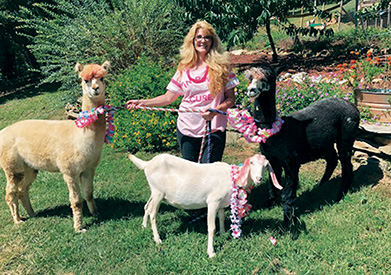
Murphy
Melissa Reschke had a spot on her upper right breast that itched. She was due for a mammogram, and one was ordered.
It came back perfectly normal. A month later, the spot was itching more, and she could feel something there.
Her doctor told her she was overreacting. Reschke is an oncology nurse, and the doctor thought she was projecting feelings. The doctor still let her get an ultrasound, even though he thought it would be a waste of time.
It wasn’t. The ultrasound found a mass the size of a grape, and a biopsy was immediately ordered.
Meanwhile, she and her husband, Matt, had recently visited Cherokee County from Melbourne, Fla., to attend her niece’s wedding. The last time she was here was 20 years prior, when she got her nursing degree from Tri-County Community College.
They fell in love with the area and decided to purchase a second home here. They weren’t really interested in a farm, but ended up deciding to purchase one.
On Jan. 17, 2017, within minutes of each other, they closed on the farm and learned she had cancer. Her husband asked her if she still wanted to go through with buying the farm.
“More than ever,” Reschke replied. “Let’s do something for us.”
She was diagnosed with invasive lobular breast cancer. It is a type of cancer that hides – it is less likely to form a firm or distinct lump, and may not show in mammograms.
Her cancer was at Stage 2, with one lymph node involved, and it was an estrogen positive tumor. Her doctor apologized.
In March 2017, she had a double mastectomy, considering the type of cancer she had. At that point, she had to decide if she wanted reconstruction surgery, and the six-month process of periodically filling expanders to prepare for the surgery began.
Before getting her breast implants, she got her ovaries removed, too, since it was estrogen positive tumor. She was 49 years old when she was diagnosed, and wasn’t having any more kids. After her ovaries were removed, went into menopause – something she wasn’t prepared for.
“My poor husband,” she said.
As she recovered, she and her husband traveled to Murphy to work on the farm. It was a place of solitude, where no one knew them. It was also a place where they could dream about the future.
“It gave me hope,” she said. “It gave me something to look forward to.”
Today, she’s healthy and cancer-free.
“Perfectly healthy,” she added.
She still takes anti-hormone therapy. She is the only person in her family to have had cancer, and testing determined it was not inherited. Testing also determined that her grade of cancer was low-grade and that reoccurrence was low.
She advocates to women to know their bodies and check for any changes. She can’t imagine what her situation would have been like if she didn’t have the knowledge from being an oncology nurse.
The farm – now called Shaka Alpaca Farm – opened to the public a year ago. For October, 20 percent of admission fees will be donated to Susan G. Komen, a nonprofit breast cancer organization. Half the month is already booked with visitors to the area.
“We’re excited about it,” Reschke said.
They are only offering private tours, and keeping groups small. After introducing guests to the Aloha spirit – the Reschkes got married in Hawaii, where he was stationed in the Air Force for eight years – they take guests around the farm. Guests may collect chicken eggs, milk goats, feed alpacas, and feed and hold bunnies. While meeting the various animals, the Reschkes educate guests about each animal.
The tour ends at the farm store, where Reschke sells her alpaca products, honey from the property and beeswax candles. For details, visit shakaalpaca.com.