
More than one hundred of the growing number of comets discovered in our solar system are classified as “Near Earth Comets,” meaning their orbits bring them close to our planet as they hurtle through space on thousand-year orbits around the sun.
Most of these large bodies of ice, rock and dust – often referred to as the “dirty snowballs” of space because of their composition – reach our planet unnoticed by the everyday earthing. However, once every couple of years conditions are met that allow a comet to become visible to the naked eye on Earth.
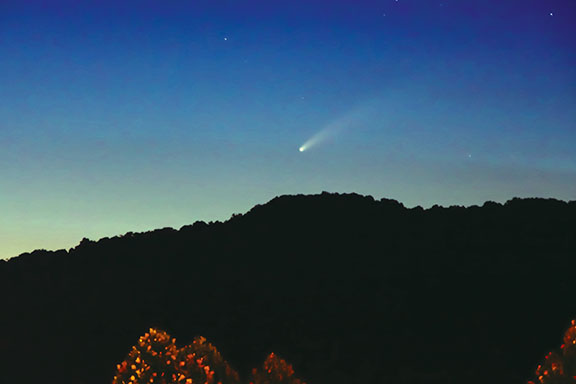
The most recent of these is the Comet NEOWISE, which is delighting professional astronomers and amateur stargazers alike – and could potentially end up ranking as one of the brightest comets to pass Earth in more than a decade.
Professor Steve Morgan, who serves as the planetarium director and an astronomy instructor at Young Harris (Ga.) College, said Comet NEOWISE is the first one in some time that has reached this level of brightness. It has been a joy to observe.
“It’s been great because it’s been quite a while since we’ve had a good comet that got bright enough that it could be seen with the unaided eye,” said Morgan, who has been an avid lover of astronomy his entire life. “NEOWISE is nice because it has a long tail that looks nice in binoculars and also shows up great in photographs. So NEOWISE has been a very photogenic comet, especially over the past week or so.
“A lot of the comets that pass by are just not visible to the unaided eye, so you’d have to have a telescope or strong binoculars to be able to see it at all,. So it’s a bit unusual but very nice when one gets bright enough, like NEOWISE, that you can spot it visually without using any optical aid.”
The majority of the comets that pass by Earth do not meet the conditions needed to produce a bright display leading to the comets going undetected and unnoticed by amateur stargazers. Factors such as the comet’s distance from earth, distance from the sun, the angle on which it passes the planet and the size of the comet, along with the unpredictable elemental composition of the body, must align to create a perfect storm that leads to a brighter display.
“All of those things come into play,” Morgan said of the conditions needed for a comet to become as bright as NEOWISE. “You need a comet that comes in on an orbit that places it not too far from Earth for easy viewing. The closer the comet comes into the sun, the more heating it gets from the sun, which is what drives the activity that releases the dust and gases that produce the tail.”
NEOWISE, which was discovered by NASA on March 27, became visible on July 3 and is expected to be visible into August as it hurtles away from Earth on its journey back into the far reaches of our solar system.
As NEOWISE grows farther away, the brightness of the comet will begin fading as the comet starts to cool and the processes that brighten its body and tail slow and cease. That means time is of the essence if you want to catch a once-in-a-lifetime glimpse of NEOWISE in all of its glory before it fades for another 6,800 years.
“It has been getting faint, and it will continue to grow fainter each night as it moves farther from the sun,” Morgan said. “But the tail has been getting even better because the comet itself, although it’s moving farther from the sun, it’s getting a bit closer to earth this week.”
Viewing tips
If you’d like to attempt to catch a glimpse of Comet NEOWISE before it leaves Earth’s view, here are a few tips from professor Steve Morgan of Young Harris (Ga.) College that may make your viewing experience better.
- Look for the Big Dipper: “One thing that helps is that it’s near a very famous group of stars, which is the Big Dipper,” Morgan said. “The best time to see it is after sunset and you want to look toward the northwest, and the comet right now is below the bowl of the Big Dipper.”
- Bring your binoculars: “With your unaided eye, it is going to be quite faint,” Morgan said. “People should be prepared for something faint, but binoculars do help a lot. You don’t need to have a telescope, which almost gets you in too close.”
- Avoid the light: “Get away from any bright lights, like if you have bright lights on your home that you can turn off,” Morgan said. “Remember that it takes your eyes a few minutes to adjust to the dark if you’ve been inside looking at the TV or your cellphone screen. Once you go outside in a dark location, give it a few minutes for your eyes to adjust to the darkness, then your eyes will better be able to pick up the comet.”