
Murphy Local leaders say a handful of non-native plants scatter seeds that cause overgrowth and strangles native plants, overtaking landscapes.
Privet, kudzu and multi-flora rose are among these natural-growing, non-native plants introduced to Cherokee County several years ago.
The invasive plants must be cut down or pulled up before seeds produce. In fact, the Murphy River Walk must be thinned out at least twice per year because of its shrub-like growth.
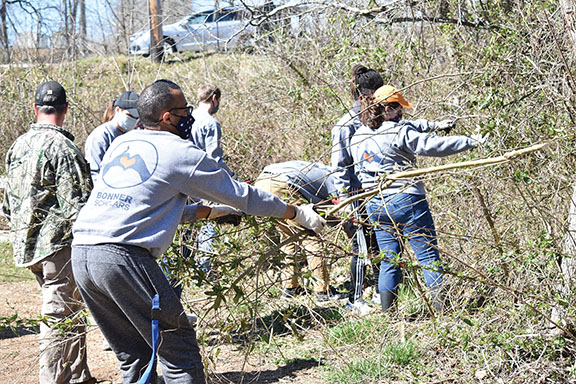
The newest section of the River Walk recently got a spruce as volunteers from Murphy High School and Carson-Newman University worked together to clear invasive plant species from the site.
Every year, students usually take alternative spring breaks to help beautify an area but last year the efforts were ceased due to COVID-19. Tony Ward, western region program coordinator for Mountain True, said several schools have sent groups over the years through a program called “Break Away” on alternativebreaks.org.
Mountain True has environmental listings on the website for volunteer opportunities at different sites on the watershed, which covers Cherokee and Clay counties in North Carolina as well as Towns and Union counties in Georgia. Mountain True merged with the Hiwassee River Watershed Coalition in 2019.
Murphy High seniors Chloe Decker and Kaiya Pickens joined the group of 11 students from Carson-Newman in Jefferson City, Tenn., as an opportunity to volunteer in their community and a learning experience.
“I want to go into ecological restoration, and I asked one of my Tri-County Community College professors about volunteer work, and he suggested Mountain True,” Pickens said. “We were given a tour of the area and shown the non-native plant species.”
Volunteers cleared the trail of Chinese privet, Japanese honeysuckle and other invasive plants that can grow large and thick on the trail. Volunteers were provided with gloves and tools then set to work on the trail.
Alexander Nichols, Bonner Scholars coordinator at Carson-Newman, said the scholars participating at the River Walk are freshmen who plan a cornerstone service trip over spring break. Nichols, who previously volunteered in the area with Davidson College in Charlotte, said he enjoyed the area for its natural beauty.
“I really enjoy the outdoor and physical nature where you can see an impact while you work,” Nichols said before starting work. “Also with COVID-19, we wanted to work outside in an open area.”
Jim Sullivan, project manager for the River Walk, believes the invasive plants are more negative than positive to the area, with the only positive being that the nectar/pollen and seeds offer food for the birds, bees and other wildlife in the area. The invasive plants can also act as erosion control on the riverbanks, but with its tendency to multiply, the plants become more of a nuisance than a productive benefit to the River Walk.
Sullivan said he is appreciative of the volunteers’ work.
“These young people are taking time out of their spring breaks to help our small town,” he said. “It’s commendable.”
The Murphy River Walk began as a concept in 2002, according to the town’s website. It follows the Hiwassee and Valley rivers with a 4-mile trail between Konehete Park and the L&N Depot. The River Walk is a volunteer project sponsored by Heritage Partners and managed by volunteers.