
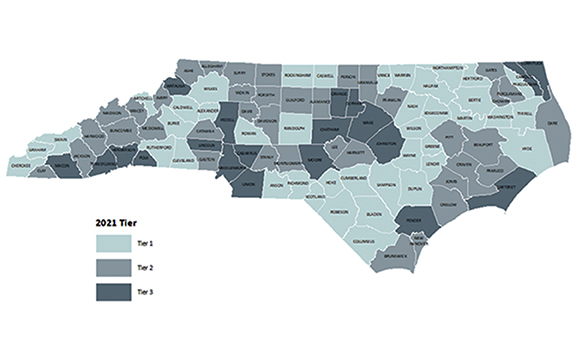
Cherokee County is among 11 counties throughout North Carolina that moved to a more distressed tier classification at the start of the new year.
Tier designations, which are mandated by state law, help determine a variety of state funding opportunities in economic development. The rankings are based on an evaluation of each county’s unemployment rate, median household income, population growth and assessed property value per capita.
Each county is ranked from 1 to 100 on each of the four variables. After calculating the sum, counties are then ranked from most distressed to least distressed in order to determine their economic distress ranking.
State law calls for 40 counties to be designated as Tier 1, 40 counties to be designated as Tier 2 and 20 counties to be designated Tier 3.
For 2021, Cherokee County dropped from Tier 2 to Tier 1, largely because of a change in the county’s population growth rank, which shifted from No. 87 last year to No. 67 this year, according to state officials.
This year, the county’s economic distress rank is No. 40; it was No. 49 in 2020.
“It doesn’t necessarily mean we lost population; it just means that other counties’ populations grew more than ours,’’ county Economic Development Director Paul Worley said. “We didn’t have a percentage growth in population because we don’t have enough housing.”
Although the rankings suggest Cherokee is more distressed than 60 other counties throughout the state, officials view the Tier 1 ranking in a positive light. “The upside is Tier 1 counties are required to provide less of a match on certain grants,” County Manager Randy Wiggins said.
More distressed counties also receive special consideration during implementation of various state economic development programs.
“This could also set us up for funding opportunities that may come down the line at a later date,” Worley said. “The state will make sure a lot of future COVID relief money goes to the more distressed counties.”
County leaders emphasize that the local economy was not devastated last year, pointing to the increase in sales tax and occupancy tax revenue during the final quarter of the fiscal year despite the pandemic. Officials say if the county’s economy was completely dependent on tourism, the pandemic would have had a much greater financial impact.
“We’re economically diversified,” Worley said, adding that COVID-19 affected the county’s industries in waves, which allowed other sectors to carry the economic burden until the situation rebounded. “It is by design that all of these things have happened over the years.
“We’ve really focused on having diversification. You’ll get some folks who’ll say we need to focus all our efforts on tourism, but had we done that, we would’ve really struggled. I love the tourism business, but the reason Erlanger Western Carolina Hospital is here is because there are companies that pay health care for employees.”
Tier rankings are re-evaluated every year. Local officials say the county must take advantage of its position on the list.
“It’s not a negative thing,” Worley said. “This really helps us out. We need to take advantage of it this year.”