
Andrews – Two citizens have publicly opposed the appointment of school employees to the Andrews ABC Board.
Toni Martin and Jenny Pike both argue that appointing school employees to the ABC board is a conflict of interest because the store distributes a percentage of net profits to the town and Cherokee County.
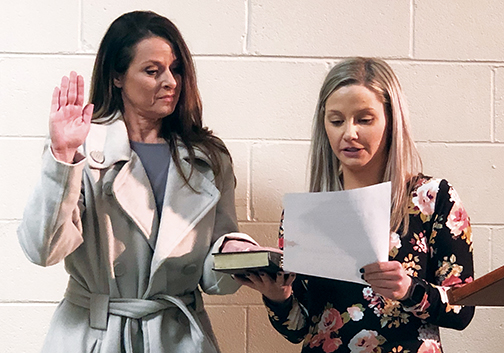
Town aldermen appointed Lance Bristol, Julie Higdon and Jenni Irwin – each of whom are employed by Cherokee County Schools – to the ABC board on Feb. 5. Mayor James Reid, who suggested Bristol as an appointee, also works for the school system.
“I believe that Bennie Jo [McKinnon], Paula [Parker] and Holly [Christy] were doing a great job. I am sorry to them for the upheaval yet again,” Martin wrote in a letter read at Thursday’s ABC board meeting. “Who benefits from the change?”
The three new members joined McKinnon and Parker after Christy was hired as the town’s attorney and resigned from the ABC board. State officials confirmed there is nothing wrong with having school employees make decisions on how to run the liquor store.
“No, that would not be considered a conflict of interest,” said Laurie Lee, director of the ABC Board Audits & Pricing Division at the N.C. ABC Commission.
Regarding who benefits from the change, “the school system and the police department,” Reid said. “Everything has spun out of control over the last few years, and we put this new board in place to keep the spending from going up.”
Reid and town aldermen have been vocal about changes they’d like to see on the ABC board and in the store since last spring. The aldermen appointed a new five-member ABC board in May because a three-person board did not allow two of them to communicate without creating a quorum, plus it created situations where two members could “gang up” on the other board member.
Since then, five people have resigned from the ABC board, leaving Parker as the only original member of the new configuration. Officials told the Cherokee Scout they want people on the ABC board who will keep the town and county in mind when making financial
decisions.
“When you have your manager and your finance officer making more than 90 percent of our police force, I see a problem with that,” Reid said. “I realize there’s a nationwide push for a minimum-wage increase, but we have to keep it within reason so the town still gets its fair share. I don’t have a problem with any one person; I have a problem with the overall dynamic of how it’s been run over the past few years.”
Alderman Jonathan Ellison, who manages the Dollar General store in town, said the ABC store manager’s pay rate of $18 per hour and the clerks’ starting pay rate of $12 per hour is not commensurate with the skill-set it requires to run the overall operation.
“The pay should match the skill-set, and that’s for any position,” Ellison said. “I’m not picking on a particular person, but I guess you could say I’m picking on the position in general. It’s not back-breaking work. If it’s going to take a minimal skill-set, the pay should be comparable.”
The ABC board promoted James Ringenberg to store manager at the aforementioned pay rate in October. While the board believes Ringenberg has enough experience to operate a retail establishment, they modified their policy and procedure manual to bypass the associate’s degree requirement before hiring him as manager.
At that same meeting, the board set the starting pay for store clerks at $12 per hour, which is $2 less than what it used to be prior to the vote. One member wanted starting pay to be $10 per hour.
The board later increased the pay rate of one full-time employee and the finance officer by $2 per hour, pushing an eight-year clerk’s salary to $16 per hour and the finance officer’s pay rate to $21 per hour.
Ellison said he doesn’t understand why the store must have a finance officer separate from the store manager. State statute includes a provision for allowing a store’s general manager to handle bookkeeping duties and store operations as to having a separate finance officer, which is typically used when an ABC board operates more than one location.
“It’s silly that we have someone who does just the bookkeeping,” Ellison said. “The manager should do it because that’s part of managing the business.”
In addition, Reid took issue with the lack of bids received before making a decision to upgrade the store’s point-of-sale system in December.
“It just makes sense that when dealing with the public’s money, you need to go out for more bids to get the most bang for their buck,” Reid said. “Our board feels like we’ve been shortchanged over the last few years.”
Per state law, the Andrews ABC Store must distribute 70 percent of net profits to the town’s general fund and 30 percent to Cherokee County’s general fund, of which no less than 15 percent should be used for public education in the county. However, that mandate does not take effect until the board has set aside the maximum amount of working capital allowed to operate the store, which is based on sales.
Although the ABC board voted to distribute a total of $21,428.50 to the community out of profits from the 2019-20 fiscal year, store staff have publicly said they weren’t mandated to do so because the store hadn’t reached the maximum amount of working capital allowed to operate. Those statements have led some officials to believe the town and county are not on anyone’s mind when making financial decisions.
“In a sense, you can say we’re trying to help the board make better decisions,” Alderman Scott Stalcup said. “We have no control over the ABC board. If they vote to pay staff $25 per hour, that’s their decision.
“That’s why, sometimes, you have to put different people on the board to make other suggestions.”
Citizens oppose school staff on ABC board
Body