
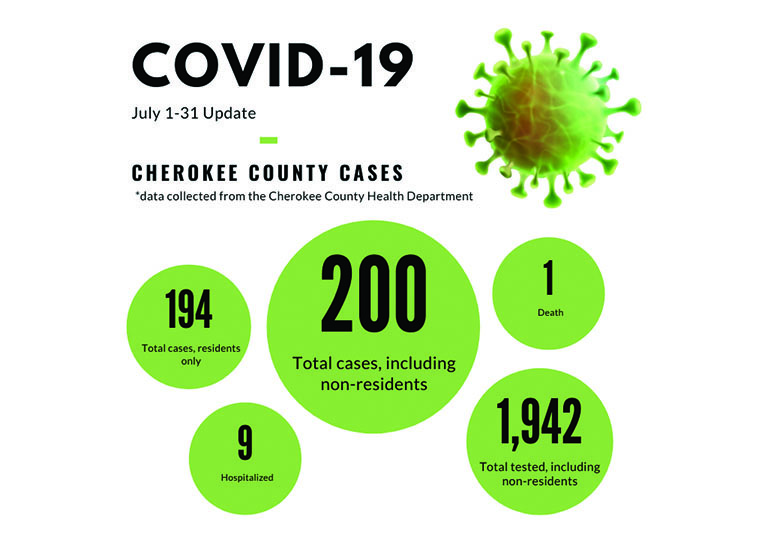
Murphy – July was, by far, Cherokee County’s worst month for COVID-19 so far. In 31 days, the county had exactly 200 cases, four times the amount of cases seen in the first four months of the pandemic.
Health Director David Badger said the increase was the result of a combination of several factors – people wanting to get out and do normal things, traveling and people going to work. While reports indicate whether a person was a contact of a previously reported case or if it was work-related, it’s not always simple to find out how the virus was actually transmitted.
“Maybe a co-worker went to Myrtle Beach and brought it back to them,” Badger said.
According to Cherokee County Health Department reports, 48 percent of July’s cases were listed as contacts of a local case, and another three percent were listed as contacts of cases from other counties or states. Badger said some of the other cases listed as work-related or travel-related were also found through contact tracing.
He said it’s a positive that a majority of the cases this month were found through contact tracing, saying it’s exactly what they want to see to suppress spread of the virus. Some people who had the virus last month attended weddings, not necessarily ones in the county.
“It’s really anywhere people are getting together and gathering,” Badger said.
This is why he said it is still very important to mitigate the spread of the virus by wearing a face covering,
washing hands and keeping distance from others. There were only two days in the entire month in which no new COVID-19 cases were reported – July 2 and July 3.
Health department staff have been working seven days a week, while keeping themselves safe and healthy. Badger said his staff has been strict with their use of personal protection equipment, and they have not had anyone on staff test positive.
“They are doing a really great job,” he said. “We have been very fortunate.”
Badger’s staff tests patients outside to help lower the risk. Each specimen tested by labs is linked to paperwork.
In July, 1,942 people were tested for the virus, and labs returned 2,072 test results. A total 4,311 people were tested in the county from the beginning of March through the end of July.
Of the 152 positive cases for which the information was clearly available last month, 138 people were experiencing symptoms and nine had to be hospitalized. One person died after testing positive last month.
Badger said the numbers for the last month can be a good reminder that the virus is in our community. He hopes it can have a positive impact by lessening the negative impact.
“The more seriously we take it and less cavalier we are about it, it’s going to be better for all of us,” he said. “My staff will appreciate it.”
As of Monday afternoon, the county had 27 active cases. Since March, the county has had 265 total cases, including 13 people from other states who tested positive while in the county, and three people who passed away after testing positive.
Using data collected from 239 cases, the state reported Monday that 10 percent of the county’s cases were ages 0-17, 7 percent were ages 18-24, 28 percent were ages 25-49, 31 percent were ages 50-64, 14 percent were ages 65-74 and 10 percent were ages 75 or older.
Anyone who experiences symptoms should contact their primary care provider, the health department or urgent care. According to the U.S. Centers for Disease Control & Prevention, symptoms include fever, cough, shortness of breath or difficulty breathing, chills, muscle aches, headache, sore throat, congestion or runny nose, fatigue, nausea or vomiting, diarrhea, and new loss of taste or smell.
As of Monday, North Carolina had 126,532 confirmed positive cases of COVID-19 and 1,982 deaths related to the virus since March. More than 105,000 of those cases are presumed to be recovered. More than 1.8 million North Carolinians have been tested for the virus, and in the last week 7-8 percent of the tests returned positive.