
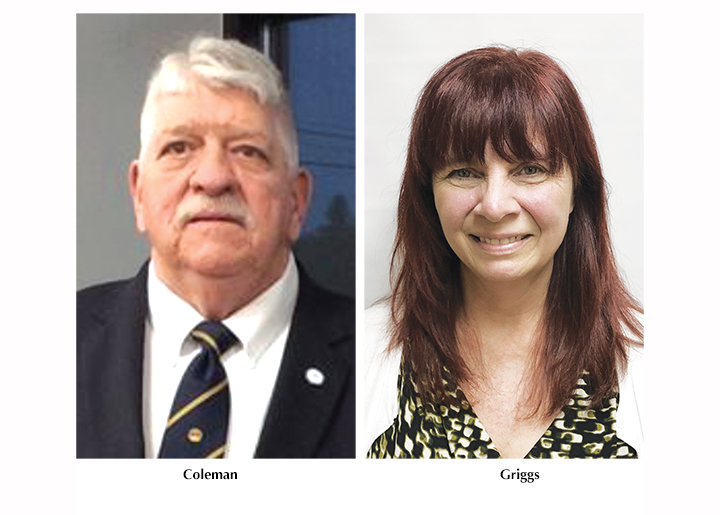
The Cherokee Scout is interviewing all candidates in this year’s local elections, which start with the primary Tuesday, March 3. Up this week is the Republican Party primary for the District 5 seat on the Cherokee County Board of Commissioners, placed in alphabetical order.
While commissioners must live in one of five districts, they are voted on countywide. District 5 is the far-western portion of Cherokee County. The winner of this primary will face Democratic Party candidate Victoria Bauman in the general election Tuesday, Nov. 3, for a four-year term.
Commissioner Roy Dickey, who represents District 5, is not seeking re-election.
Steve ‘Cold Cash’ Coleman
Steve “Cold Cash” Coleman was born and raised in Cherokee County. He has served the community in various capacities over the years and, if elected, he vows to be more accessible than commissioners who served before him.
“I hate to say it, but some of these politicians want to be elected to an office just to say they’ve held an office. And when they get there, they don’t want to do anything,” he said. “If I get elected, I want to do something productive. I’ll be available to anyone who wants to call. If I can possibly help them, I will.”
While crime, drugs and lack of housing are among the top issues the county must work to address, Coleman said sensible economic development should remain a top priority. In addition to reactivating the railroad line, the county should further research the feasibility of having commuter flights to and from the Western Carolina Regional Airport in Andrews.
Coleman believes business executives in the tri-state area would take advantage of such flights, and an accompanying shuttle service would compensate for the lack of ground transportation options in and out of the county.
“[Lack of] infrastructure is a killer in western North Carolina,” he said. “You have no easy way to get in and no easy way to get out. If we could get Corridor K completed, that would be a tremendous help.
“The reason Cherokee County has not grown for years, even with industry, is because they have no easy access of getting the raw material in and getting the finished product out.”
In regard to education, Coleman feels the school district should offer more vocational and technical training so young people can gain enough work experience to make an informed decision regarding their career goals.
“When I got out of high school, I didn’t know a bit more about what I wanted to do than the man on the moon,” he said.
Coleman also feels the county should invest in detox, rehab and employment programs for residents struggling with drug and alcohol addiction.
“Let’s do something instead of sitting on our hands, arresting them, slapping them in jail and running them through the court system,” he said. “Let’s see if we can come up with some alternatives that could help with this.”
Additionally, Coleman feels the county must continue to invest in emergency personnel.
“As the population expands, we’re going to have to expand emergency services,” he said.
Jan Griggs
Jan Griggs has lived in Cherokee County since the early 2000s after retiring from the U.S. Marine Corps. She has served the community in various roles over the years, and vows to follow three principles if elected as a county commissioner.
“Honor, courage, commitment,” she said. “Honor with integrity, responsibility and accountability. Courage to do the right thing, in the right way, for the right reason. And commitment to the people of Cherokee County.
“That’s what I’m going to run on, and that’s who I have been since I joined the Marine Corps at 18 years old.”
If elected, one of her primary goals will be to convince other local leaders to develop and commit to a plan for the future of the county.
“Our county has no future plan of what we’re going to do,” Griggs said. “There was a study done about seven years ago to develop a five-year plan, but it’s sitting on a shelf and has never been used. What a waste of money.
“If you don’t have a plan for the future, how can you work on today? If there had been a plan in place five years ago, we would probably already have consolidated schools.”
Griggs also believes the county could be more proactive with efforts to improve broadband internet access. She said local leaders should seek volunteers who would be willing to help apply for grants to fund not only broadband expansion, but other county initiatives as well.
“We totally missed the boat on a [broadband] grant last year,” she said. “There’s a lot of people who will volunteer if you ask them.”
Additionally, Griggs feels the county should adjust its pay scale for public employees to retain talent and remain competitive with neighboring counties.
“Our county employees’ pay is not equivalent to their counterparts in surrounding counties,” she said. “We lose deputies every year to Clay and Graham counties because they’re paid higher in those counties, yet those counties are smaller than us.”
Griggs acknowledges that a higher pay scale may require a tax increase, or at the very least an increase in the tax base. If elected, she would work to educate the public on the benefits of raising taxes to improve the county.
“You have to show people exactly where their money is going to go and why they need to raise taxes,” she said. “We wouldn’t have to raise taxes astronomically because we have 28,000 people in this county. We need quality people earning quality pay.
“If we had a pay scale that was commensurate to the duties, we would attract more people and not have as much turnover as we do. If you explain that to people in layman terms, I think they would understand why the taxes may have to go up.”
Griggs feels that education, lack of housing and lack of high-speed internet access are among the top issues the county must address sooner rather than later. She believes the county can make strides to improve those issues within 10 years if local leaders work together.
“You have to stand up for what you believe in, but at the same time you have to be able to bend when you’re not right,” she said. “You have to listen to the people of the community, listen to the input of other commissioners, and listen to the county manager and the finance director.
“If you’re not working together, it’s not working at all.”