
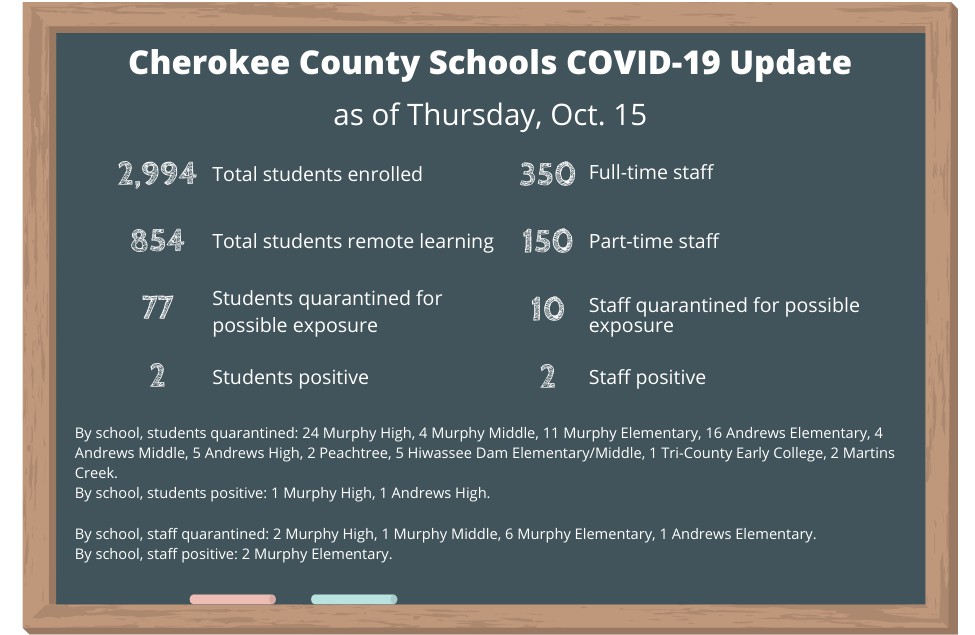
It’s been two months since students returned to school, and so far there’s been no spread of COVID-19 through local campuses.
All cases were traced to activity outside the schools, Cherokee County Schools lead nurse Heather Watson said. The only issue was at Ranger Elementary/Middle School, when a large amount of staff who worked closely together had to be quarantined at the end of August, closing it temporarily.
“I actually think we’re doing better than expected,” Watson said.
Health Director David Badger agreed. He anticipated more cases, but was optimistic based on the plans the schools developed with his department.
“The schools have been doing an amazing job,” he said. “I’ve been really proud.”
In total, Cherokee County Schools has seen 36 students test positive, including a few who are remote learners, since school began on Aug. 17.There have been 13 staff members who have tested positive since school began.
Of the students who have tested positive, Watson knew of only one who had been hospitalized for complications. For the most part, she said the students have been “pretty resilient.”
Since March, Cherokee County has seen 77 kids ages 0-17 test positive for the virus, according to the N.C. Department of Health & Human Services. For school settings, the state tracks clusters, or five or more linked cases. Across the state, 20 schools have had identified clusters, including Robbinsville Elementary School.
Watson has seen – especially at Murphy Elementary School, where she works – that almost everyone has been doing a good job following guidelines, like wearing masks and social distancing. She said the schools were also doing an excellent job of cleaning and maintaining marking reminders for social distancing.
She said they were prepared to have to use the isolation rooms at each school more than they’ve had to. Only 16 students have had to be sent home after screening, and none of those students tested positive for the virus.
Badger said the schools have been doing a good job with symptom screening, noting the process is about protecting others. The schools took a cautious approach to reopening, and he praised the cohort system for minimizing the opportunity for the virus to spread.
To prepare for flu season, Watson said schools have already hosted flu shot clinics.
“We’re strongly encouraging everyone to get a flu shot, just because the symptoms mimic COVID,” she said.
As of Monday, the county had 79 active cases. Since March, the county has had 738 total cases, including 19 people from other states who tested positive while in the county and 19 people who died after testing positive.
Using data from 733 cases, the state reported Monday that 11 percent of the county’s cases were ages 0-17, 8 percent were ages 18-24, 29 percent were ages 25-49, 25 percent were ages 50-64, 15 percent were ages 65-74 and 13 percent were ages 75 or older.
While numbers are looking better in the county, Badger stressed the importance of testing. He thinks the actual presence of the virus is higher than the numbers show.
Badger also knows some people are self-quarantining without getting tested, while others are waiting until their conditions worsen to get tested. While self-quarantining is good and does reduce the spread, contact tracing is an important part of the process to reduce the spread.
He said most testing being performed has been linked to contact tracing. Another popular reason for testing lately has been for travel screening.
Badger said the Cherokee County Health Department has been working with the state on COVID-19 vaccination plans and implementation strategies, adding that it’s a positive that they were planning for the future.
Anyone who experiences symptoms should contact their care provider, the health department or urgent care. COVID-19 symptoms range from mild to severe and may appear 2-14 days after exposure, while flu symptoms appear 1-4 days after exposure.
According to the U.S. Centers for Disease Control & Prevention, both COVID-19 and flu symptoms may include fever, cough, shortness of breath or difficulty breathing, fatigue, sore throat, congestion or runny nose, muscle aches, headache, nausea, vomiting and diarrhea. COVID-19 symptoms may also include a new loss of taste or smell.
Anyone can have mild to severe symptoms, but older adults and those with underlying medical conditions appear to be at higher risk for severe illness. The CDC said the virus spreads easily, and the risk of spreading the virus increases the closer and longer a person’s interaction with another is.
As of Monday, North Carolina had 247,172 confirmed positive cases of COVID-19 and 3,939 deaths related to the virus since the beginning of March. As of Oct. 10, there were only two people who tested positive for the flu and one flu-associated death across the state this season.
Schools managing virus well in county
Body