
Murphy – Principals will see changes in their paychecks this month, and not all for the better.
In the 2017-2018 school year, the state put into effect salary changes for school principals that base pay on the average daily school attendance and the school’s performance on the state report cards over a period of three years. Previously, pay was based on a combination of years of experience and the number of teachers they supervised.
There are three levels for performance – base, which is for those that did not meet growth for two of the three years; met, which is for those that met growth for two of the three years, or had one of each growth level in the three years; and exceeds, which is for those that exceeded growth in two of the three years. Those who have not been principals for three years get the base salary for their school attendance.
Stephanie Hass, chief financial officer for Cherokee County Schools, said this is the first year many local principals are seeing the effects of the changes, as principals are moving on the scale. The salaries change in January for principals to factor in school report card grades, which are finalized in the fall.
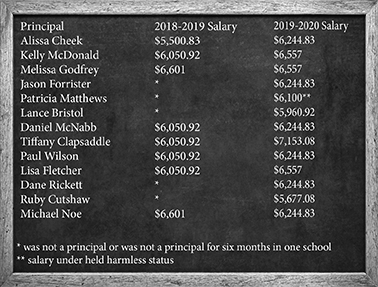
Both Melissa Godfrey, principal of Andrews Elementary School, and Michael Noe, principal of The Oaks Academy, went from being principals of schools that exceeded growth to those that met growth. As a result, Godfrey’s salary went from $6,601 monthly to $6,557, while Noe’s went from $6,601 to $6,244.83 monthly.
Another concern was another level of daily attendance, 200 or less, was added, which could have affected local principals. Fortunately, Hass said the state set salaries for those principals that were still higher than the previous year’s salaries for principals with schools with less than 400 students on average. Six principals dropped to the new level.
Superintendent Jeana Conley said for the state to base a principal’s salary the school’s performance is not fair.
“This is a critical job to so many people,” she said. “The leadership of the principal is critical to school personnel and children. For them to have to worry about their livelihood should not be part of the formula.”
However, Conley was pleased to see some principals benefit from it. For example, Murphy Middle School’s Tiffany Clapsaddle will see $7,153.08 monthly instead of $6,050.92 for being a school that had exceeded growth the past two years.
With the fluctuating salaries for principals, teachers could make more than principals, as their salaries still fall on a scale determined by their experience and certifications. Principals also work and are paid 12 months each year, while teachers work and are paid for 10 months.
Conley said it will be hard to find people who want to put themselves through that.
“It’s going to be more difficult to recruit and retain,” she said. “But at least they’ll really want to be there.”
Patricia Mathews is one principal who was making more as a teacher, and as a result, she falls under a held harmless policy, which allows her to continue to get paid the same amount she did as a teacher. Once her principal salary is higher than her last teacher salary, her held harmless status will expire, and her salary could fluctuate like the others.
While her state-mandated principal salary is $5,677.08, she should get paid $6,100 once her held harmless status for this year is approved.
School performance affects principals’ pay
Body