
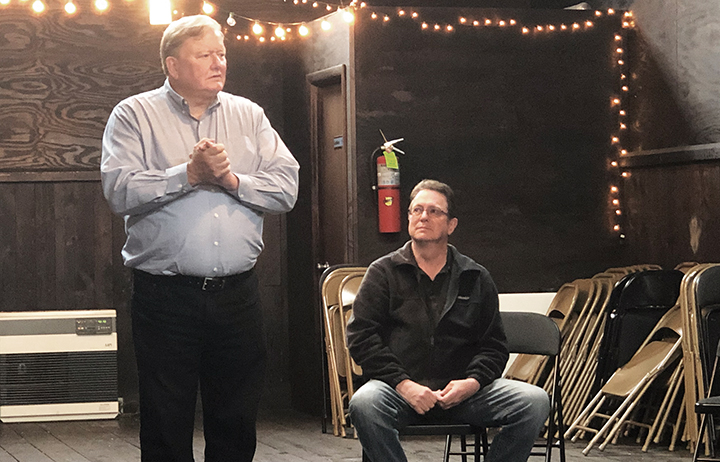
Murphy – State leaders are speaking out in favor of allowing counties to decide how to best move forward amid challenges caused by the COVID-19 pandemic.
“We need to trust the common sense of your community, of your citizens and of your business owners, and push the power away from Raleigh down to the local level,” state Treasurer Dale Folwell said last week in an interview with the Cherokee Scout. “We’re all working together, but we may be in different boats. What’s affecting Murphy may not be affecting Manteo.”
Now that North Carolina has “flattened the curve” so fewer people are contracting the coronavirus at the same time, which was the primary stated goal of Gov. Roy Cooper’s Stay-at-Home Order, the state’s economy has begun a phased reopening. However, the governor’s plan is designed to address the state as a whole, rather than the unique situations faced by each individual county.
The governor’s broad approach to reopening may be the reason for what some leaders have described as an unnecessarily slow process. In contrast, the N.C. Chamber produced a more accelerated plan that would allow for all businesses except bars to reopen immediately, as long as the U.S. Centers for Disease Control & Prevention’s recommended guidelines for sanitization, social distancing and personal protective equipment are followed.
The chamber’s plan acknowledges that an increase in COVID-19 cases is likely and expected as testing increases. However, the number of cases leading to hospitalization, rather than increased cases, is a better metric in both determining impact on hospital capacity as well as detecting potential geographic hotspots.
In addition, the chamber’s plan points out that bordering states are reopening their economies with more expedient phasing and greater regional flexibility than North Carolina. This places North Carolina at an economic disadvantage due to the ability for residents to cross state lines to spend money. It also makes little sense for businesses to remain closed due to the threat of further spread since local residents could contract the virus while traveling across the border.
“If people are leaving Murphy and going down to Blue Ridge (Georgia) to get their hair cut and eat out, it’s not accomplishing what we want,” state Rep. Kevin Corbin (R-Franklin) said during a civic leadership meeting in town on May 13. “They may get the bug there and bring it back.”
State and local leaders say the longer the economy is hampered due to shutdown orders, the greater the impact will be on citizens’ quality of life. Hospitals around the nation have already begun laying off health-care workers due to a loss of revenue from canceling elective surgeries and non-emergent visits to divert resources toward care for those with COVID-19. State, county and municipal governments also expect revenue shortfalls to impact just about every other area of life.
Cherokee County officials are examining areas where they can reduce expenditure in the 2020-21 fiscal year budget, which must be finalized by July 1. Meanwhile, the Town of Murphy has already felt an impact from a loss in water and sewer revenue, which will likely burden much-needed infrastructure upgrades.
The Town of Andrews, whose finances have been monitored by the state’s Local Government Commission since 2017, expects a decrease in revenue for this fiscal year and possibly the next. The revenue loss will likely prevent Andrews from hiring another police officer in the near future, which law enforcement officials say is much needed.
“This is going to impact all the core functions of government,” Folwell said. “Education, public safety, roads, etc., are all going to be impacted by this.”
On the bright side, Cherokee County’s unreserved fund balance is 40.78 percent of annual expenditures. Meanwhile, Murphy’s unreserved fund balance is 157.28 percent of annual expenses, which means the town may have enough money to weather the storm, depending on the loss of revenue due to COVID-19. The state recommends that local governments maintain a minimum unreserved fund balance of 8 percent.
“Even though the Town of Murphy could not have predicted COVID-19, they have shown an incredible ability to watch the pennies and paperclips, which is exactly what it’s going to take to get out of this crisis,” Folwell said. “I applaud them.”
Although the county and Murphy have healthy unreserved fund balances to manage the foreseeable future, lawmakers cannot predict how much of that reserve will be depleted since the full economic fallout associated with the virus has not come to light. A nationwide poll conducted in March estimated that nearly 7.5 million businesses were in danger of closing permanently by the end of September.
In addition, more than 36 million Americans have filed for unemployment due to the coronavirus crisis, marking the biggest spike in unemployment in U.S. history. Since March, more than 1 million North Carolinians – or more than 20 percent of the state’s workforce – have filed for unemployment relief. Experts say the problem could worsen over the next four months.
“This is my fear: we’re destroying the joy of achievement and upward mobility,” Folwell said. “The reason most of these small businesses are in business is for the joy of achievement, and to give the business owners and employees upward mobility in their life. That’s being destroyed.
“When that happens, it starts to break the spirit. And that’s very hard to recover from.”
Although several state leaders have expressed concern about the future of North Carolina’s economy and citizens’ quality of life, it’s unclear whether Cooper is open to their suggestions. Folwell said the governor has not convened the Council of State to discuss the reopening plan developed by the chamber, nor the phased reopening plan put in place.
The Council of State is composed of the governor, lieutenant governor, secretary of state, state auditor, treasurer, superintendent of public instruction, attorney general and commissioners of agriculture, labor and insurance.
“The Council of State has never been debriefed about COVID-19,” Folwell said. “If we want to learn something about the policies of N.C., we have to watch a press conference, which is completely scripted and read off a teleprompter. We’ve been asking for him to [convene the Council of State] and talk about it. Conversations are not even scheduled.”
When asked whether Cooper expressed an openness to the idea of allowing local governments to control policies related to relaunching their respective economies, Corbin replied, “I think he’s listening to it. I think he feels like it’s better to be consistent across the state and not let districts or counties make the decision.”
However, Folwell and other state leaders believe local municipalities have the knowledge and expertise to make their own decisions about how to protect its citizens’ health and livelihood.
“I’m very convinced that people are highly informed about things they need to do to keep this medical virus from spreading. Cherokee County, Murphy and surrounding areas are rich in common sense,” Folwell said. “I’m trying to get people to think about how connected we are while also acknowledging the fact that we’re in different boats. Anytime this country faces a crisis, it seems like the lower income and fixed income people get hurt the worst.”
Corbin echoed those sentiments.
“We need to move as quickly as we can to get back open,” he said. “The consumer will ultimately make that decision because you can’t mandate that people go out and spend money. As long as they’re staying at home either because they have to or they want to, [the more] it’s going to hurt.”
Leaders disagree on state reopening plan
Body