
Picture this: You’re walking in the mountains on a nice weekend hike, you come around the corner and there’s a dark-looking stick in the middle of the path in your way.
You continue moving forward on the trail, but then the stick starts moving – and you realize that it isn’t a fallen branch impeding your progress, but a snake. What do you do?
The answer is much easier than you’d expect – do absolutely nothing.
“Whatever you do, don’t try to kill a snake. The majority of bites occur when people try to kill a snake or pick it up,” said Jeff Hall, a wildlife diversity biologist with the N.C. Wildlife Commission. “While it can be startling to encounter a snake in your backyard (or on the trail), it’s important to remember that most of the snakes people see in their yards are harmless and non-venomous.”
There are more than 38 snake species native to North Carolina, with only six of them being venomous and only one – the copperhead – being found statewide. Hall said the copperhead’s widespread range of habitats leads to many people calling for assistance who think, often mistakenly, that they have one slithering through their yard.
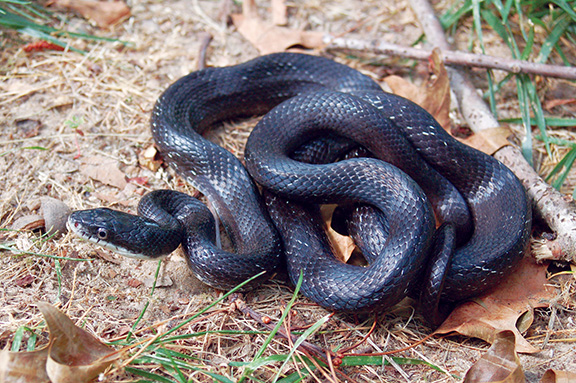
“While it’s not uncommon for people to have a copperhead in their yard, usually what they have is a non-venomous and harmless species, such as a rat snake or a garter snake, both of which are commonly found in backyard habitats,” Hall said. “Unfortunately, many non-venomous snakes, like the corn snake, are mistaken for copperheads and killed.”
Killing a snake on the trail or in your back yard could also be illegal, with North Carolina having a handful of snakes being listed as endangered species. Regardless if the snake is venomous or non-venomous, snakes pose little threat to those who come across them, as long as they are left alone.
When confronted, snakes are less likely to bite than flee, but if they feel cornered or are restrained, they will lunge out at the aggressor in an attempt to defend themselves. Hall recommended gently spraying a snake with a garden hose if you want to persuade the reptile to leave your property.
Hall said the most important thing that people can do when it comes to snakes is to educate themselves and others about the reptiles, then learn to appreciate them as an important part of the ecosystem.
“Snakes are strictly carnivorous, preying on smaller animals such as rodents, slugs and insects,” Hall said. “Snakes also serve as an important food source for other animals like foxes, raccoons, eagles, hawks, and owls. Instead of being widely feared and unjustly persecuted, snakes should be appreciated for the awesome creatures they are and treated with respect.”
How to shake a snake at home
Body