
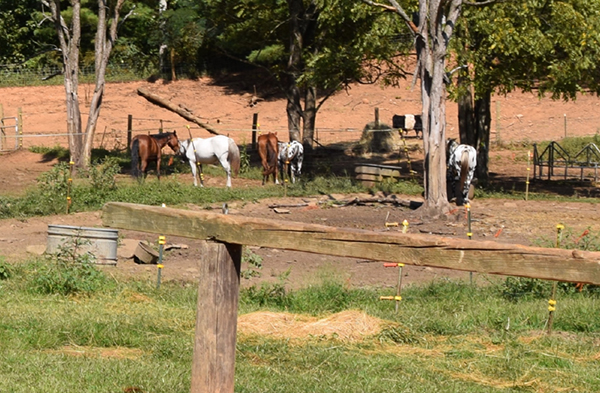
Murphy – After losing her horses nearly a year ago, Janice Dockery is getting them back following a second dismissal of animal cruelty charges against her.
The latest came after a 4 ½ hour hearing Thursday afternoon that included testimony from two Cherokee County sheriff’s deputies, a farrier, a veterinarian and a horse rescuer – all called by the state to make the case that Dockery’s seven horses had been mistreated and neglected over a long period of time.
The seven counts of misdemeanor animal cruelty were being charged for a second time after being dismissed initially because the state’s star witness – Dr. Brittany Beil – was on a preplanned vacation, and the judge would not permit any more continuances.
After being seized on Oct. 22, 2018, Dockery’s horses remained wards of the court through the interim period between the first dismissal and the refiling of the charges, leading to more than $25,000 in bills for Cherokee County for their care. County Manager Randy Wiggins said Monday he does not expect the county to get any of the money reimbursed in light of the dismissal.
Dockery declined to comment after the hearing was concluded, but she wrote a lengthy statement that can be read at cherokeescout.com.
* Read Jan Dockery’s guest column in full online.
“I will soon be able to see my horses again. I pray to God in heaven that we can just be left alone to live in peace,” Dockery said to conclude her letter.
At the Thursday hearing, Judge Roy Wijewickrama heard the state’s elaborate – though repetitive at times – case during the bench trial. He was asked afterward by defense attorney Nathan Earwood to again dismiss the charges.
“There was nothing more here than speculation and conjecture,” Earwood said. “At the end of the day, we’re talking about a dirty horse.”
Assistant district attorney Brian Chapman countered by saying, “You don’t just get a substance caked on that takes two weeks to get off in a day.”
The warrants for these charges – which noted that the horses were covered in mud and feces, something covered extensively throughout the hearing by all the witnesses – noted an offense date range from Feb. 26, 2018, through Oct. 22.
Wijewickrama noted that he heard no testimony of anything that occurred before on or around Oct. 2, with the only mention of that time period being Earwood pointing out that sheriff’ Deputy Michael Faggard had been to Dockery’s home in July and reported the horses were “well-fed and watered.”
The judge dismissed the charges based on the lack of evidence ranging back to the alleged start time of the offenses.
District Attorney Ashley Welch said it was common to have a date range of alleged offenses listed on a warrant, which is usually typed up by a magistrate after meeting with a law enforcement officer or a citizen about the charges. While a lot of man hours went into this case, the dismissal was “completely within the judge’s discretion.”
Deputies Faggard and Montgomery Ward testified that when they were called to the scene on Oct. 2, 2018, the horses were in pens too small for them, and they were covered in mud and feces. Faggard, who later admitted he had little experience with horses, said the animals looked unhealthy.
“You could see ribs,” Faggard said.
The deputies contacted James Amos, a local farrier, who testified that the knee-deep feces on the horses was the first time he had seen such a thing in 25 years working on more than 1,000 animals.
“They weren’t safe, weren’t healthy,” he said. “I recommended a vet because this was above my pay grade.”
Amos testified that he immediately called in Beil to do an examination, which she did on Oct. 13.
Beil provided extensive testimony on her examinations of each horse by name, including ratings on a 1-to-9 scale of their condition. All seven horses were scored a 3 or 4 on the scale, which Earwood got her to admit later was subjective.
Beil’s 90-minute testimony was clear that she believed that the “organic material” caked onto the horses’ coats had happened over a long period of time.
“They slept in it, they rested in it,” she said, referring to the fecal matter.
Under cross examination, Beil said she spent around an hour examining the horses, which Earwood calculated at around 8 minutes per horse. Beil said some of them were not approachable and required a visual exam be done.
Earwood argued that there was a difference between what one person or another might believe is proper care and what rises to a legal standard. He reminded the court that Faggard said he based his standard of charges on the vet’s report, and she recommended they be seized and cared for at local rescue operations. Earwood suggested a potential conflict, seeing as Beil would be paid by Cherokee County to care for them.
Horse rescuer Annette Ensley, who has cared for four of the horses at her facility in Graham County, called the horses “unkempt” when she received them but has nursed them back to full health. She was shown a picture by Earwood of mud on her farm during cross examination, at which time she said “whoever took that picture was trespassing,” and added that her farm is more than adequate for the 32 horses she is caring for.
Wijewickrama said after his ruling that law enforcement would be keeping a close eye on Dockery’s care for the horses in the future.