
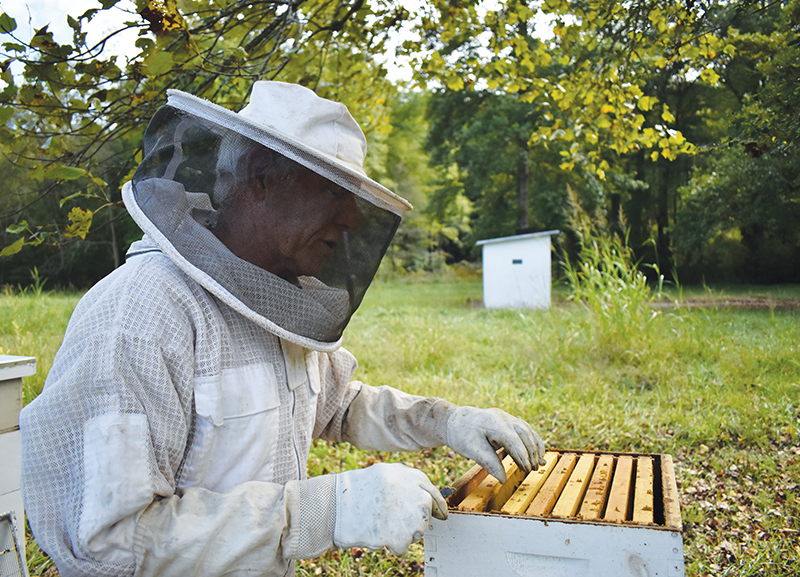
Ranger – After calmly billowing smoke into a chest-high hive in front of him, Don Reynolds reaches down and gently lifts out a wooden frame covered with more than a dozen Italian honey bees.
As he inspects the frame, rotating it in his hands and holding it to the sunlight, an affirming smile is glimpsed through the meshed beekeeping suit protecting him from potential stings.
The colony in this hive, one of the two which he and members of the Appalachian Beekeepers’ Association maintain, has stocked up more honey for the approaching winter than Reynolds expected to find on a warm September Friday, meaning the bees are healthy and thriving.
Reynolds has been president of the Appalachian Beekeepers’ Association for two years. His hive-handling experience of more than 45 years certainly certifies him as a beekeeping veteran.
During those 45 years, which span from his start raising hives in southern Louisiana as a teenager to his time in the U.S. Air Force maintaining hives on assignment in Maine and onto western North Carolina, Reynolds has observed the rise in popularity of beekeeping as a hobby.
“Yeah, I think it is (more popular now). And I think one of the reasons is you see more in the news about the honeybees’ issues and the losses they’ve had,” Reynolds said. “And people know that bees are really good for the economy and good for crops. It’s generated a lot of interest.”
In fact, honeybees and their pollination services are particularly important to North Carolina’s economy.
“About one of every third mouthful of food that you eat is attributed to honeybee pollination,” Reynolds said.
Along with beekeeping’s rise in popularity, he has witnessed the increase of difficulties surrounding the practice.
“Here (in North Carolina) you have issues keeping your bees alive over the winter,” Reynolds added. “There are these ‘bee ticks’ called verola mites and they came into North Carolina in the early ’90s. They’re so devastating to honeybees, and they’re so small that you can’t see them.
‘You have to treat for them because they bring viruses and weaken the hive. Between pesticides, herbicides and the mites, they combine to create issues for colonies.”
Because of these factors that have led the large decreases in honeybee populations nationwide, small independent beekeepers, including hobbyists, have been thrust into an important role in the pollination pipeline.
Large commercial beekeepers have been shipping their colonies throughout the country during growing seasons to supplement the lack of honeybees in certain areas. However, Reynolds said commercial beekeepers are not enough.
“The growers cannot find enough hives to pollinate what they need pollinated,” he said. “It’s all the small keepers, such as the 30 members are our club, and across the country that are actually contributing to the survival of the honeybee.”
The Appalachian Beekeepers’ Association meets at 7 p.m. on the first Monday of each month at Mountain Folk Center off U.S. 64 West in Ranger.
“One thing that I will tell everybody,” Reynolds said. “If you want to get started with bees, find your local club and join it because there’s a lot of experienced beekeepers. Every meeting we have there’s usually someone new here, and try to guide our discussions to those new folks and encourage them to ask questions.”