
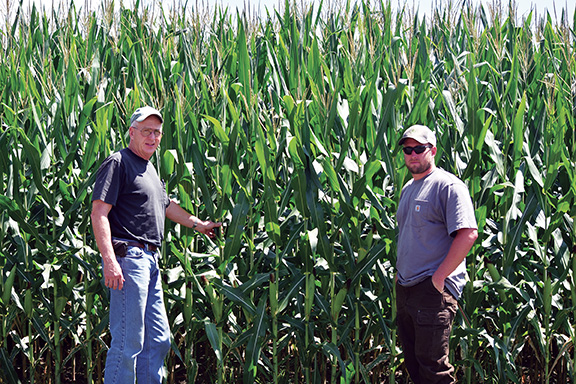
Woods take care of 476 acres
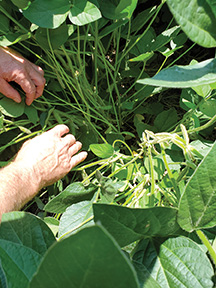
Under the leaves, soybeans can be seen growing at the Wood Farm around Western Carolina Regional Airport.
Andrews - Ed Wood will be the first to admit that farming isn’t for the weak of heart, but he loves it anyway.
“I think God put me on this earth to farm,” he said. “I know it sounds corny – pardon the pun.”
Wood Farm has 275 acres of feed corn, 1 acre of sweet corn and 200 acres of soybeans on land surrounding Western Carolina Regional Airport, on either side of the U.S. 19/74 four-lane highway and in nearby areas. But it didn’t always look this way.
His grandmother was a Walker, one of the families who helped settle the area. His grandfather came to Cherokee County from Lyman, S.C. – near Spartanburg – from 1900-20, and they got married. Some of the land where the farm is today was his grandmother’s property, and his grandfather ended up buying tracts of land to build the farm.
His grandfather, Edgar Wood Sr., had dairy cows and maybe some corn. He built contraptions to help with farming, and even used water from a lake at Healey Fields to generate electricity.
“He had quite an operation,” Wood said.
Building the airpark
After World War II, his grandfather built the airport, which officially opened in 1947. Wood’s father, Edgar Wood Jr., was an aviator who learned to fly in the Army Air Corps and trained pilots during World War II.
There were many guys who continued flying after the war, and there was an idea to have places where pilots could fly in and spend time without needing a car for amenities. The Woods’ version had a pool and tennis court – Edgar Jr. loved playing tennis – and there were plans to add a hotel. He continued to train veterans to fly through Wood Flying Service.
“They called it an airpark,” Wood recalled. “Andrews-Murphy Airpark.”
His grandfather passed away in 1954. His father had to sell off some assets, so he sold off the dairy herd.
He tried to run both the farm and airport for a couple of years, but it got to be too much. Around 1957, his father recruited two respected farmers from Hendersonville – Sam Ward and Joe Maxwell – to take over the agricultural operations.
Four-lane splits farm
The farm’s acreage was split when the U.S. 19/74 bypass was built. His father fought for a different route, and even offered land along Airport Road for the highway, but the offer wasn’t accepted by the N.C. Department of Transportation.
Wood’s brother, Keith, started helping their father with the farm after he graduated from N.C. State University with an agronomy degree in spring 1980. Their father passed away in fall 1983. Wood, who also graduated from N.C. State with an agricultural engineering degree in 1980 but used his expertise as an engineer with Union Carbide, decided to return home in 1984 to take care of the farm with his brother.
“We’ve tried a lot of different things over the years,” Wood said.
In the 1980s, they grew Christmas trees. At one point, they had strawberries and potatoes. More recently, the farm had pumpkins, but after Wood had back surgery a couple of years ago, he decided that wouldn’t be the best crop for his health.
Of course, there has been a lot of rain in the last two years, so there probably wouldn’t have been much of a pumpkin crop, he conceded. The average rainfall in the area for 2000-19 is 62 inches a year, according to a spreadsheet Eric Carlson developed for him. This year, the area has already seen 59 inches, about 20 inches more than the average to date.
His corn does better in dry years. His office walls hold plaques for state championships in corn yield, including ones for 2000, 2008, 2010 and 2012 – all dry years, according to his spreadsheet.
Using technology
Another thing that helps with yield is the type of seeds they use. It’s genetically modified to generate traits that allow the crop to be more efficient and economical. There’s insecticide in the genes, which saves time and money spraying to protect the crop from insects.
“We can farm cheaper and do a better job,” Wood said.
That’s not the only new technology involved with farming. There’s even GPS technology that provides farmers with yield maps.
Wood said he doesn’t want to go back to how farming was in the 1980s. Back then, they had a 300-bushel potential per acre with varieties available. Today, the potential is twice that thanks to better breeding and better technology.
“It’s just fascinating how much farming’s changed,” he said.
Even with the technology, it’s still hard work, Wood added. He has had corn blow down from winds produced by hurricanes in the Gulf of Mexico. There’s no guarantee a farmer will get a dime back from his investment on a crop.
He thinks his grandfather would approve of the technological advances they have made over the years. As for his father, he knows the farm was important to him. After all, he passed it down to his boys.
The tradition continues as Wood’s son, Matthew, works at the farm, while the brothers remain 50/50 partners in the business.
“I’d like to see it continue as a farm,” Wood said, adding that people do tell him they enjoy driving through on the four lane.