
 I started reporting on meetings of the Cherokee County Commissioners in the fall of 1969, and it was a politically tangled setup, to say the least.
Both parties fought hard to elect state legislators and sometimes one won, sometimes the other. The winner changed the local law at will.
When I arrived, there was no county manager at all. The county financial officers (two Democrat women)served in that capacity.
There were six commissioners, three from each party, and the chairman (a Democrat) could by special state law vote twice if he needed to break a tie.
He was W. T. Moore from Andrews, and I never saw him use his special power. The commissioners shied away from disputes and preferred to take action only when unanimous, which meant there was lots of long-winded discussion on most topics.
I sat at the chairman’s left elbow and soon learned to get him to tell stories and ignore the rest. He had some good ones.
For W.T. Moore was a descendant of the historic Moore family, Clay County pioneers who settled first on Tusquittee in the mountains above Hayesville. Born 1891, died 1972, late-70s when I interviewed him.
McCormick Farm
An inventor named Cyrus McCormick developed machinery for American farms that replaced hand labor in the late 1800s, especially harvesting grain and cutting hay.
“Some of our men took horses and rode across the mountains to Athens, Tennessee,” he told me. “Bought a McCormick mowing machine with iron wheels. Horse pulled it across the field, made the wheels turn and they powered a long flat blade to cut the grass.”
He said the Moore men took the machine apart on the spot, packed it on the horses and brought it back to Tusquittee.
“Until just a few years ago it was still in use on the old home place,” he said.
Woods burned every year
Back in the old days, he said, there was very little underbrush in the woods. For several reasons.
The mighty chestnut trees had not died from blight yet, dropping nuts for men and animals every year. The chestnut also had a heavy canopy that regulated how much sunlight got to the ground, where hogs and cattle grazed.
“We burned the mountains off every spring,” he said. “We’d head out with matches, rags and coal oil (kerosene) setting fire as we went. There was no build-up of leaves from year to year, we burned off just the current crop and some young sprouts.
“The woods were like a park. I won’t tell you that you could take a big wagon and a team. … But you could take one horse and a two-wheel cart and go just about anywhere you wanted.”
Building a landmark
As an adult, W.T. Moore would become a prosperous contractor and eventually have his own hotel on Junaluska Road at Andrews.
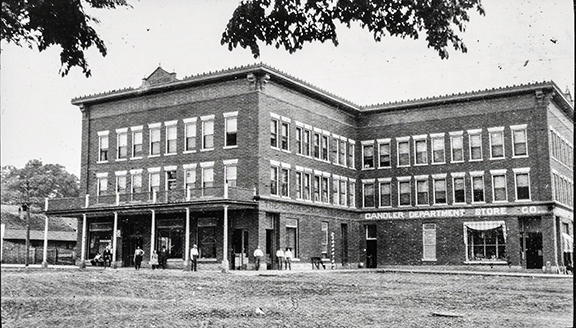
But when the Regal Hotel was built on in downtown Murphy in 1910, he was just a teenage construction worker on the job. The majestic three-story hotel advertised steam heat and rooms rented for $2 a day.
“I’ll tell you something most folks don’t know,” he said, laughing. “In 1910, the folks putting up the Regal thought that electric power might just be a flash in the pan, maybe not last.
“So we put in electric wiring throughout the building. But we also had to stub in gas lines inside the plaster walls, so it wouldn’t be too much trouble to convert to gas if needed …”
Wally Avett first wrote for the Cherokee Scout as editor in 1969. His books are available as signed copies at the Scout office in Murphy. Call him at 837-5531 or email wallyavett@gmail.com.