
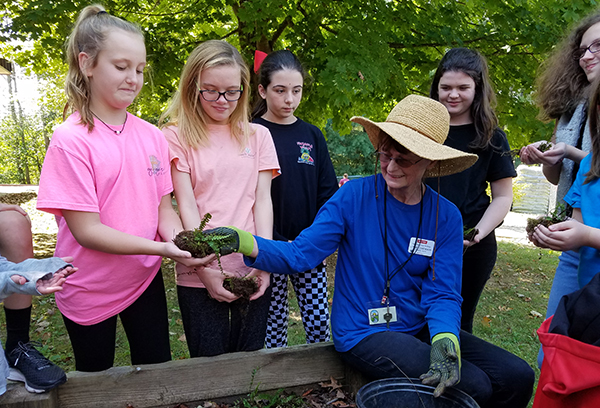
Ranger – Through her membership with Master Gardeners, Lynne Corenbaum learned that raised gardens at local schools had been forgotten as years passed. She knew she could take on the responsibility of teaching the children and teachers how to use and maintain the beds.
“In my generation, kids helped,” she said. “One generation passes information on to the other ... it’s just sort of gotten lost.”
So far, she’s started working with students at Ranger Elementary/Middle School, The Oaks Academy and Hiwassee Dam elementary/middle and high schools, but hopes to share her knowledge on all local campuses. She’s even helped schools find grants to provide funding for garden projects.
At Ranger, she’s started working with Sherry Brookins’ sixth- and eighth-grade classes. In sixth grade, the garden project works with the ecosystems part of the curriculum, and the students are even raising earthworms that will be released into the garden to help aerate the dirt and provide nutrients. The eighth-graders do a review of ecosystems before learning about biomes, and will be measuring the plant growth.
“It’s kinda tying it all together,” Brookins said.
Brookins appreciated what Corenbaum was doing for her students as they planted strawberries and ferns.
“It means a whole lot because they actually get to come out here and do hands-on learning,” she said. “You can tell they haven’t had any planting experience at all.”
One student, Hayden Williamson, said he already learned from Corenbaum things he never knew about ferns – like the plant doesn’t need sunlight to grow.
“It was cool,” he said.
Corenbaum sees the garden projects as a way to give back to the community. While those in the N.C. Extension Master Gardener program do have to complete 20 hours of community service each year, she doesn’t see the projects as simply a way of fulfilling that commitment.
She feels a person goes through life, gathering all sorts of knowledge and skills, and reaches a point where they want to volunteer or find a job that allows them to pass on their knowledge to the next generation.
“You want to do something with it,” Corenbaum said.
This is also one reason she decided to start the process to become a substitute teacher. She had heard that there was a shortage of substitutes in the outlying schools, and knew she could help. She was approved at the last board of education meeting.
“I’ve had one day of teaching so far, and I loved it,” Corenbaum said. “These kids are great.”
While she may only be assigned to help certain classes with gardening projects, she sees everyone as potential students.
“I’m happy to relate the information to anyone,” Corenbaum said.
Corenbaum takes garden knowledge back to school
Body