
‘Micromanagement’ blamed
for high turnover rate in town
Andrews – The political climate in town has created an atmosphere of micromanagement that leads to continued turnover at several key personnel positions, including chief of police, according to both current and former officials.
The micromanagement of police operations by elected officials who have no law enforcement training has spawned constitutional concerns. That was the case earlier this year, when Mayor James Reid ordered police to establish checkpoints to determine residency in hopes of keeping out-of-town visitors from spreading COVID-19 to Andrews.
However, the creation of residency checkpoints was not the only time the town’s elected leaders gave questionable orders to law enforcement
officials.
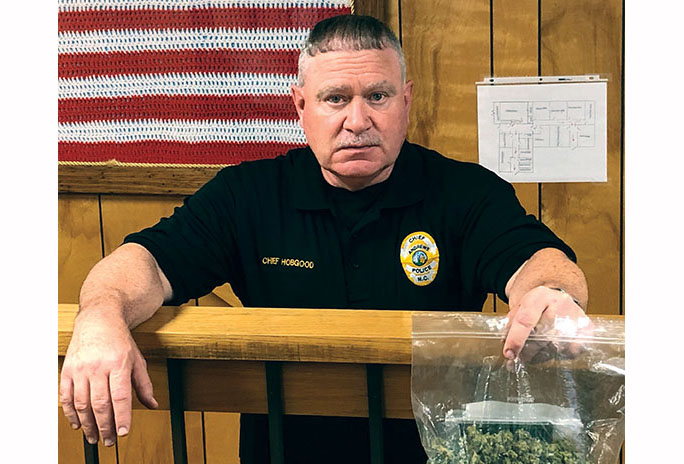
“The board [of aldermen] continually told us they want us to harass, harass, harass these people until they get mad and want to leave town,” former Andrews police chief Michael Hobgood said while explaining why he resigned last week. “Harassment is against the law. We can’t just stop people without reasonable suspicion.
“This is a free country. They have a right to walk the sidewalks of Andrews. Many times, the board would go to my officers, who would later come to me aggravated and say, ‘Chief, they want me to violate people’s rights and civil liberties.’ And I said, ‘You’re not going to do it.’ I told them to listen to me, and we didn’t do it.”
Reid acknowledged that he used the word “harass” when expressing concerns about pedestrians carrying backpacks and bicyclists on sidewalks. However, he said he never intended for police to break the law.
“I probably said that statement, but I meant that I want to see criminals prosecuted to the fullest extent of the law,” Reid said, adding that he and some board members often succumb to pressure from town residents. “Just like when we had the barricades and curfew in place, no matter how much pressure the public puts on us, we have to let whoever we are going to trust at that police chief position run the department.”
‘Family reasons and concerns’
Hobgood submitted a letter of resignation on July 6. The letter says he resigned due to “family reasons and concerns.” He told the Cherokee Scout those concerns revolved around micromanagement and unconstitutional orders by some elected officials.
“They tell the police department to do this and do that, but no board member has the education nor the training to dictate what my police officers should do on the street,” Hobgood said. “They [lack] organization and chain of command, and it causes daily chaos. I gave them a full year, and it just did not get any better. Nothing improved, and I saw it was time to leave.
“There’s one board member that never impeded or got in police business, and that’s Scott Stalcup. He let me run the department freely.”
Three different people have served as the town’s police chief in the two and a half years since the new administration took office. To understand reasons for the turnover, the Scout spoke with several current and former Andrews police officials, some of whom requested anonymity due to fear of retribution from lawmakers. They all cited a culture of favoritism and micromanagement by elected officials as a primary cause of instability.
“There’s a lot of the good ol’ boy system going on, and that’s the biggest problem,” one officer said. “You can’t call officers and ask them to do you favors.”
“We were ‘voluntold’ to do a lot of stuff,” another officer said. “You know, special treatment here and there for these people; don’t mess with these people. There’s certain town officials who want their area patrolled more because they think they need it better.”
Officers say they are also expected to transport everyone who committed even the slightest misdemeanor or traffic infraction to jail even if it’s not economical to do so.
“They complain about issuing less citations than the number of people we pull over, so they want us to issue a citation for every single traffic stop,” an officer said. “That’s taking away officer discretion.
“They also want us to start calling the mayor anytime we take someone to jail to let them know we’re out of town. The mayor should not be that involved in what’s going on in the day-to-day operation of the police department.”
Not the first complaints
The Scout spoke with lawmakers to see if this was the first time they have heard these types of complaints. While Alderman Mike Sheidy did not return messages seeking comment as of press time Tuesday, Alderman Steve Jordan said he heard a complaint about micromanagement at least once during a board meeting.
Stalcup said a previous outgoing police chief also cited micromanagement as the reason for leaving. Alderman Jonathan Ellison, who took office a little more than six months ago as a result of newly staggered elections, said he was unaware of the issue, but sensed he might have rubbed some officers the wrong way when questioning police operations.
“I have brainstormed with [the chief], and shared ideas and asked his opinion on some things that maybe we could do to help combat some of the issues that we’ve had,” Ellison said. “I have done nothing but try and lend support to the chief, but in trying to show support, I don’t think I have sat well with all of the officers.”
Town lawmakers argue that they never intended for officers to interpret their questions, suggestions or concerns as direct orders. However, police officials say the repeated micromanagement leaves them no other choice of interpretation.
Elected leaders say they would have preferred for the officers and chief to be more blunt in resisting their opinions. However, they also acknowledged that government workers often take a more passive approach when dealing with lawmakers who could ruin their life by firing them, which could affect their pension and the ability to provide for their family.
While the micromanagement by lawmakers seem to be overambitious attempts to rid the town of crime, police officials say there are better, legal ways to accomplish that goal.
“They want us to fix the drug problem, but they don’t want to give us the resources we need,” one officer said. “You can be a lot more proactive with more than one officer on a shift. Before this administration, the department had eight officers. Since then, we’ve never had more than six.”
‘They want stability’
The stability of town operations has declined over the last two and a half years. In addition to losing three police chiefs during that time, the town has lost personnel in three other key roles: town administrator, town clerk and town finance officer.
Today, those positions are filled by people who all wear several hats within the administration. The people interviewed for this report said the situation rapidly declined after Bill Green was forced to resign as town administrator last year.
“My job has always been to insulate and protect the employees from elected officials,” Green told the Scout last week. “Basically, a manager’s job is to keep the garbage policies put in place by elected officials from destroying the unit that you’re trying to run.
“None of [the lawmakers] have an idea of the legalities involved. That’s why I forcefully inserted myself into things and more or less made them step back. I knew when I left that things would probably get worse for the chief, because no one else had little to lose in taking a stance as I did.”
Law enforcement officials worry that if the culture in Andrews continues, the town will not be able to attract hard-working, honest police officers to the department. If that happens, the town could be left to choose from a pool of “bad actors,” which could cause even more trouble.
“What we’ve done for the past two and a half years is not working,” Reid said. “Everybody is just waiting for their next job, and we have a mayor and a board that are trying to micromanage every step of the police department. We have to try something different.
“I’ve worked with a lot of boards, and this board is very opinionated. It’s like our problem is the problem that matters, and that’s what’s so messed up. It’s not our problem that matters, it’s our town’s problem that matters. We’ve got to figure out a solution to the overall problem in Andrews and make people feel safe.
“The biggest problem is that we have trust issues. We don’t feel like we’re seeing results because we don’t feel like we’re putting experienced people in those positions. Why can’t we get experienced officers? Because they don’t want to work for a mayor and a board that micromanages every single thing. They don’t want to work for a place that has a different chief every four to five months. They want stability.”