
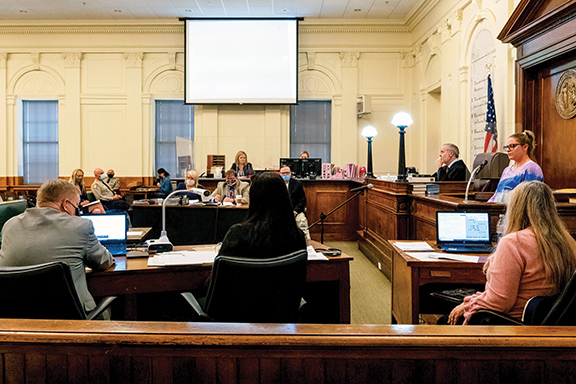
Defense asking court to dismiss all charges
Murphy – Defense attorneys representing Jackie Slaughter have asked the court to dismiss charges against their client on grounds that the jury reached a verdict contrary to the weight of evidence presented at trial.
Attorneys Rich Cassady and Holly Christy filed a motion for appropriate relief last week asking the trial judge to dismiss both charges related to the assault on Cody White. Their motion argues that jurors must have engaged in “conjecture or speculation” in order to reach a guilty verdict on the charge of assault with a deadly weapon with intent to kill inflicting serious injury.
“Their verdict must be supported by the evidence adduced at trial and only the evidence adduced at trial,” the attorneys wrote in their motion.
A motion for appropriate relief is a motion made after sentencing to correct any errors that occurred before, during or after a criminal trial. Essentially, this type of motion allows the trial judge to correct errors in a case without the time and expense of an appeal.
After five days of witness testimony and about nine hours of deliberation, jurors convicted Slaughter on the lesser of two charges related to a 2017 assault that nearly killed White. Jurors initially reported that they had reached an impasse on the afternoon of March 16 but were instructed to continue deliberations by Judge William Coward. The jury remained deadlock on the attempted murder charge when they delivered a verdict on the lesser charge a few hours later that day, so Coward declared a mistrial on the first count of the indictment.
At trial, defense attorneys argued that police bungled the investigation and that the two main witnesses in the case had biased reasons to blame Slaughter. The defense also pointed a finger at the victim’s aunt, Daratha Curtis, who they believe cut her nephew because she was angry at him for stealing his dying mother’s methadone pills when she was battling throat cancer.
The motion filed last week does not dwell on the possibility of Curtis being the true culprit. Nor does it harp on the knives overlooked by police or any other mistakes made by authorities who investigated the crime. Rather, it focuses on trial testimonies and overall physical evidence in the case.
“No forensic evidence was adduced at trial that [Slaughter] possessed the knife,” the motion says. “To the contrary, the state’s witnesses from the N.C. State Crime Lab testified that [Slaughter] was excluded as a contributor to any DNA evidence, and that his fingerprints were not found on either the weapon the state posited was used in the assault or the second knife found over the privacy fence over three years later.”
At trial, White testified that he was sitting on the left end of a living room loveseat talking with Curtis, who was sitting in a separate chair facing him, when Slaughter pulled back his head and slit his throat from behind. Defense attorneys challenged White on this version of events in court, arguing that he provided a different story to authorities when he initially spoke with them following the assault.
The defense argued that White never mentioned seeing Slaughter with a knife, nor that his head was pulled back during the assault, until just before the trial when he met with investigators and prosecutors to review the case. White pushed back on the accusation and said he relayed those details to investigators in his initial interview four days after the assault, but they may not have written them down.
White suffered an 11-inch laceration that stretched from the right corner of his mouth, down the side of his face and around to the back of his neck. The injury included damage to his internal and external jugular veins.
White testified that the weapon stuck in his jawbone when he was cut and that it continued on a path to the back of his neck after he moved his head. In documents filed last week, the defense team argues his testimony proves “this was not a lightning-quick assault, but took a short amount of time,” during which blood would have spilled from his cheek.
Investigators never found a spec of blood on Slaughter. Six people occupied Curtis’ mobile home on the night of the assault, and the only two who appeared to be covered in blood were White and Curtis.
While White’s testimony implies that Slaughter moved in order to cut him, no one said they saw Slaughter standing anywhere other than the kitchen area prior to sitting on the loveseat after White and Curtis fled the trailer.
Everyone who testified in court said they saw Slaughter standing at the entrance to the kitchen nearest the right side of the loveseat a few feet from where White was seated. Curtis and White said Slaughter was standing there before the assault, while two other witnesses said they awoke after hearing a scream or loud noise and saw Slaughter standing in that spot.
In addition, no one besides White testified to witnessing the assault. Nor did anyone besides the victim say they saw Slaughter with a knife, not even Curtis. However, Curtis claims she saw Slaughter conceal something with a black handle behind his back moments prior to the assault. She said she thought the object was a stun gun.
Furthermore, the bloodstain on the floor shown in crime scene photos is positioned to the right of Curtis’ chair and slightly to the left of where White was sitting. No blood was located between the coffee table and loveseat where Slaughter would have presumably stood to commit the crime.
The defense argues that it is physically impossible for White to have been seated on the loveseat when he was assaulted and have the blood land on the floor several feet to his left. At trial, Slaughter’s attorneys argued that White had stood up to leave the property and walked past Curtis, who then slit her nephew’s throat with her right hand.
“It is a physical impossibility that there was no blood on the coffee table, the space between the coffee table and the loveseat, the loveseat, and/or [Slaughter]; all to the right of Cody White,” the defense’s motion says. “A jury can draw reasonable inferences if the evidence supports such a reasonable inference. A jury may also resolve contradictions or discrepancies in evidence. A jury cannot, however, engage in conjecture or speculation on what ‘really happened’ or conjure evidence.”
The motion for appropriate relief further argues that White’s testimony is the only contradiction or discrepancy that exists in the case, as none of the other evidence incriminates Slaughter. The
court filing includes a certified transcript of White’s testimony for the court to review before making a decision.
If the court grants the motion for appropriate relief, the judge could just vacate the conviction, allowing the state to retry the case with a new jury. However, Slaughter’s attorneys have asked the court to completely dismiss the charges, which would terminate the criminal case.