
- Listen to the Front Porch Productions podcast with Mary Ann Thompson and host Abigail Hickman free at cherokeescout.com.
Murphy As a young woman living here during the 1950s, Mary Ann Thompson had no idea that working for the bookmobile would lead to a lasting legacy of bringing awareness to the history of the Trail of Tears in Cherokee County.
Mary Ann Thompson surrounds herself with the art and artifacts that she collected in her career as an art instructor at Tri-County Community College and researching Cherokee history to become the first president of the North Carolina chapter Trail of Tears Organization. After graduating from Murphy High School in 1954, Thompson’s first job was helping Nancy DeWeese drive the bookmobile to Cherokee, Clay and Graham counties.
“She told me we’d be going to Robbinsville, and we’d stay a week there,” Thompson said. “The Cherokee had their own school there and they spoke the native language, and I really wanted to talk to the kids.”
She recalled letting children pick out their own books, then the teenagers would get to choose from a different collection targeted for their age.
“I wanted to talk to the kids because we didn’t speak the same language, and I read and learned about their culture and history,” Thompson said. “I fell in love with it all – except the removal. To think they would take them out with nothing to help them.”
Collecting artifacts
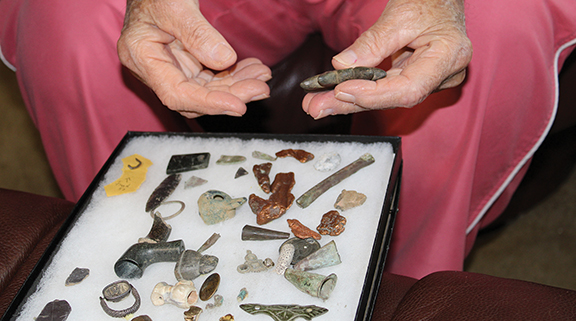
This interest sparked a desire to collect Native American artifacts, which she has displayed in her home. Thousands of arrowheads and other relics adorn curio cabinets and wall hangings in the home she shared with her husband, Jack.
Thompson served as vice president of Cherokee County Historical Museum Board since it was established in 1977 until 1986. She is vice president today, museum Director Terrisa Carringer said.
Thompson took art classes with two of her friends under an instructor in Marble. She was tutored for two years, then asked if she wanted to work with him.
“Painting grew on me, I didn’t really like watercolor, but I love oils. I could add more details with it,” she said. “I would rather paint than eat at that time.”
Thompson has almost all of her paintings still with her, depicting her favorite animals and scenes from books she has read. The paintings are framed, and Thompson said each one holds a special piece of her.
Art teacher at college
When Tri-County Community College was founded in 1964, Holland McSwain, the first president of the college, asked Thompson to teach art.
“I loved that I could teach others the love for art and painting,” she said. “I felt so good to have that job to give that to someone else.”
Thompson said she had classes in the mornings and evenings, leaving a large amount of time in the middle of her day open in which she would look for arrowheads and other relics around the campus. She retired from the college after 29 years of teaching.
In 1993, the Trail of Tears Association was created and incorporated in Missouri as a nonprofit organization, according to nctrailoftears.org. The association entered into a cooperative agreement with the National Park Service to promote and engage in the protection of the Trail of Tears Historic Trail resources.
Reading an article in the Asheville newspaper, Thompson realized that the history of the Trail of Tears in Murphy was not recognized. She wrote letters to county commissioners and state officials, plus called senators about the history she learned in her studies of the Cherokee.
To prove the history she knew, Thompson worked with Brett Riggs, a research archeologist with the University of North Carolina, to find artifacts and report on her findings. The report by Riggs and Lance Greene titled The Cherokee Trail of Tears in North Carolina was published in 2006 detailing the results of an inventory project dependent on the assistance and support of numerous individuals, agencies and organizations.
Promoting the trail
Thompson said she and Riggs would spend hours researching and going to different locations to look for artifacts.
“He was so smart, and he loved the history like I did,” she said about Riggs. “He would come over for a week at a time, and we would hunt for artifacts as long as we could both stand up.”
Thompson said they held meetings at the library at night to promote education about the trail.
“We would let them know on the radio when we would have the meetings and about 100 people came to hear the story of the Cherokee,” she said. “We went over all the history about Cherokee County’s part in the Trail of Tears.”
Thompson also helped in researching the route of Hernando De Soto. De Soto was thought to have traveled through the area from 1539-43 with an army of 600 men to discover riches, according to an article in the Encyclopedia of North Carolina.
In a letter to Thompson dated June 5, 1991, the University of Michigan Museum of Anthropology assistant curator of North American archeology Russell Showronek said, “I can assure you that all of your work has paid off. There is no doubt that there was Spanish/Native American contact in the 16th century at Peach and in the Hiwassee Valley.”
A family woman
Thompson has many reasons to be proud through her paintings and work for the history of Cherokee County. But she is most proud of her husband and family.
“My Jack was a great man,” she said, clutching at her chest. “He had a good life, he was a hard worker and the best at whatever he did.”
Jack Thompson worked for the U.S. Forest Service from 1952-85, retiring after 33 years. In 1986, he was elected Cherokee County sheriff, a position he served in for 12 years.
Jack passed away in September 2015. The couple were married for more than 50 years. The couple have one son, Emmett; a granddaughter, Wendy Ward; and three great-grandchildren.