
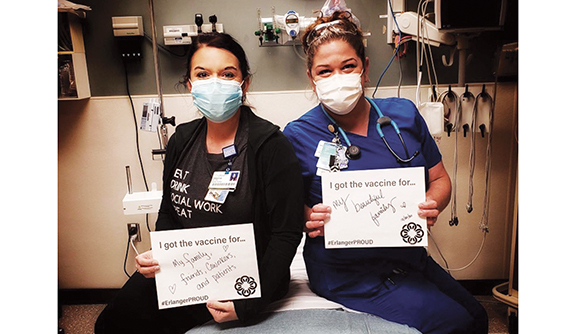
Peachtree – As soon as she learned vaccines would be available for healthcare workers, Belinda Miller was ready to roll up her sleeve.
In fact, the emergency department nurse was one of the first employees at Erlanger Western Carolina Hospital to receive the Moderna COVID-19 Vaccine on the morning of Dec. 26.
“I’m blessed,” Miller said about 20 minutes after receiving the vaccine. “I feel perfect.”
She said it felt like a normal vaccine. She was not experiencing any symptoms, not even a sore arm.
Miller signed up as soon as she could to get the vaccine because of her potential exposure. Fortunately, she hasn’t contracted the virus yet.
“I don’t want to contract the virus and give it to someone I care about,” Miller said. “There’s always that possibility you can pass it on to someone else.”
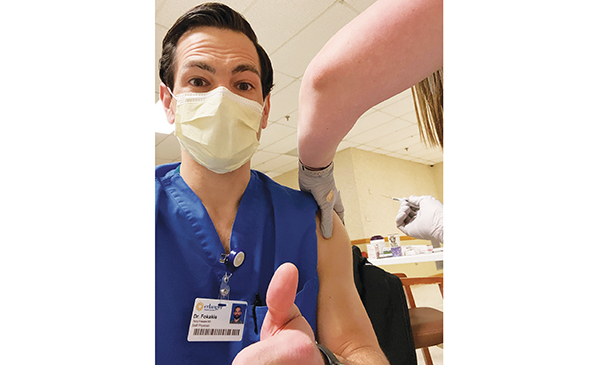
The hospital vaccinated 80 staff members that day. Dr. Terry Fokakis was also in line early that morning to get his COVID vaccine. He got the vaccine for a few reasons – to help increase immunity in the community, protect his pregnant wife and be a role model for his patients. In conversations with patients, almost all said they would get the vaccine if he did.
“I need to lead by example,” Fokakis said.
A big factor for him was helping get the community closer to 80-90 percent immunity from the virus.
“I felt that this is we’re getting close to beginning of the end,” Fokakis said. “The more people we can get the vaccine, he sooner we’ll get there.”
Miller has been working as nurse for six years, three of them at the local hospital. Early on in the pandemic, it was stressful making sure she had on all the appropriate protective equipment – including two masks – for every patient, but she has gotten used to that.
Working in the emergency department, she has been one of the first to see those with COVID or COVID-like symptoms enter the hospital over the last 10 months. With each person, she’d hope for a vaccine just to stop it.
“Based on our small population, we’ve had our fair share of cases,” Miller said.
She said some people are more affected by the virus than others, and from what she’s seen age doesn’t matter. She’s seen some that have had to go on to the intensive care unit or need a ventilator.
“It can be a big deal for some people,” Miller said.
While she hasn’t seen anyone she personally knows admitted to Erlanger for severe COVID symptoms, a family member who lives in another state did have the virus and was hospitalized for a few days.
“He’s older than me, so I was a little bit concerned for him,” Miller said.
She let the doctors do their job, and he ended up doing very well with the treatments they gave him, she said.
Fokakis has talked to many other physicians, and they all agreed half the COVID patients they have seen do great, while the other half do terrible and there’s no explanation why. They’ve seen 16-year-olds die and 101-year-olds survive.
“Instead of rolling the dice, it’s much simpler to get the vaccine,” he said.
Fokakis knows it can be intimidating to get a new shot, but he spent weeks researching both the Moderna and Pfizer vaccines, the development, effectiveness and outcomes. He said while the vaccine is new, the science behind it isn’t, and all it does is program cells to identify the COVID proteins and protect the body from it. It doesn’t insert itself into DNA.
“It lead me to a point to feel extremely confident with getting the vaccine,” he said. “I hope it relieves some of my patients’ fears.”
Fokakis said we need at least 80-90 percent of the community to have received the vaccine or have immunity from infection, although there are some questions still about how long immunity will last – something that can be answered as more data is collected through more people getting vaccinated.
Miller hopes people in the community will have conversations with their primary care physicians and take the vaccine when it’s their turn to help contain the spread, in addition to taking other precautions.
As of Dec. 29, the day before local hospital employees were able get their first dose of the vaccine, the state reported that 63,571 people across the state had already received their first dose. Hospital workers in Chapel Hill, Charlotte and Durham were the first to be vaccinated almost two weeks prior to Miller and her co-workers.
“I was happy to see them get it,” Miller said, adding that urban areas have been more affected by the virus.
Fokakis said while many health-care providers, including those in the Cherokee County Health Department, have all done well doing their part to hold off the spread of virus until herd immunity through a vaccine was available, the community as a whole could do better with precautions, like wearing masks and avoiding gatherings.
“If we can get everybody on board, we can curtail this pretty quickly,” he said.