
.
By Charlie Benton
cbenton@cherokeescout.com
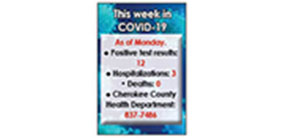
Cherokee County celebrated Monday, when no new positive test results were reported for the coronavirus.
Meanwhile, the county is continuing to use up its weekly 400 first doses of the Moderna COVID-19 vaccine with appointments booked out. Despite having good news to share, Health Director David Badger still expressed concerns looking ahead.
Almost exactly a year into the pandemic, 4,485 first doses and 2,251 second doses of the vaccine have been administered in the county, amounting to 15.6 percent of the county’s population. The county has also completed vaccinations of some essential workers in the state’s Phase III, including teachers and child-care workers.
“The state has given flexibility for Phase III, North Carolina’s essential workers, but at this point and time we’re working through basically pre-existing appointments for (ages) 65 plus, so we haven’t really green-lighted accepting new appointments for those phases until we kind of get more resolution on future allocations,” Badger said.
Gov. Roy Cooper authorized the vaccination of all Phase III essential workers statewide starting March 3.
“We basically have up from the end of March and into the first part of April enough appointments to meet our current baseline allocation of vaccines, and until we get more clarification on what future allocations of vaccine will be, we’re hesitant to go ahead and create appointments,” Badger said.
Although the health department continues to offer the lion’s share of vaccines in Cherokee County, Badger said Erlanger Western Carolina Hospital and some federally qualified health centers had also received doses of the jab. He also said local Walgreens stores have received some doses through the Federal Retail Pharmacy Program.
He said while Cherokee County was not getting any of the newly approved Johnson & Johnson vaccines, having another vaccine in the arsenal was a large-scale improvement. The Johnson & Johnson vaccine was approved by the FDA on Feb. 27 and is administered in a single dose, unlike the two-dose Moderna and Pfizer vaccines.
The new vaccine can also be stored at a higher temperature, making it easier for many providers to keep on hand.
“More vaccines means more supply,” Badger said. “More supply means more people can get vaccinated, so it’s significant.”
Badger said so far, he had not had any issues using all of the county’s allotted vaccines. However, he expressed concerns that it might be more difficult to convince younger people to take the shot as the state moves toward younger groups.
“Certainly it’s what we need, to have supply available. But on the flip side of that, it doesn’t matter if we have all the vaccine in the world, we need to make sure people take the vaccine,” Badger said.
He emphasized that his concern was not unique to Cherokee County.
“It’s an individual choice that people are going to have to make,” Badger said. “No one’s going to be forcing them to do that, but in order for us to get to a point where we can all be safer to protect not only ourselves, but our loved ones then people need to educate themselves on the vaccine and make an informed decision on whether they’re going to take one.”
He also said he was concerned about the number of people from across the country returning to their vacation homes in the region as the weather warms up and the tourist season begins.
“We don’t live in a bubble,” Badger said. “There are a lot of people that have second homes here from Florida and other areas, and if there are issues with getting vaccine into arms in Florida (it could compound) issues here.”
Badger said that in his opinion, distribution of the vaccine should extend further out into the community, including from the offices of primary care physicians and from more retail store pharmacies.
Across the state, progress against the virus continues to be made, with only six counties at red level of community spread under the state’s COVID-19 alert system as of March 4, compared to 27 red counties as of Feb. 22.