
Peachtree The proposed consolidated Cherokee County High School site has a long history dating back through the centuries as the courthouse for the Cherokee Nation, a large plantation and prison site.
Cherokee County was once referred as the stronghold of the Cherokee Nation in 1838 by Capt. W.B. Williams of the U.S. Topographical Corps according to the Cherokee County History Book, Volume II.
A 2006 report conducted by Brett Riggs and Lance Greene for the University of North Carolina Research Laboratories of Archeology and the Trail of Tears Association, North Carolina Chapter, said the Cherokee lived quiet lives in the 1830s as subsistence farmers and most dwelled in log cabins with dirt floors on properties of 5-10 acres.
In 1830, when the U.S. Congress passed the Indian Removal Act, the people of Aquohee and Tahquohee had implemented a lot of the aspects of anglo-American lifestyle and economy, as well as government styles and legal codes.
‘They were peaceable’
Billy Ray Palmer, local historian and retired professor at Tri-County Community College, said the Cherokee adopted modern ways hoping to satisfy the general population so they wouldn’t have to be removed.
“The elders in the Cherokee Nation embraced Christianity, and they were peaceable. When the Cherokee were asked to hike to Murphy to Fort Butler, it is said they told them they would after church services,” Palmer said. “The locals were happy with them, but some wanted the land.”
After the removal of the Cherokee, the land was sectioned off and bought by John Sudderth of Burke County. Sudderth was a Confederate colonel, Cherokee County Board of Education member Joe Wood said.
Sudderth purchased large tracts of land in Cherokee County during the Indian Land sales, according to Marble and Log: The History and Architecture of Cherokee County, NC. He gifted the land to his son-in-law and daughter, Mr. and Mrs. Robert Dale McCombs.
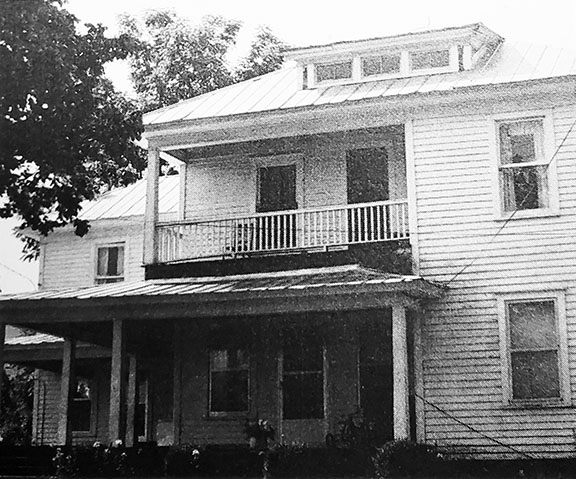
“The McCombs built a substantial two-story, center-hall house with a double tiered porched, on a plantation which by 1860 worked at least 19 slaves,” according to Marble and Log. “As the family grew, this whole section of Peachtree near the college was known as the McCombs settlement.”
McCombs started a plantation on the land and built the large plantation house around 1850, which was later remodeled in 1922. Palmer said the McCombs would have grown soy beans and corn mostly on the plantation, with slaves working the fields.
‘Awesome old house’
Micah Foti of Brasstown lived in the McCombs’ plantation house until the house was burned in 2002 in a training exercise by the Peachtree Volunteer Fire Department.
“It was an awesome old house. It had been added onto a few times, and whenever we moved in around 1988 there were 13 rooms,” he said. “It was supposedly 180 years old when we moved into it, and there were secret passages and false walls, which were so cool when I was a boy.”
Foti remembered termites being a large problem, which is probably what led to the home’s destruction in 2002.
Over the years living at the McCombs plantation, Foti found several artifacts like old knives, farming tools and an old cane. He said he would play around the large barns on the property and river that was close by.
In 1993, an archeological survey conducted by New South Associates for the planned rerouting of U.S. 64 recovered no materials indicating the 19th-century Cherokee occupation that McCombs wrote about in an 1880s letter about the courthouse being on his property, according to the report by Riggs and Greene.
The report states since the letter wasn’t identified until 2002, the 1993 survey did not specifically target identification of the Aquohee District Courthouse site.
Another excavation at the McCombs’ slave quarters in 1999 revealed more findings of Cherokee artifacts in the area, according to the report by Riggs and Greene. A pre-1833 Omega-eye U.S. Army button as well as pearlware plate sherds were also found.
While the property already has an extensive history, it is set to make more history as the Cherokee County Board of Commissioners voted 3-2 favor to fund one new project and move forward with consolidating Andrews, Hiwassee Dam and Murphy high schools on March 15. Commissioners voted to commit up to $40 million toward the new school.