
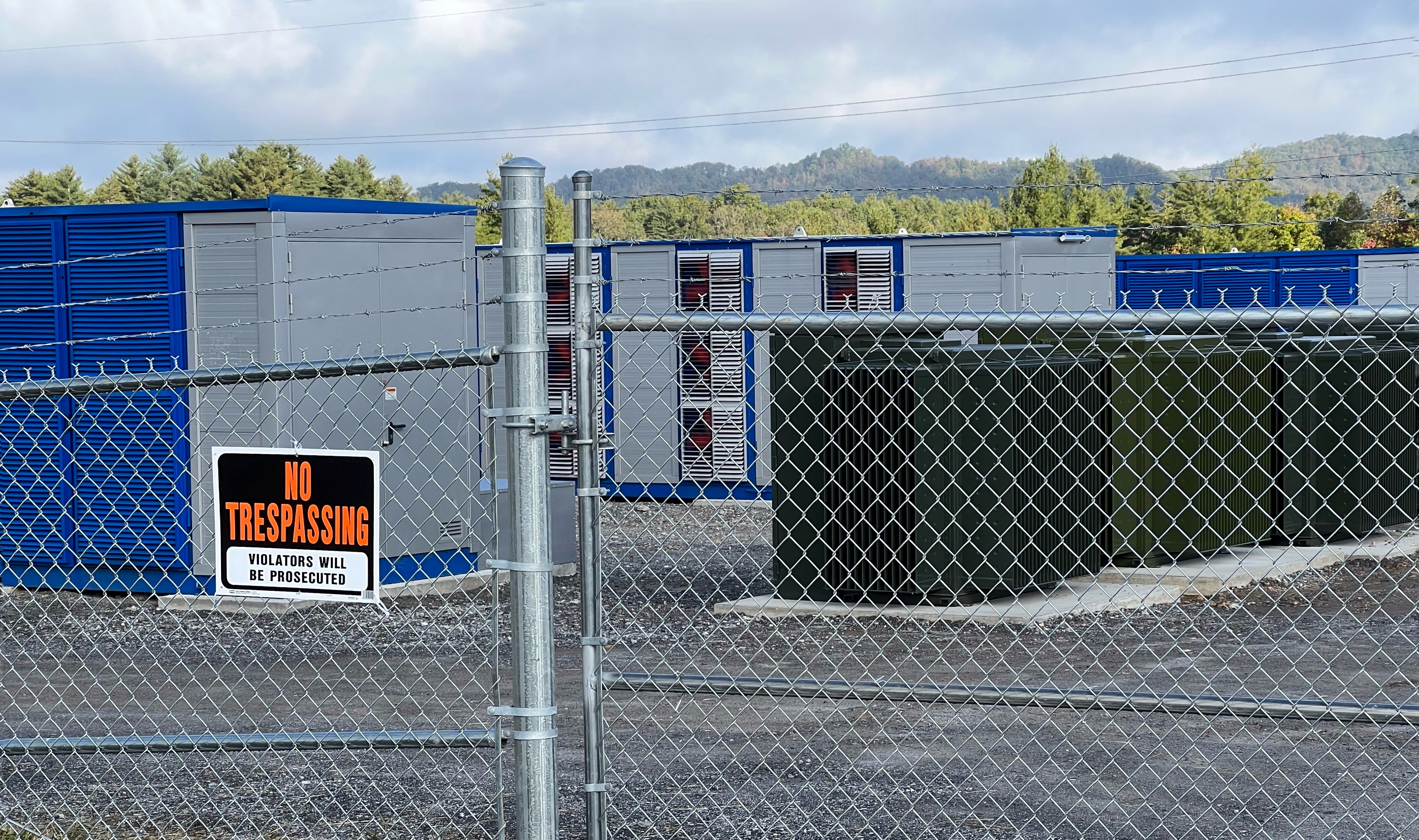
Last month, Fortune.com published a headline stating that Bitcoin mining is “the most stupendously profitable business on the planet right now.” This may explain why there are two crypto mining farms in Cherokee County, with a third reportedly on the way.
However, the newly constructed crypto mining farm on Harshaw Road in Murphy is drawing criticism from residents who say the noise produced by cooling fans adversely affects their quality of life. The decibel level of the farm reportedly fluctuates depending on the temperature.
“Outside my front door, the noise level is about 65 decibels,” Jennifer Lugiewicz told Cherokee County commissioners at their Oct. 18 meeting. “A general conversation is about 60 decibels. In order for me to go outside and have a conversation, I have to scream at whomever I’m talking to.”
The crypto mining farm on Harshaw Road is owned by Exponential Digital Inc., which originally purchased the property under a different business entity but changed its name last week. The company paid $450,000 for 3 acres of land amid a corn field near Lugiewicz’s home in July and constructed a crypto mining farm consisting of five shipping containers filled with computers and cooling fans.
Exponential Digital Inc. is a Delaware corporation that lists a business address in San Francisco, Calif. North Carolina records list Jingyang Fang as manager, president and secretary of the business.
California business records list Fang as the registered agent of another Delaware corporation called Bmining US Inc. The company lists the same San Francisco address shown on North Carolina records and states that it is in the business of providing “crypto mining services.”
Cryptocurrency mining has been compared to the California Gold Rush because miners are rewarded for their work with crypto tokens. Investopedia.com probably explains it best by comparing crypto miners to auditors.
Essentially, miners verify the legitimacy of cryptocurrency deals, which is crucial because there is no central bank nor government authority determining the validity of transactions. Instead, the crypto mining process achieves a decentralized agreement through what’s called “proof-of-work.”
In addition to validating transactions on the blockchain, mining is the only way to release new cryptocurrency into circulation, which is paid to the miner that solves a computational math puzzle. The first computer to solve the problem is awarded the next block of cryptocurrency and the process restarts. Therefore, miners are essentially creating cryptocurrency.
Successful Bitcoin mining operations demand a lot of computing power, which requires cooling. Several local residents who contacted the Cherokee Scout say the noise produced by cooling fans at the site on Harshaw Road is, at times, unbearable.
“Local economic leaders have reached out to the owners of the data mine in an effort to remedy the problem,” county officials said in a release. “The Cherokee County Board of Commissioners has asked for a review of the county noise ordinance and for further investigation into the issue.”
Exponential Digital Inc. is reportedly working to determine the best way to mitigate the noise. An internet search shows there are several sound barrier options for crypto mining farms, including the use of trees, which may be the most welcome solution for Harshaw Road residents who feel the shipping containers are an eyesore.
Residents have also expressed concerns over the amount of energy consumed by the crypto mining farm. A Murphy Electric Power Board official declined to comment on the amount of energy used by any household or business. However, he did say claims that the crypto mining farm raises rates for area customers are false, adding that an increase of customers “helps keep rates stable.”
“Every one of us that comes into the community and uses electricity helps support the rate base,” General Manager Larry Kernea said.
Cryptocurrency miners are motivated to migrate to the cheapest sources of power because they compete in a low-margin industry where, typically, their only variable cost is energy.
In North Carolina, the average electricity retail price is 9.5 cents per kilowatt hour, according to the Global Energy Institute, which uses the most recent data available from the U.S. Energy Information Administration. In contrast, California energy consumers pay an average of 18.15 cents per kilowatt hour.