
In my former professional life, I edited magazines about knives and their history. Living in Chattanooga, Tenn., I was immersed in Civil War history. I had a view of the Lookout Mountain battlefield from my office. I have guided school groups on trips to the Chickamauga Battlefield. There are leaders in that war who were impressive.
 One of the most gifted and innovative cavalry commanders during the Civil War was active around Chattanooga and elsewhere in the Western theatre. His name was Nathan Bedford Forrest. After the war Gen. William T. Sherman was asked who the best cavalry commander in the war, and he said, “A man I never met. A man called Forrest.”
One example of Forrest’s determination was at the battle of Fort Donelson on the Cumberland River. Invested by Ulysses Grant, the Confederate generals were standing around a campfire taking a vote to surrender when Forrest walked up, muddy to the waist. When he learned what they were contemplating he told them he had found a way out.
The consensus was they had already voted and decided to surrender. Forrest told the group he did not come there to surrender but to fight, he had a way out and was going.
His command waded the swamp bottom and escaped, taking an infantryman behind each cavalryman. The rest of the Fort Donelson command surrendered the next day.
During the war, Forrest is said to have killed 41 men and had 40 horses shot out underneath him. “I was a horse ahead at the end,” he is reported to have said.
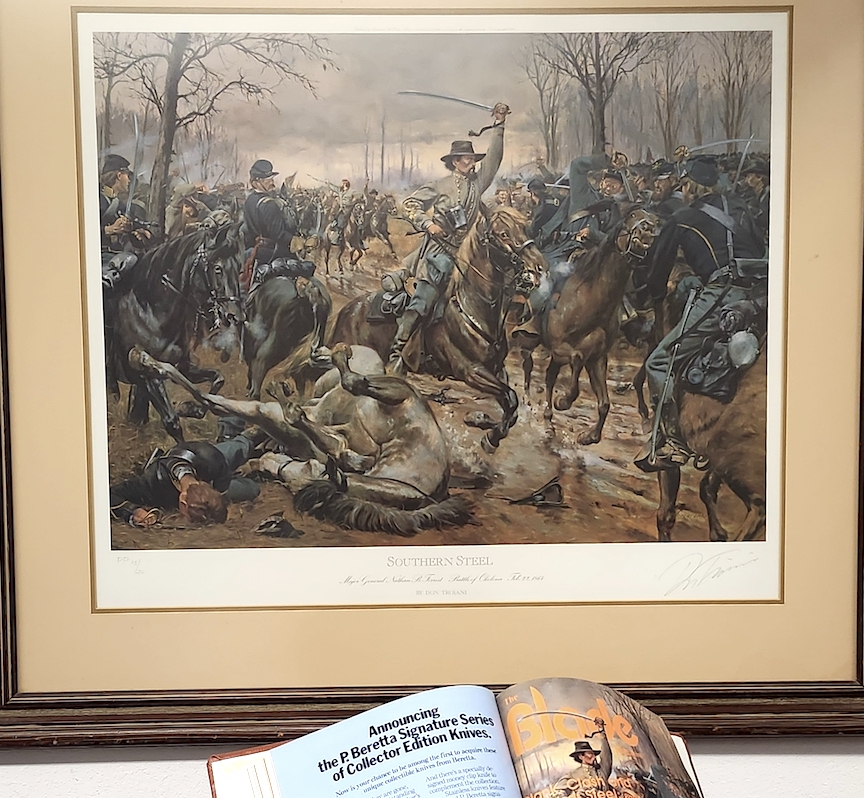
As a magazine editor, I came across a Don Troiani print of Forrest, his sword raised attacking Union Cavalry at the Battle of Okolona, Miss. Forrest had become such a thorn in the side of the North with constant and successful raiding, that a group was put together to end Forrest once and for all, commanded by Gen. Sooey Smith.
Before he attacked Forrest, he ensured he had fresh mounts for his troopers and equipped each with a Spencer repeating rifle – the state-of-the-art weapon of the time. He greatly outnumbered Forrest and moved from Memphis, Tenn., to attack.
Forrest deftly stayed just out of range through Mississippi, stretching the pursuers over many miles. Realizing the closest troops were stretched too far ahead of the bulk of his pursuers, Forrest turned and attacked. One of the attacking cavalrymen was his brother, Jeffery, who Forrest raised from the time the boy was 14. In the attack, Jeffery was shot, dying, with Forrest holding the brother he had raised as a son in his arms as life left the young man. Furious in his grief, Forrest mounted his horse and alone spurred toward the rear of the Union column.
One of his command saw Forrest’s one-man charge, and he stood in the stirrups and yelled to the cavalrymen, “Men, will you stand by and watch them kill your general?” The charge commenced from the entire command – but Forrest was horse lengths ahead. Singlehandedly he rushed in among a half-dozen Union troopers hacking with his sword. That is the scene captured on the Troiani print.
I secured permission to use that artwork as a front cover of my knife magazine, and purchased one of the framed prints, hanging it in my office. The print is titled “Southern Steel,” taking the title from the post-Civil War song “I’m a Good Old Rebel.”
The postwar song screamed defiance in the defeated South and was once requested and performed before Queen Victoria. One of the lines is “They died of Southern fever, of Southern Steel and Shot – and I wish it was three millions instead of what we got.”
That print was on my wall as I began doing Civil War ancestor research. While I did have some Confederate ancestors, one serving under George Patton’s grandfather, I discovered most of my ancestors were pro-Union North Carolina and east Tennessee mountain men who opposed secession. I’ve outlined some of them in previous columns here.
Among them was Jesse Carroll, who lived near Suit, and enlisted in the Union cavalry at Strawberry Plains, Tenn., early in the war.
He served in the Second Tennessee Cavalry (Union). He was actively involved throughout the war, including major battles such as Chickamauga.
I learned that great-great grandaddy’s regiment was part of that Smith expedition against Forrest. And when Forrest made his furious dash into the Union cavalry at the Battle of Okolona, the troopers he attacked were specifically mentioned in the Official Records of the War of the Rebellion. It was the Second Tennessee Cavalry.
I had a print of Forrest doing his best to kill troopers of my great-great-grandad’s unit. Possibly one of the troopers attacked by Forrest could have been Grandaddy Carroll.
Forrest was no saint, especially by today’s standards. He was a slave trader pre-war. When the Ku Klux Klan was formed in Pulaski, Tenn., they asked the ex-general to head it, telling him it was to be a support group for war widows and orphans. Forrest quickly disavowed connection with the Klan once he learned what they were up to – but the damage was done. Few delve further into the history without the woke reaction that Forrest is to be canceled and judged by today’s standards instead of the times in which he lived.
When he died in his hometown of Memphis, his grave spot was named Forrest Park for 156 years. That was until outraged Memphis leaders decided to rename the park and expel his remains. The Sons of Confederate Veterans paid for the re-interment at their national headquarters in Columbia, Tenn.
The print remains on my wall, not as praise to Forrest but as a remembrance of my ancestor, Jesse Carroll. The more I stare at the print, the more convinced I am he is portrayed there.
Bruce Voyles’ local history column runs every other week in the Cherokee Scout. Email him at RoadsLessTraveled@cherokeescout.com.