
 |
For railroad fans, there are tourist trains that run from Blue Ridge, Ga., to Copperhill, Tenn., bringing a revitalization to both those towns, to the tune of 60,000 riders a year, with a similar excursion train leaving Bryson City. However there is another local excursion train that has a different appeal because it includes a famous part of railway history – the Hiwassee Loop.
The story began in 1874 when the Marietta and North Georgia railway planned a line to connect Atlanta with Knoxville, Tenn. By 1882, using convict labor, the railroad had only been extended by 27 miles, with money running short and unable to bridge the Etowah River.
The project was saved by Joseph and Abraham Kinsey, two Murphy-based businessmen who owned a copper mine, with the only way to move the ore by oxen drive hopper carts. They invested heavily in the new railroad. Joseph was named president of the reorganized railroad, holding that position for a year, but likely influencing a narrow gauge spur reaching Murphy in 1887.
A standard gauge track finally made it to Murphy 10 years later in 1897.
The main objective was Atlanta to Knoxville, halted by a major geographic problem, how to get a train from Farner, Tenn., down Bald Mountain to the flatter land around Etowah and on to Knoxville. Eager for the completion of the line, the City of Knoxville guaranteed the railroad a bonus of $275,000 if the company could put trains in Knoxville by July 1, 1890.
In a rush to complete the line, the first solution was a series of “W” zig zags down the mountain. A maximum of four cars could be transported this way. The locomotive would pull into one leg with four cars, switch the tracks, and back into the next leg, switch again and go forward into the third leg, going back and forth like this until getting to the bottom of the mountain.
The locomotive then had to reverse the process, zigzagging back to the top where it would pick up four more cars and repeat the process. That inefficient process did win the bonus from the city.
Legend has the new president of the railway took the bonus as his own and quickly disappeared for parts unknown, forcing the railway to go into receivership.
The new owner, Henry McHarg, was buying bankrupt railroads across the United States, and in 1898 obtained what would he renamed the Atlanta, Knoxville & Northern Railway. The price? Assume the debt of $956,500.
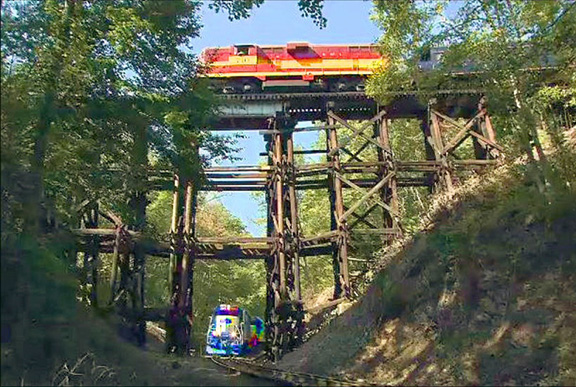
Borrowing a construction engineer from the L&N Railway, the Bald Mountain solution was something novel for U.S. railroads, he would loop Bald Mountain. The result was a spiral loop that crossed itself over a wood trestle before continuing into the canyon of the Hiwassee River near Reliance, Tenn.
The loop came close to requiring a second crossing, avoided only by the resistance of McHarg.
The railway already traversed a series of sharp turns on Tate Mountain near the marble deposits in Georgia, an area the railroaders called “The Hook.” With the coming of the rails looping the loop at Hiwassee was known as “The Loop.” Quickly the Atlanta to Knoxville route became known as “The Hook and Loop” line.
When Milton Smith began combining railways into what would become the L&N (Louisville & Nashville), the Georgia-owned Western & Atlantic saw the competition coming, felt threatened, and tried to stem The Hook and Loop with legislation in 1903 that prohibited any railway from laying track within 20 miles on either side of the W&A route.
In response, Smith purchased the Hook & Loop line from McHarg for $4,000,000. A nice profit for McHarg, and L&N now owned a direct line from Atlanta to Cincinnati via Knoxville. The L&N relocated its Atlanta division headquarters to Etowah, Tenn.
Newer lines eventually superseded the Hook & Loop line’s passenger travel, but freight business continued to sustain it. Copperhill was providing an average of 1,000 railroad cars a month of acid, crude copper, iron sinter and ballast during the Tennessee Copper Company’s heyday.
The Hiwassee Loop is one of only six loop the loop railways in America, and the only one constructed East of the Mississippi River.
With the coming of CSX railroad in the 1980s, many lines were sold or abandoned, among them the trains on the rails of the iconic Hiwassee Loop. That changed in 1998 with the coming of an excursion train.
You can ride it today, a part of the Tennessee Valley Railroad Museum, leaving Etowah several times a month, sometimes a 50-mile trip to Farner, or a longer 94-mile trip that goes into Copperhill, Tenn., with a layover allowing riders enough time for lunch and to explore the revitalized town – invigorated by not one but two excursion trains (one from Blue Ridge) dropping cash laden tourists into the downtown area.
The old L&N Headquarters in Etowah has been turned into a well-done railroad museum. Train tickets range from $38 for children, $58 for adults up to $118 per person.
The route takes riders past the TVA Appalachia Powerhouse at Smith Creek, then up and around Bald Mountain, riding on the roadbed of history. The Hiwassee Loop trip is a pleasant way to take in one of our area’s unique offerings.
Having worked at the newspaper in Copperhill before the coming of the tourist trains, seeing the desolate town it became after the closing of the copper mining there – and then seeing how the simple arrival of a couple of excursion trains to Copperhill has turned it into a economic boom town, it makes one question if those who oppose an excursion train with Murphy as a destination have ever been to Blue Ridge, Ga., Copperhill or Etowah on train days.
A good 60,000 riders annually is a fact our county leaders should find hard to dismiss as something our county cannot afford – but so far, they have managed to do just that.
Maybe they should try one of those train rides.
Bruce Voyles’ local history column runs every other week in the Cherokee Scout. Email him at RoadsLessTraveled@cherokeescout.com.