

.
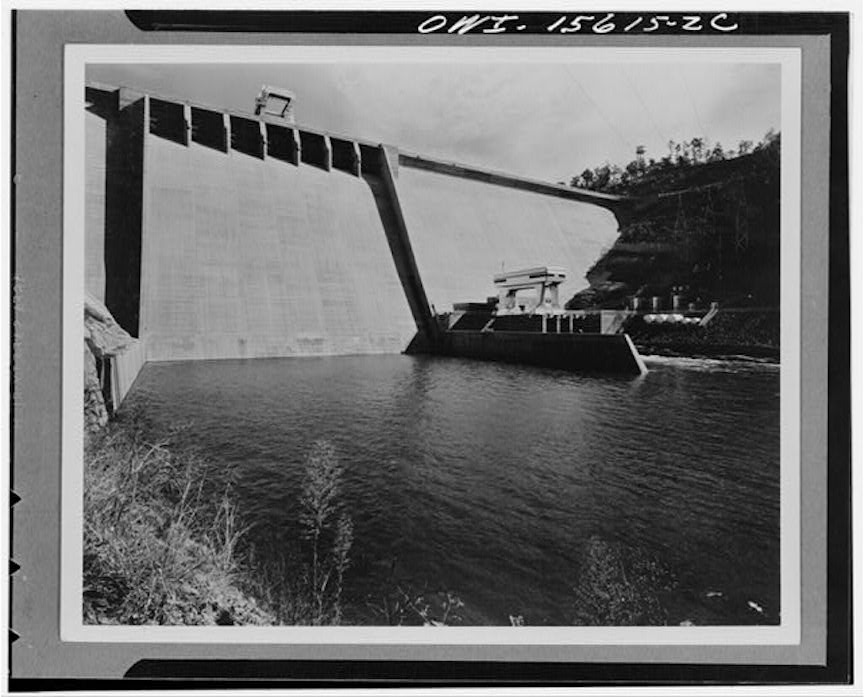
Hiwassee Dam in an early Tennessee Valley Authority photo. At the time of its completion it was the highest overflow dam in the world at 307 feet high.
Hiwassee Lake will be rising soon. In the winter months TVA draws Hiwassee and surrounding lakes down as much as 60 feet for flood storage. What that exposes is not some ghostly remnant of the valley that was – no chimneys, no fence lines, no headstones half-submerged in the shallows. What it exposes is bare red clay and mud banks, the dead bottom of the shallow sections of a reservoir.
TVA cleared the trees to the waterline when they built it. The structures came down. The dead were moved. What went under stayed under. There is nothing left to come back up.
The valley the Fowler family had farmed since 1853, the roads mountain people had walked on foot and horseback for a century, the 21 cemeteries that a civil engineer spent a year relocating grave by grave – all of it is simply gone. That is the story of Hiwassee Dam, and of three others built in these mountain counties between 1936 and 1945.
The official reasoning was flood control for Chattanooga and electricity for the war effort. Both were true. What was also true is that the bottomland being flooded had been home to farming families since shortly after Cherokee removal. Some of them for six or seven generations.
Work on Hiwassee Dam began July 15, 1936. The dam was to impound the Hiwassee River at Fowler Bend and back water 22 miles upstream to the edge of Murphy. The project required the purchase of 24,102 acres. Two hundred sixty-one families were removed. Twenty-five miles of roads were relocated. Eight new bridges were built. The dam itself, when completed in 1940, stood 307 feet tall – the tallest overfall dam in the world at the time.
The work nobody wanted to talk about fell to a civil engineer named H. Jervy Kelly. Kelly found 21 cemeteries in the path of the future lake. He published legal notice for 30 days in the Cherokee Scout, obtained permission from the State Board of Health to move human remains, and prepared hand-drawn plats of every burial ground – row by row sketches recording where the dead of Cherokee County lay. The cemeteries bore the names of the families and church cemeteries who had buried their kin in that river valley for generations: Rose, Fowler, Hiwassee Baptist Church, Old Persimmon Creek, Montgomery, Thomas Payne, Pleasant Grove and a dozen others. When the notice period expired, Kelly moved 462 graves to 19 reinterment cemeteries. One hundred and nine graves, by agreement with their families, were left in place above the calculated high-water line.
A confidential 1935 TVA report had set the tone for all of it. Two TVA economists described the farming families of the Hiwassee valley as living in a condition of social and economic maladjustment on land so low-subsistence as to be best suited for afforestation or any practical use other than agriculture. The families who had to pack up, move their dead, and watch the water rise were not consulted about how their lives ought to be characterized.
Congress authorized Chatuge Dam on the Clay County-Towns County line and Nottely Dam in Union County, Georgia, on July 16, 1941. Construction began at both sites the following day. Three shifts, six to seven days a week. The urgency had nothing to do with flood control. Alcoa’s aluminum smelters near Knoxville and the Manhattan Project’s uranium enrichment operations at Oak Ridge needed enormous and continuous electricity. Chatuge and Nottely were storage dams, designed to hold water that would be released to drive the turbines at Hiwassee Dam 45 miles downstream.
Chatuge displaced 278 families and required relocating 40 miles of roads, including portions of U.S. 64 and all of N.C. 69, and moving 532 graves from 20 cemeteries. Nottely displaced 91 Union County families from land that had been entirely self-sufficient. One farmer named Ledford said he had never in his life bought a loaf of bread, a pound of meat, or a bushel of corn, and owed no man a dollar. Both dams were closed and filling before 1942 was out.
There is one story from Chatuge worth telling on its own. After the dam was completed on its emergency wartime schedule, TVA engineers delayed closing the gates for nearly three weeks. The reason was a farmer who lived in the flood zone and was too sick to be moved. TVA built a special access road to his isolated home. When he was finally transported to his son’s house a half-mile away, they closed the gates.
Fontana Dam, the largest of the four dams, displaced more than 1,300 families from Graham and Swain counties and put entire valley communities under a lake that averages 130 feet deep. The federal government promised to build a road along the north shore connecting displaced families to their cemeteries. They built six miles and a tunnel, then stopped. Locals call it the Road to Nowhere. The dispute was settled in 2010, when the federal government paid Swain County $52 million in lieu of ever finishing it.
In mid-2025 the Cherokee County Board of Commissioners petitioned the federal government to open Hiwassee Lake’s shoreline to private development, arguing TVA had taken more land than necessary and then deeded it to the Forest Service rather than returning it. Online polls ran better than three to one against it. Hunters, fishermen, hikers and people who had used that shoreline their entire lives showed up and pushed back. In early 2026 the commissioners rescinded the petition and the sponsors voted out of office.
The irony is not hard to see. TVA removed 261 families from the Hiwassee bottomland in the late 1930s and their descendants never got the land back. Eighty-five years later, the argument being made was that the government had taken too much – but the families who lost the land were not the ones who would have benefited.
One Nottely farmer, asked about losing his land to the dam, said simply: If it will help beat Hitler, it is worth every bit of it. He gave up everything he had ever built. He never asked for anything back.
Bruce Voyles’ local history column runs every other week in the Cherokee Scout. Email him at RoadsLessTraveled@cherokeescout.com.