

.
Harry Chapin's finale in many of his concerts was everyone singing, "All my life's a circle." For me, it's true.
This column marks the 100th "Roads Less Traveled" within these pages, which is a circling back around best explained with some recapping.
I left Cherokee County for a year at Western Carolina University, then a couple of years at DeKalb College, finishing my college education at Georgia State University where I edited the literary magazine and wrote a weekly column in the college paper. Being an urban university in downtown Atlanta was not conducive to campus life, and to compensate, every day from 10:00 until about 10:30 there were no classes and the student body tended to assemble on a huge elevated plaza connecting the college buildings.
In the newspaper office, conversations often turned to where we might end up working. Jobs at the Atlanta Journal Constitution were inherited and off the radar. Most looked to the Augusta Chronicle or the Columbus Enquirer. Except for one lone soul whose stated ambition was to return home to the mountains and work at his county weekly. That was me. I wanted to come home and work at the Cherokee Scout.
There were rumblings on the editorial staff back home that the editor was considering starting another newspaper, and I was brought in more or less as a reserve – got the job thanks to a recommendation from my cousin-in-law, Lonnie Britt. A job was created for me. On Mondays, I worked at the Citizen-Advance in Copperhill under Ed Middleton, the epitome of an old-time country editor, where I wrote stories, sold ads and did photography. Tuesdays and Fridays were at the Blue Ridge Summit-Post, and Wednesdays and Thursdays I worked at the press room in Murphy.
I was also deeply involved in knife collecting, having just co-authored my first price guide for that industry. My overtime at the Scout on press days worked well, allowing me to bail on Fridays and attend knife shows, where I was making more money on weekends than my weekly newspaper salary.
The editor in Blue Ridge tightened the reins once I gave him a copy of my first book. It changed something in him. He announced he didn't want me taking comp time on Friday – if I earned overtime in Murphy, I should take off Wednesday or Thursday when under their supervision. This conflicted with knife shows in Louisville, Cincinnati and Texas. There was no compromise, and I had no choice but to leave the job I wanted throughout my college years.
I was soon editing a knife magazine in Chattanooga, then started a magazine and book publishing company – with one crucial advantage over all our competitors: the knowledge I brought from working at the Scout. The close-knit knife community was similar to that of a rural mountain county, a market I understood intuitively.
My time in the back shop is where I learned to economically spread color throughout a magazine layout, saving a significant amount of money that those who had never worked with the smell of newsprint and ink in the air didn't have the opportunity to learn. I sold my publishing company, waited out a non-compete, then went back to editing other knife magazines.
We renovated a place in Murphy I inherited, and on a weekend visit home we discovered there was a River Walk and many other improvements to a town we thought we knew. I remarked to my wife, "You know, this place we always claimed we escaped from isn't here anymore." The town had moved on without us and done well by itself. Soon we were Cherokee Countians again. A circle reconnected.
One Floridian at a restaurant checkout referred to us as "salmon" – born here, swam out into the ocean and swimming back upstream to spend our final days. If the shoe fits ...
We renewed long-dormant friendships with people who had never left, discovered new ones, and day by day Murphy began to feel like home again. There is something particular about returning to a place where people remember your people, where a last name carries its own quiet history.
Among those old friends was Wally Avett, who called to say he was giving up his column and recommended me to Scout Publisher David Brown as a replacement. Samples were requested, I sent four and another circle closed. I was writing for the Cherokee Scout again.
Those first four columns were all built around local history – I had never taken the time to learn the history of the place of my birth. I'd been too busy before: as a teenager driving 45 minutes each way from Hiwassee Dam to Grape Creek for dates, playing weekend gigs with my band, playing basketball for the Eagles, clogging with the Carolina Sweets. My post-college return for the Scout job hadn't worked out, and for the next 36 years I had been a Chattanoogan. Now I was back home and finally taking the time.
A wise man once said that if you want to learn about a topic with which you're unfamiliar, the easiest way is to write about it. And so began my asking questions about the story of Cherokee County and the adjoining states and counties: how did we get here, how did things evolve, what are the good stories I missed hearing? Each answer hopefully ends up as a column here.
The most any writer can hope for is that someone is willing to read what they write.
I still have a list of questions about living here. That doesn't always mean a recitation of dry facts – that's not writing. While I don't footnote the historical side of what I report, as a historian I prefer to dig first into primary sources rather than repeat a misquoted myth.
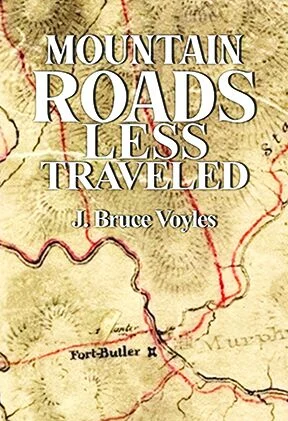
And as a former book publisher, another circle connects. To mark my 100th column I have pulled some of my favorite columns and put them into book form, now available at the Cherokee County Museum or through ebook outlets.
Thank you for reading my writings. It is appreciated.