
Shortly after the Cherokee had been removed and their land sold to private ownership by the government, in 1839 a new county was created from what was then a part of Macon County – named for the people who had been forcibly removed only a couple of years before – Cherokee County. The proposal of naming the county Junaluska County in honor of the famed Cherokee leader was rejected.
A county seat was needed, and land was set aside for that, a town named for a notable politician – by other politicians – Archibald D. Murphey, known as the “Father of Education” for the state. He had died by the time the town was named for him, and in and true proof of Murphy’s law, a clerk misspelled the name and Murphy it remains.
A county requires laws, and courts to adjudicate those laws, and for a time county business and court actions were housed in the now abandoned facilities at Fort Butler, following briefly by the government business being conducted from a log building in the new town. The population of the county at this time was a little short of 4,000 people.
In 1844, under the push of A.R.S. Hunter, the founder the trading post that would later become Murphy, a courthouse was built on the town square, a large building using brick made in Cold Springs located on the Hiwassee River. This would be the county’s courthouse until May 4, 1865. (Robert E. Lee and Joe Johnston had already surrendered their armies at this time, Richard Taylor would surrender his Louisiana based Confederate army on May 4), but the word had not been received by Union Col. G.W. Kirk, commanding bands of raiders known as “Kirk’s Raiders,” and some units included many local men.
It was on May 4, while Kirk was further east assisting Stoneman’s cavalry raid through Asheville that troops under his command burned the Murphy courthouse. The incentive according to some accounts was pending criminal cases recorded there on some of the local men involved in the arson.
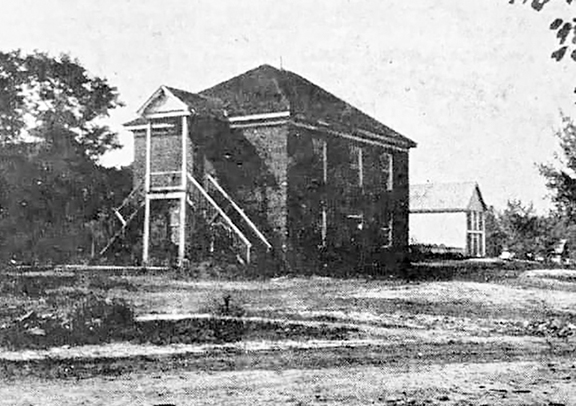
The second courthouse was built in 1868 reusing the brick from the first courthouse, with the original plan for a one story building. Once construction had begun it was discovered there was enough brick remaining to add a second story to the square building – and they did. The space required to conduct the county’s growing business soon outgrew the small facility. A third courthouse was needed.
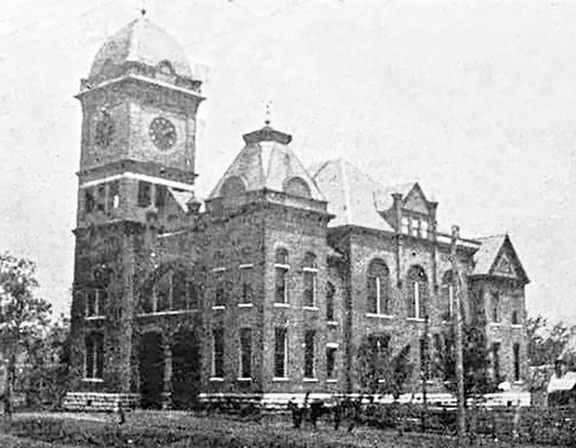
The third courthouse was moved off the town center, located at the corner of what is now Central and Peachtree streets. This larger brick courthouse boasted marble trimming, a clock tower, fireproof vaults, offices on the first floor and a courtroom on the second. It was completed in 1892, but an accidental fire burned much of the courthouse in 1895. After inspection it was determined enough of the remaining walls were sturdy enough to restore the building to a fourth courthouse occupied in 1896.
The restored courthouse did not survive an arsonist in 1926, with the resulting fire totally destroying the structure.
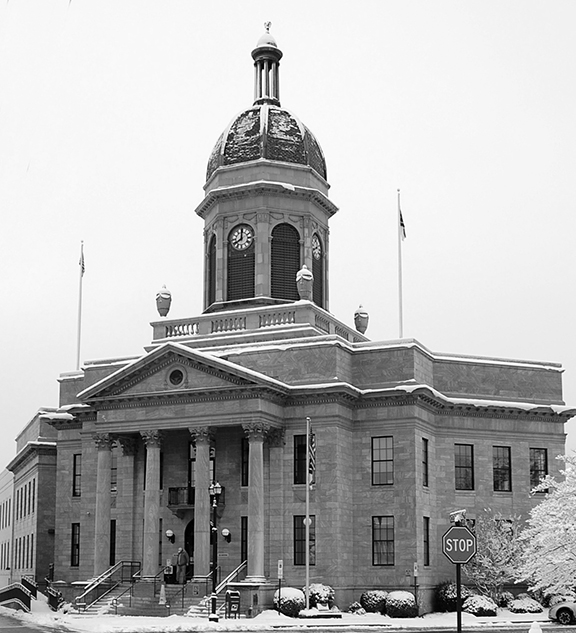
Having their fill of burned courthouses, the county leaders decided they would put an end to the fires by building a courthouse of inflammable material, choosing regal blue marble, mined locally, making the Cherokee County courthouse one of the few counties in America built from marble quarried in its own county. It was dedicated on Nov. 12, 1927, at a cost of $256,000.
The Classical Revival design was by architect James A. Baldwin. The South Carolina native had studied at the University of South Carolina and the University of Pennsylvania before opening his office in Asheville. He was one of the first architects licensed in North Carolina.
That is the courthouse that is still the standout building of downtown Murphy. It is two stories with a four-columned Corinthian Greek portico, and a five bay diagonal entrance facing the street. The floors are marble, and the wings intersect at a two-story rotunda with a marble sunburst medallion on the floor at the center. The entire structure is capped by what has been described as a monumental cupola. It stands today as one of the most photographed and iconic structures in the county.
The courthouse has served the county well, with most of the county’s historical legal cases held in the courtroom. The courthouse also hosted one Murphy High School prom. Sheriff Claude Anderson was shot on the courthouse steps but survived and continued to serve as sheriff for years.
In recent years, the courthouse underwent a $9 million renovation and expansion in 2013, adding office space, but unfortunately not continuing the distinctive marble exterior. The jail built in 1922 adjoining the courthouse
was demolished to make room for the new addition. The lantern on top of the cupola was restored in 2017-18.
While many nearby courthouses have been converted to historical societies and civic headquarters with their county business moved to modern less stately facilities, our regal blue marble courthouse, now on the National Register of Historic Places since 1979, remains as the center of the county’s legal business.
Bruce Voyles’ local history column runs every other week in the Cherokee Scout. Email him at RoadsLessTraveled@cherokeescout.com.