
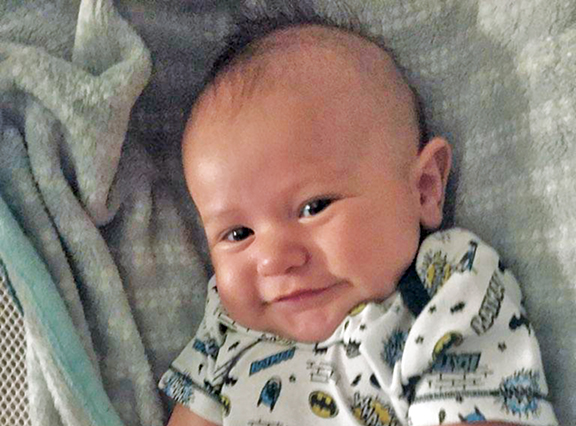
Andrews - Like any grandmother, Teresa Davis wants the best life possible for her grandson, Maddox. He’s her first grandchild, and he has her “wrapped around his finger.”
“He’s a very happy baby,” Davis said. “His facial expressions are so funny …
He’s just a happy baby. He doesn’t have a care in the world.”
Then one day, her daughter, Storm Nelson, called crying after one of Maddox’s doctor’s appointments. She told Davis that after presenting research she had done when the tip of Maddox’s penis became inflamed, the doctor determined Maddox had a birth defect called hypospadias. Davis, a nurse, had never heard of it.
“I started crying, too,” Davis said. “That’s my grandson. He’s perfect in every way.”
According to the Centers for Disease Control & Prevention, one in every 200 babies is born with hypospadias in the United States. If not treated, it could cause problems with erectile dysfunction or urinating. Most cases require surgery to correct the birth defect, and surgery is usually done in stages between ages 3-18 months.
Maddox turns 1 later this month, and Nelson didn’t learn that her son had the defect until he was 9 months old. She wishes there was more awareness for parents, as well as for the medical community, so something could have been done sooner for her son.
“He could never have a family, and I don’t want to take that away from him,” Nelson said.
When he was born, doctors told Nelson that Maddox was born pre-circumcised, but there was a flap of skin they wanted to keep there in case it was needed. That skin is often used in the surgery to rebuild the urethra.
After he gets surgery, healing procedures take up to six weeks and require Nelson to take off from work to care for Maddox. She said it’s ideal to do the surgery as early as possible so the child is less likely to cause complications during the healing process.
He’s already had one surgery canceled at Scottish Rite Hospital in Atlanta because of insurance issues. The surgery was estimated to cost $25,000, with insurance covering all but $5,000. Nelson said the doctors told her they wouldn’t know how severe Maddox’s condition was until they perform the surgery. As a result, the financial costs could be greater.
“I just don’t know what to do,” Davis said. “That’s a lot of money. I don’t know how we’re going to help him.”
She has started a GoFundMe page and is looking for any resources to help her grandson have surgery so he can live a normal life. They’ve reached out to Shriners International, but they were unable to help.
They have another consultation coming up with Erlanger, and both Nelson and Davis are
hoping for good news for Maddox. For details, visit gofundme.com/f/durjs-surgery-fund.
Samantha Sinclair is the Scouting Around columnist for the Cherokee Scout. You can reach her by phone, 837-5122, Ext. 24; or email, scoutingaround@cherokee-scout.com.