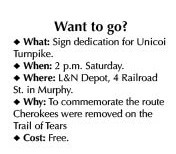
Murphy – The N.C. Chapter of the Trail of Tears Association will be hosting a Wayside Exhibit sign dedication for the Unicoi Turnpike at 2 p.m. Saturday at the L&N Depot.
The exhibit will commemorate the route by which Cherokees were removed from western North Carolina on the Trail of Tears. Dr. Brett Riggs, renowned Sequoyah professor at Western Carolina University, will guide a short walk after the dedication titled “The Long Road to Exile.”
In 1987, Congress designated the Trail of Tears as a national historic trail across eight states. In the years since, scholars and enthusiasts have gathered more information to identify additional routes and sites like Fort Butler.
 |
According to local historian Billy Ray Palmer, the Cherokee and white immigrants lived peacefully together in Cherokee County, as the two groups would trade with one another. A past study by Riggs and Lance Greene for the University of North Carolina and Trail of Tears Organization noted that southwestern North Carolina was a mosaic of traditional tribal towns interspersed with wagon roads, churches, schools, stores, inns and courthouses.
The Cherokee people of the Aquohee and Tahquohee districts had adopted many aspects of Anglo-American government. And the Cherokee Nation established itself as a constitutional republic, with American-style governmental structures and legal codes.
In 1820, Baptists founded a mission and school for the Cherokee in Peachtree. Under the direction of the Rev. Evan Jones, mission schools were established and preaching stations were placed. The mission and associated schools trained Cherokee students in material and academic skills, disseminating Western lifestyles in the “darkest part of the nation.”
The uniquely blended ways of the Valley Towns communities was abruptly brought to a halt when the 1838 military deportation of the Cherokee was put into action. The Cherokee removal was the culmination of a 30-year push by the U.S. government to “extinguish” tribal land rights east of the Mississippi to make room for American expansion.
Fort Butler near downtown Murphy was an important site in the Cherokee removal known as the Trail of Tears. The fort looked over present-day Murphy and was located near the Unicoi Turnpike, along which the Cherokee were marched to Fort Cass and on to Indian Territory.
Fort Butler was the headquarters of the Eastern Division of the U.S. Army overseeing the Cherokee nation. It was the military force charged with forcing Cherokee emigration.
The fort was established in 1836 by Gen. John E. Wool to keep order after the ratification of the Treaty of New Echota, which established terms for the Cherokee Nation to cede their territory in the Southeast and move to the Indian Territory.
The treaty was not approved by the Cherokee National Council nor was it signed by the principal chief at the time, John Ross. However, it was amended and ratified in March 1836, when it became the legal basis for the Cherokee removal.
In early 1838, it became evident to the U.S. Army that the Cherokee were not going to willingly leave their lands. After the May deadline passed for the Indian Removal, Fort Butler was expanded under Gen. Abraham Eustis.
The military removal occurred in Georgia in late May of 1838, but reports of abuse and mistreatment caused Gen. Winfield Scott, the commander stationed at Fort Cass, to suspend operations until June. During the summer of 1838, more than 3,000 Cherokee prisoners from western North Carolina and northern Georgia passed through Fort Butler en route via the Unicoi Turnpike to Fort Cass in Tennessee.