In the real estate business, the mantra is “location, location, location,” but for Cherokee County Schools, it has too much real estate and too many locations.
Too many campuses combined with a low-income county and a shrinking school age population results in significant challenges for Cherokee County’s education system.
Despite that, Cherokee County Schools perform respectably well, according to N.C. School Report Cards, with all but one school receiving a C or higher. including one A (Schools of Innovation & Technology) and two Bs (Murphy High and Peachtree Elementary). The only D was Andrews Elementary.
School report cards aside, statistics from the N.C. Association of County Commissioners show Cherokee County Schools serve a community that has underwhelming numbers: The county ranks 55th out of the state’s 100 counties in pre-kindergarten enrollment, 27th in K-12 expense funding (a disproportionate amount going to building maintenance), 60th in teacher salary supplements, 61st in third-grade reading proficiency, 22nd in adults without a high school diploma (8% of the population) and second in the state for residents age 16-24 who are neither in school nor working full- or part-time.
Cherokee County Schools commissioned a study in March 2020 that dug into the state of enrollment, facilities, costs and trends. The study, still posted on the school district’s website as its long-range plan, argued for consolidation of the county’s three largest high schools into one. The study was used to secure a $50 million grant (subsequently increased to $64 million) to consolidate the high schools, but the grant was rejected when the board of commissioners refused to approve the local match to secure the grant.
The county will be able to apply for another consolidation grant next year, assuming it has a plan in place. The school board and board of commissioners meet Monday to discuss future plans.
Since the last grant was rejected, the board of education has discussed alternative consolidation plans focused on elementary and middle schools in hopes of qualifying for future grant funds, without any decisions.
As an interim measure, the school board did away with combined elementary/middle school campuses, expanding middle schools in Hiwassee Dam and Murphy and the elementary school in Ranger. The campus in Martins Creek closed its middle school but didn’t acquire any additional elementary students.
The net result was no change in the number of campuses.
A surplus
Cherokee County Schools still has 13 schools spread over 12 campuses – three high schools, one early college high school, one continuation high school, three middle schools and five elementary schools.
Those 13 schools serve county with a population of 29,361, according to U.S. Census data.
No other county in North Carolina has so many campuses for so small a population.
At the same time, spending per student remains about the same as any other North Carolina County (and significantly less than neighboring counties in Georgia, where many parents are choosing to send their children), so resources are spread more thinly to maintain all those campuses.
The 2020 study said Cherokee County Schools pays over $55,000 per month just to repair facilities.
Renovating campuses is pricey – Andrews Elementary, build in 1952, needed an estimated $5.7 million in 2020. Peachtree Elementary, built in 1947, needed $4.4 million in repairs. Among high schools, Murphy High, built in 1957, needed $11.7 million in work. Hiwassee Dam, built in 1955, needed $4.6 million.
None of the campuses needed less than $1 million. And all those figures are pre-COVID-19 and don’t take into account post-COVID inflation.
Meanwhile, most campuses are underutilized, in many cases by a lot – Andrews High was at 39.6% utilized, the lowest in the county. Only one school, Murphy Middle, was over capacity, yet it was expanded over the summer to accommodate middle schoolers from Martins Creek.
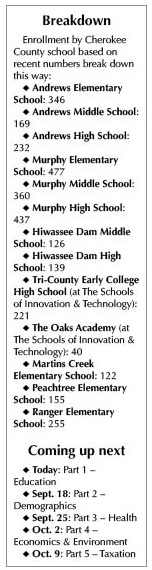
The 2020 report fretted over declining projected enrollment and predicted 2021-22 numbers of 206 at Andrews High, 177 at Hiwassee Dam and 458 at Murphy. Those numbers seem extravagantly high at the start of the 2024-25 school year, with Andrews at 169, Hiwassee Dam at 139 and Murphy High at 437.
Education in a mountains
Cherokee County is big, but not that big. At 455.43 square miles, it ranks as the 52nd largest of the state’s 100 counties – near dead-center.
But size isn’t the only factor; terrain is a big issue. Except for a fairly straight four-lane highway running east-west through Andrews and Murphy and a four-lane from Murphy to the Georgia state line, Cherokee County highways are windy mountain roads. Some are treacherous. Joe Brown Highway, the main road serving west Cherokee County north of Lake Hiwassee, narrows down to one lane bridges at two locations.
The drive from Violet in the west to Topton in the east is 53 minutes under the best conditions, according to Google Maps.
Before Google Maps and even paved roads, community schools were built in many outlying areas. Many have closed as highways improved. Still, a direct drive from outlying communities to Murphy, the county seat, can take 30 to 40 minutes and that doesn’t take into account bus stops along the way or inclement weather.
Surrounding counties face similar conditions, but have nevertheless consolidated their schools – Clay County has one high school, one middle school, one elementary school and one primary school; Graham County has one high school, one middle school and one elementary school. Macon County has 12 schools, but its population is larger than Cherokee County by around 9,000.
The vast difference in enrollment between schools also results in disparities in programs and services. Murphy High and at the Schools of Innovation & Technology just down the road in Peachtree have more to offer than other high schools, especially Hiwassee Dam.
Aside from the convenience of having high schools in the east, middle and west, the high schools are deeply associated with community identity. Andrews once had its own hospital and it sure as heck isn’t going to give up its high school without a fight, local leaders say. In Hiwassee Dam, its high school is the de facto community center.
Those are some of the major issues local leaders, parents and children face in Cherokee County education. Clearly, there are no easy answers. Hard decisions will cost some leaders their reelections. Taxes may increase.
But the alternative – the status quo – are crumbling campuses, poorer working and classroom conditions, and snowballing problems.
That’s what makes next Monday’s meeting between the school board and the county board so important.
Here are some other facts.
Population
Of North Carolina’s 100 counties, Cherokee County is the 71st largest in population. Of its neighbors, it is larger than Graham (7,718, 98th) and Clay (11,924, 92nd), and smaller than Macon (38,539, 64th). Nearby Swain ranks 89th with a population of 13,857.
There are three other counties of nearly identical populations as Cherokee County: Ashe, Bladen and Montgomery. Of mountain counties with similar populations, Ashe and Cherokee are nearly twins.
So what do Ashe County Schools look like?
According to the National Center for Education Statistics, using 2022-23 school year data, Ashe County has six schools, including a high school, and early college, one middle school and three elementary schools serving 2,743 students. It has a $36.7 million budget and spends $12,837 per student. The student/teacher ratio is 13.58.
From the same source, Cherokee County Schools has 13 schools over 12 campuses, including three high schools, an early college, a continuation school, three middle schools and five elementary schools serving 3,146 students. It has a $40.2 million budget and spends $13,614 per student. The student/teacher ratio is 13.25.
Connectivity
Other factors that affect education include broadband internet access – the county ranks 69th, with 79.2% of its population with broadband Internet – and access to computing devices – the county ranks 41st, with 79.9% of the population having access to a computing device.
Poverty
A quarter of Cherokee County’s children live in poverty (ranked 70th) and the average weekly wage of $832 ranks the county 88th. Per capita income is even worse – its per capita income of $40,021 ranks Cherokee County 98th in the state.